

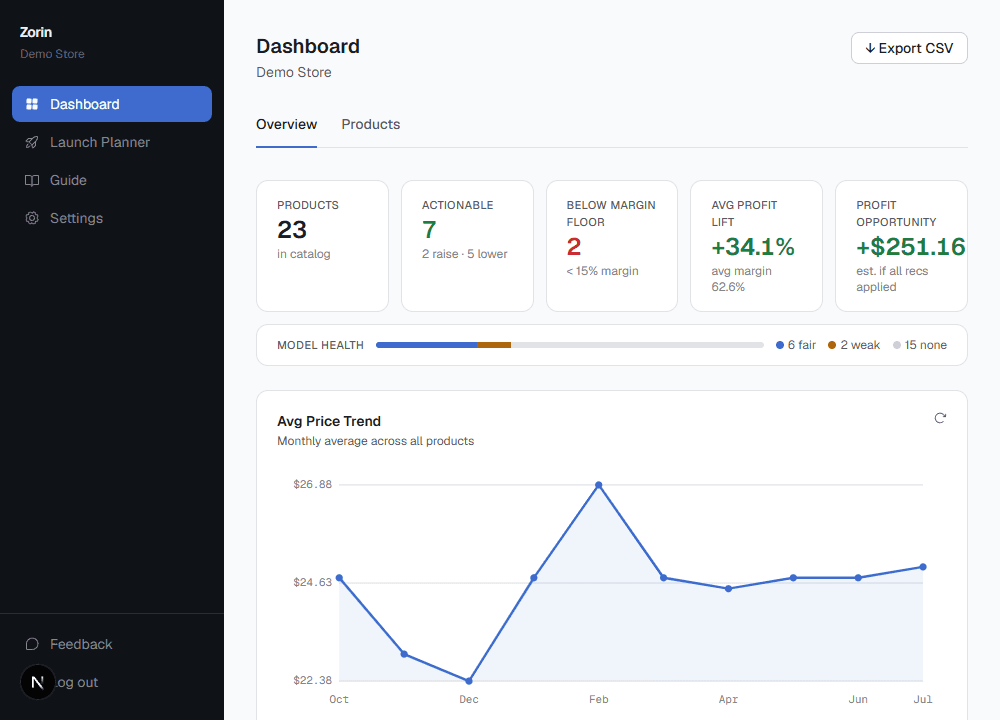
Most merchants price by gut feel or by copying competitors — but their customers aren't your customers, and their costs aren't your costs. Zorin fits a statistical demand model per SKU from your Shopify or WooCommerce sales history (or a plain CSV upload) and returns a clear raise, lower, or hold recommendation with a confidence score and estimated profit lift. Beyond individual recommendations, Zorin lets you roll pricing changes out at scale through scheduled campaigns, track real profit and loss over time, benchmark against competitor prices, and even price brand-new products with no sales history yet using a Van Westendorp price-sensitivity survey. Built for DTC brands and Shopify/WooCommerce sellers who want data-driven pricing without hiring a data analyst.
6 ratings

Building Zorin

AI video with native sound, paid per clip. Nothing stored.

A calmer Mac menu bar, one click away.

Enterprise Software. Intelligent Automation. Global Impact.


Comments
18Really like that Zorin uses your own sales data instead of just copying competitor prices. The confidence score on each pricing recommendation is a nice touch too — makes the suggestions feel much more actionable.
Building AI-powered visual content tools for ecommerce brands
The SKU-level demand model and scheduled campaigns seem especially valuable for smaller DTC teams that cannot afford a dedicated pricing analyst. I like that it supports both Shopify/WooCommerce history and a plain CSV—does the recommendation explain which factors drove a raise versus hold decision?
Building PZERO, saving you money - pzero.studio
Zorin reads Shopify or WooCommerce sales history or a CSV and recommends which SKUs to raise, lower, or hold. When model bills start adding up, pzero.studio is where we buy leftover capacity.
AI content generation with top models
The confidence scoring and automatic promotion detection stand out—pricing recommendations are only useful when merchants understand when not to trust the data. A before-and-after profit simulator would also be valuable before pushing a pricing campaign live.
I build & lead the engineering behind AI agents · Co-Founder & VP R&D @ Dial
The data-driven pricing angle is compelling - most sellers either underprice (leaving money on the table) or copypasta competitor rates without understanding their own margin structure. Using actual sales velocity data from Shopify/WooCommerce and providing confidence scores makes this actionable rather than theoretical. The detail about scheduled campaigns and SKU-level optimization is what separates this from basic competitor monitoring tools.
Widgetry: Reviews ,Popup & 26+ All the conversion tools you need — none of the bloat, none of the usage fees. Flat $14.99/mo.
A before-and-after profit simulator would also be valuable before pushing a pricing campaign live.
https://flico.art, https://picavo.co
The SKU-level demand model and scheduled campaigns seem especially valuable for smaller DTC teams that cannot afford a dedicated pricing analyst. I like that it supports both Shopify/WooCommerce history and a plain CSV—does the recommendation explain which factors drove a raise versus hold decision?
k
A before-and-after profit simulator would also be valuable before pushing a pricing campaign live.
I build & lead the engineering behind AI agents · Co-Founder & VP R&D @ Dial
The data-driven pricing angle is compelling - most sellers either underprice (leaving money on the table) or copypasta competitor rates without understanding their own margin structure. Using actual sales velocity data from Shopify/WooCommerce and providing confidence scores makes this actionable rather than theoretical. The detail about scheduled campaigns and SKU-level optimization is what separates this from basic competitor monitoring tools.
Turning Shopify or WooCommerce sales history into SKU-level price recommendations is a practical way to replace guesswork with evidence. The scheduled campaign rollouts and profit/loss tracking look particularly valuable for DTC teams; surfacing confidence ranges and the assumptions behind each recommendation could make the insights even easier to act on.
German guy from Germany :-D
Elasticity estimation needs price variation, and that's exactly what most DTC catalogues don't have — plenty of SKUs have sold at a single price for their entire history, with the only variation coming from the promos you're deliberately excluding. What's the minimum number of distinct price points before the model produces anything meaningful, and does Zorin ever tell a merchant "I can't price this yet, run a deliberate test at ±10% for two weeks first"? The confidence score suggests it might already do something like that, and honestly that would be the most valuable feature in the whole product.
German guy from Germany :-D
Elasticity estimation needs price variation, and that's exactly what most DTC catalogues don't have - plenty of SKUs have sold at a single price for their entire history, with the only variation coming from the promos you're deliberately excluding. What's the minimum number of distinct price points before the model produces anything meaningful, and does Zorin ever tell a merchant "I can't price this yet, run a deliberate test at plus/minus 10% for two weeks first"? The confidence score suggests it might already do something like that, and that would arguably be the most valuable feature in the whole product.
Building FDE Team & Mindpool USA
Most pricing tools fall apart on new products with no sales history, the Van Westendorp addition is a smart fix. Curious how the model handles sudden demand shifts like a product going viral mid-cycle.
Practical growth systems for UK trades and small businesses.
Using sales history to recommend raise, lower or hold is a clear way to make pricing decisions actionable. Can Zorin also surface the data points behind each recommendation for merchant review?
The scheduled pricing campaigns with automatic revert is what I'd actually use day-to-day — most sellers hesitate to test a price change because rolling back 50 SKUs manually is painful. Pairing that with conflict detection before changes go live feels like it was built by someone who has broken a store with a bulk edit before. Does the profit dashboard break down margin bleeders separately from top earners after a campaign ends?
The per-SKU demand model and confidence-scored raise/lower/hold recommendations feel more actionable than competitor price scraping alone. The CSV path plus Shopify/WooCommerce focus should also reduce setup friction. Can merchants see which inputs most influence a recommendation, so they can sanity-check unusual products before rolling out a scheduled change?
I’m not sure if this is necessary, but effort has gone into it, so I appreciate it.
Founder of SameSame
The distinction between raise, lower, or hold recommendations and confidence scores seems useful for avoiding knee-jerk price changes. Scheduled campaigns plus profit and loss tracking could give DTC teams a clearer feedback loop. I like that plain CSV upload lowers the barrier to testing historical data.