

Turn any song into a music video in 3 minutes
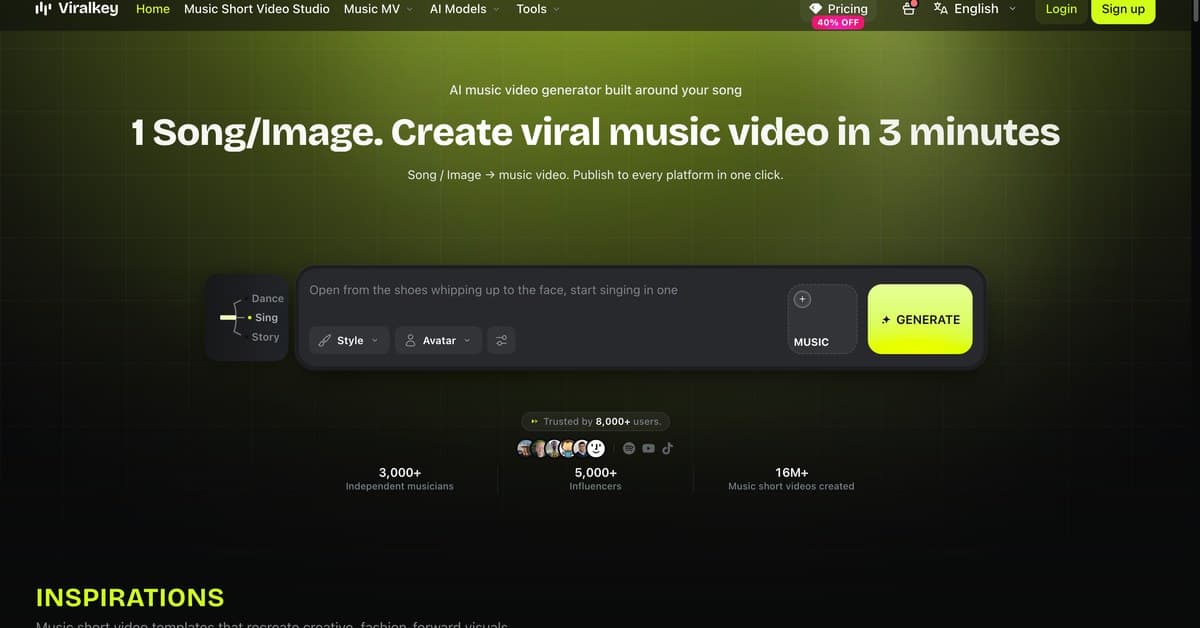
Viralkey is an AI music video generator built for independent musicians and short-form creators. Upload a song and a single photo, pick a template, and get a finished vertical music video in about three minutes.
The core problem it solves is consistency. Most AI video tools give you a different-looking person in every shot, which breaks the illusion that you are watching one artist perform. Viralkey uses face merge to lock your character across every cut in the video, so the result reads as a single coherent piece rather than a collage of unrelated clips.
It ships with 100+ templates organized into nine styles: narrative, performance, atmospheric, experimental, beat-sync, animation, lyric video, mixed, and social effects. Each template is pre-timed, so cuts land on the beat instead of drifting against it. The system analyzes tempo and song structure to place shot changes where the music actually turns.
Output is vertical 9:16, watermark-free, ready to publish. Pricing is freemium: free credits to try it, paid plans from $18.33 per month.
48 people supporting this launch
4.8
6 ratings
Up to 40% off all yearly plans for the rest of 2026
Visit deal
AI video with native sound, paid per clip. Nothing stored.

A calmer Mac menu bar, one click away.

Enterprise Software. Intelligent Automation. Global Impact.


Comments
33Hey Fazier 👋 I work on video for musicians, and the same problem kept coming up: the song is finished, the release date is locked, and there is still no video. Hiring a crew takes weeks. Editing it yourself takes a weekend you do not have. So most tracks ship with a static waveform on a black screen. Viralkey is our attempt at fixing that. You upload a song and one photo, pick a template, and it does the rest. It reads the BPM, beat points and song structure, plans the shots, generates the footage, and cuts it to the beat. About three minutes end to end. The part we spent the most time on is character consistency. Early versions had the face drifting between shots, which killed it because it stopped looking like the artist. Face merge now holds the likeness across every shot even as location, lighting and styling change. Same song and photo with a different template gives you a genuinely different video, which means one release can become a whole week of content. There are 100+ templates across story, performance, lyric, beat-sync and a few weirder ones. Exports are watermark-free and cleared for commercial use. I would really like to hear what breaks, especially from anyone releasing music regularly. What would you need it to do before you would use it on a real release?
Six marketing tools for UK small businesses, one login.
The part we spent the most time on is character consistency. Early versions had the face drifting between shots, which killed it because it stopped looking like the artist.
That's true.
Web & Agentic AI Developer | React, JavaScript, AI Automation & Full-Stack Development
The [specific feature] is interesting because [reason]. One thing I'd like to know is whether [specific question]. This could be particularly useful for [specific use case].
I tink is useful just to start brainstorming
Brainstorming's a fair way to use it — a lot of people run a few styles on the same track just to see directions they hadn't considered, then commit to one.
great product for content creators
Thanks ~Welcome to try!
Witter
I will defenitly give it a try
Appreciate it — shout if anything breaks.
Locking the same face across every cut is what separates this from a pile of unrelated clips. How long a track can it hold that consistency across?
That's the part we spent the most time on. However many cuts a clip runs through, the face holds — same person on every angle, every style change. No drift. It's the difference between a music video and a pile of unrelated clips, like you said. Worth flagging though: output caps at 15 seconds for now. Full length is in the queue, but I'm genuinely torn on what goes first — longer videos, or being able to keep talking to one video and revise it until it's right? Curious which one people here would actually want.
I am passionate about technology and marketing. There are many problems in marketing which can be solved efficiently with the help of technology. I am on the lookout for them.
How can ViralKey help improve brand’s visibility?
Depends what you're posting. For musicians it's usually the release cycle — one track, several visual takes, test which one lands before committing budget to a real shoot. For brands it's more about volume. There are 100+ style presets, so the same audio can look completely different across a month of posts without it feeling repetitive. What are you working on? Happy to be more specific.
Viralkey Your product has strong potential, but I found a few key improvements that could make it even better. I'd love to share my feedback and suggestions—please contact me at [email protected]
Appreciate you taking a look. Feel free to drop the specifics here — happy to discuss in the open, others might have the same thoughts.
Creator of Text Repeater Tech and web utility tools
Great initiative! The user interface looks very clean and beginner-friendly. I really like how it simplifies the workflow. Are you planning to add a dark mode or any third-party integrations in the future?
Both are on the list — no dates I want to promise yet, but they're not off the table.
Creator of Text Repeater Tech and web utility tools
Congratulations on the launch! I really appreciate the minimalist design and how straightforward your onboarding process is. It's quite refreshing to see a tool that solves a specific problem perfectly without overwhelming the user with too many complex features right from the start. I’m just curious to know, what was the biggest technical challenge you faced while building the core features for this product?
Honest answer: it's less one hard problem and more that video models don't actually hear music. You hand one a track and it has no idea where the beat is, when the phrase turns, where the singer takes a breath. So everything that makes a music video feel like a music video has to be reconstructed outside the model and handed over in a language it does understand. That turned into three separate fights. Getting the body to move with the track rather than just near it. Getting motion and lip-sync to hold at the same time — either one alone is manageable, both together is where things fall apart. And keeping character and style locked while all of that is happening. Which is why most of the work ended up being prompt engineering. We're past 50,000 lines now, and it isn't 50,000 lines of "make it cinematic" — it's cinematography, directing, screenwriting, shot design, choreography, music analysis, written down as rules a model can follow. None of that came for free. Most of it we had to actually learn before we could encode it.
Software Engineer
damn, this is insane
Ha, appreciate it 🙏
Solo developer behind On Brand Ads.
How well does the beat-sync engine handle subtle rhythm changes or acoustic demos without heavy drums?
It doesn't key off drum hits alone — that's the short version. When a track has strong percussion the motion tends to follow the hits, but when it doesn't, the sync shifts to the breath and density of the track instead. Sparse acoustic material still gets something to hold onto. Subtle timing shifts are handled relative to tempo rather than as fixed offsets, so it adapts instead of drifting when the feel changes. Where it's honestly weaker is heavy rubato — if the performance floats well off the pulse, you'll notice.
As a new startup this tool help me to make content for my YT channel
This is exactly the reason we developed this product. If you're making YouTube videos, Story templates generally work better than beat-sync templates—they offer more narrative space. Viralkey also strongly supports publishing to short video platforms! If you encounter any strange issues, please let me know, and I'll read every comment here.
There are already many similar Vibe coding products now. What are your advantages?
Oh, we don't do ambient coding—Viralkey makes music videos. You upload a song (or a photo, or both), and you get a multi-shot music video in about three minutes. Every shot is meticulously designed by us, indistinguishable from a high-budget music video! Our top priority is consistency. Most tools cause people to appear out of place in different shots, which is a disaster if you're making a series. We use a locking mechanism to ensure that the same person is in every shot.
I can see this being extremely valuable as a content creator. Great Job
That's the crowd we built it for. Let me know how it goes if you try it.
as a song lover this is absolute great product
00s indie hackers
The character-consistency work is the most important part here; without it, a music video quickly feels like unrelated AI clips. The beat-aware templates also make this more practical for independent releases. How does the workflow handle songs with tempo changes or quieter intros where beat detection is less obvious?
looks like a great product, gonna try