
Test keyboards, screens, mics and USB, free in your browser.
4.8(6)10StartupsSide projectsSaaS
usbRecognized is a free online hardware testing platform with 22 browser-based tools for diagnosing keyboards, mice, gamepads, touch screens, touchpads, monitors, webcams, microphones, speakers, USB devices and printers. There is no download, no installation and no account — every test runs locally using secure web APIs, so your keystrokes, camera feed and audio never leave your computer. Check for dead pixels, backlight bleeding, color banding, greyscale uniformity, real refresh rate and frame pacing, or run the one-click Quick Device Check for a full hardware health report. Free forever in 24 languages at usbrecognized.com.
usbRecognized is a free, browser-based hardware testing platform with 22 tools covering input devices, displays, audio, cameras, USB hardware and your browser itself. No downloads, no installation, no account — open a page and start testing.
Input devices Keyboard Tester checks key registration, ghosting, N-key rollover and switch chattering. Mouse Tester verifies every button and measures clicks per second. Gamepad Tester visualizes sticks, triggers and dead zones. Touch Screen Test and Touchpad Test report multi-touch points with coordinates, pressure and contact radius.
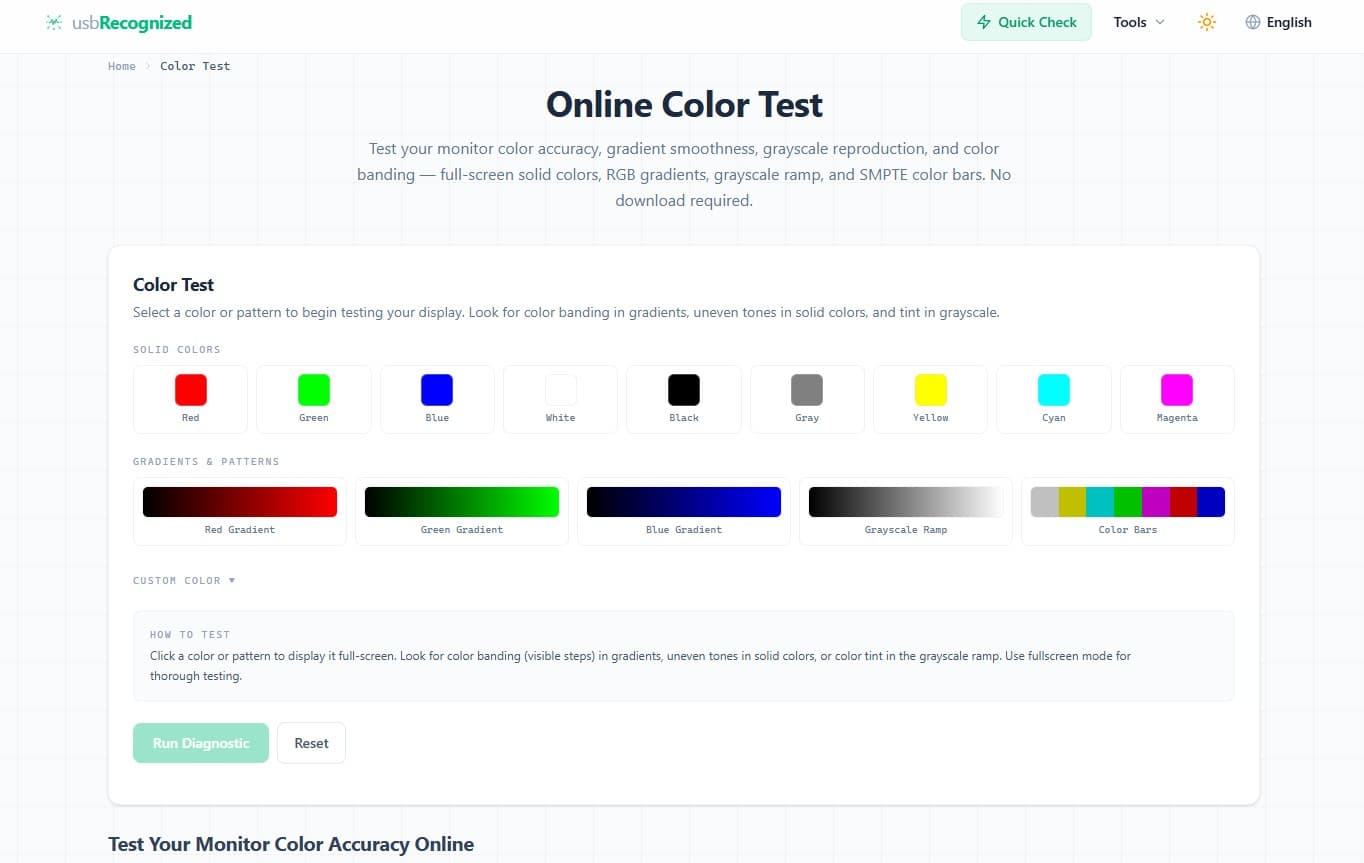
Display Refresh Rate Test measures real refresh rate using requestAnimationFrame. Frame Rate Test reports instant, average, minimum and 1% low FPS with frame-time jitter. Dead Pixel Test cycles full-screen colors to expose stuck pixels. Screen Bleeding Test checks backlight bleed, IPS glow and uniformity. Contrast Test, Color Banding Test and Greyscale Test evaluate black level, gradients and grey uniformity. Color Test checks color accuracy.
Audio, camera and USB Microphone Test shows a live input level meter. Speaker Test and Stereo Test verify left and right channels, frequency response and balance. Webcam Test previews your camera with resolution and frame rate. USB Device Check and USB Device Info enumerate devices and resolve vendor and product IDs. Printer Test prints a test page and checks print quality, including nozzle condition.
Browser and system Browser Info reports your engine, version and Web API support matrix. Screen Resolution reports viewport, device pixel ratio and HDR support.
How it works Everything runs locally through standard web APIs including WebHID, WebUSB, the Gamepad API, MediaDevices, Canvas and the Web Audio API. Your keystrokes, camera image and microphone audio are processed on your own machine and are never uploaded.
Start with the Quick Device Check One click scans your input devices, display, camera, microphone and browser capabilities, then returns a Hardware Health Report with a score and clear next steps.
Available in 24 languages and free forever at usbrecognized.com.
usbRecognized is a free online hardware testing platform with 22 tools that run entirely inside your browser. Whether you are troubleshooting a failing keyboard, checking a used monitor before you buy it, or confirming that your webcam and microphone work before a meeting, you can run a complete diagnostic in seconds — with no download, no installation and no account.
Input Devices The Keyboard Tester highlights each key as you press it, detects ghosting, measures N-key rollover and flags chattering switches. The Mouse Tester verifies every button, counts clicks per second and exposes double-click faults. The Gamepad Tester checks analog sticks, triggers and dead zones on Xbox, PlayStation and generic controllers. The Touch Screen Test and Touchpad Test report every touch point with coordinates, pressure and contact radius, so unresponsive areas are easy to find.
Display Diagnostics The Refresh Rate Test measures real frame timing instead of trusting the advertised specification, and the Frame Rate Test reports instant, average, minimum and 1% low FPS with frame-time jitter and stutter counts. The Dead Pixel Test cycles full-screen colors to reveal stuck or discolored pixels, while the Screen Bleeding Test checks backlight bleed, IPS glow and panel uniformity. The Contrast Test evaluates black level and shadow detail, the Color Banding Test looks for gradient stepping and bit-depth problems, the Greyscale Test examines grey uniformity, and the Color Test checks overall color reproduction.
Audio, Camera and USB The Microphone Test shows a live input level meter with waveform feedback. The Speaker Test and Stereo Test verify left and right channels, frequency response and stereo balance. The Webcam Test previews your camera feed with resolution, frame rate and device name. The USB Device Check and USB Device Info enumerate connected hardware and resolve vendor and product identifiers, and the Printer Test prints a test page and diagnoses print quality, including nozzle condition.
Browser and System Browser Info reports your browser engine, version and full Web API support matrix. Screen Resolution reports viewport size, physical resolution estimates, device pixel ratio and HDR support.
Beyond Pass or Fail Operating systems typically report only whether a device is connected. usbRecognized returns measurable data instead: how many simultaneous keys your keyboard handles, how fast your mouse clicks, what your display actually refreshes at, where a defective pixel sits and which vendor an unknown USB device belongs to.
Privacy by Design All processing happens locally through standard web APIs including WebHID, WebUSB, the Gamepad API, MediaDevices, Canvas, the Web Audio API and the Fullscreen API. No testing data is uploaded to a server, because no server processes it. You can verify this yourself by opening developer tools and watching the Network tab during a test.
How It Works
Available in 24 languages, free and unlimited at usbrecognized.com.
6 ratings

AI video with native sound, paid per clip. Nothing stored.

A calmer Mac menu bar, one click away.

Enterprise Software. Intelligent Automation. Global Impact.


Comments
10Free Online Hardware Testing Tools — 22 Browser-Based Device Tests for Keyboard, Mouse, Display, Webcam and USB usbRecognized is a free online hardware testing platform that lets you check virtually any computer peripheral directly in your web browser. There is nothing to download, nothing to install and no account to create. Open usbrecognized.com, pick a test, and you will have a result within seconds. If you have ever wondered whether a keyboard key is genuinely broken, whether a monitor really runs at the refresh rate printed on its box, or whether a webcam is faulty or simply blocked by a permission setting, this is the toolset built for exactly those questions. Every test runs locally on your own machine, so your keystrokes, camera image, microphone audio and USB device details never leave your computer. What usbRecognized Is usbRecognized is a browser-based diagnostic suite with 22 tools spanning input devices, displays, audio, cameras, USB hardware, your browser and your system configuration. Instead of installing vendor software for every component, you use one website. Every tool is free, unlimited and usable without registration, and the platform is available in 24 languages. Input Devices Keyboard Tester. Displays a visual layout and highlights every key as you press it, so you can confirm instantly whether a key registers. It also detects ghosting, measures N-key rollover to show how many keys register simultaneously, and flags chattering switches that fire twice from a single press. Mouse Tester. Checks every button, including left, right, middle and side buttons, and measures clicks per second. It detects unintended double-clicks caused by worn switches and verifies scroll wheel direction and step accuracy. Gamepad Tester. Visualizes analog stick positions, trigger pressure, button states and dead zones for Xbox, PlayStation and generic controllers, making stick drift easy to spot. Touch Screen Test and Touchpad Test. Both report multi-touch support and show every contact point with live coordinates, pressure and contact radius, so dead zones are simple to locate. Display Diagnostics Refresh Rate Test measures your display's real refresh rate using requestAnimationFrame and Canvas frame timing rather than trusting the advertised number, confirming whether a monitor truly runs at 144 Hz or 240 Hz. Frame Rate Test reports instantaneous, average, minimum and maximum FPS with 1% low figures, frame-time jitter, stutter counts and a rolling history graph. Dead Pixel Test fills the screen with solid colors so stuck, dead and discolored pixels become obvious. It runs in full screen, which is essential for inspecting a new monitor or a second-hand display before you buy it. Screen Bleeding Test reveals backlight bleeding, IPS glow, clouding and panel uniformity problems using full-screen color patterns with brightness control. Contrast Test presents sixteen-step dark and bright greyscale patches plus black level and white saturation references, exposing crushed blacks and highlight clipping. Color Banding Test shows lossless greyscale, red, green and blue gradients with a direction toggle, making gradient stepping and posterization easy to identify. Greyscale Test covers near-black 5% grey, a five-step grey ramp, neutral 50% grey, a 32-step chart and a uniformity grid. Audio, Camera and USB Microphone Test shows a live input level meter with waveform feedback, confirming your microphone is detected and that levels are not clipping or silent. Speaker Test and Stereo Test verify audio output channel by channel, covering frequency sweeps, bass and treble response, channel separation and left-right balance, which is the fastest way to catch a dead channel or a reversed connection. Webcam Test previews your camera feed with resolution, frame rate and device name, distinguishing a broken camera from one blocked by permissions. USB Device Check and USB Device Info enumerate connected devices using WebHID and WebUSB, showing vendor and product identifiers resolved against a built-in vendor database. Printer Test prints a proper test page and diagnoses print quality, covering color output, nozzle condition and connection status, so you can separate a driver problem from a hardware problem. Browser and System Browser Info reports your browser name, version, engine and web API support matrix. Screen Resolution reports viewport size, estimated physical resolution, device pixel ratio, color gamut and HDR support. The Device Health dashboard collects results from across the tools into a single hardware health score with cross-device correlation. Quick Device Check If you do not know where to start, the Quick Device Check performs a one-click scan across your input devices, display, camera, microphone and browser capabilities, producing a Hardware Health Report with an overall score and clear next steps. Beyond Pass or Fail Operating systems typically report only whether a device is connected or disconnected. usbRecognized returns measurable data instead: how many simultaneous key presses your keyboard supports, how fast your mouse clicks, what your display actually refreshes at, where a defective pixel sits and what vendor a mysterious USB device belongs to. Privacy by Design Every test runs entirely in your browser using standard web APIs, including WebHID, WebUSB, the Gamepad API, MediaDevices, the Canvas API, the Web Audio API and the Fullscreen API. No testing data is uploaded to a server, because no server processes it. You do not have to take that on trust: open your browser developer tools, switch to the Network tab and run any test. You will see no outgoing requests carrying your keystrokes, camera frames or audio. Who Uses usbRecognized Gamers verifying a mechanical keyboard before a tournament, buyers inspecting a used monitor for dead pixels or backlight bleed, IT technicians triaging a returned laptop, repair shops reproducing an intermittent fault and resellers grading equipment before listing it. Browser Support All modern browsers are supported: Chrome, Edge, Firefox, Safari and Opera. Keyboard, mouse, touch, display, camera and audio tests work essentially everywhere. Advanced device access, such as USB and HID enumeration, requires desktop Chrome or Edge. Most tests also run on Android and other mobile browsers. How It Works Open a specific tool, or run the Quick Device Check for a full scan. Grant browser permission when prompted for camera, microphone or USB access. Interact with your hardware — press keys, click, touch, speak or plug in a device. Read your results, health score and recommended next steps. Frequently Asked Questions Is usbRecognized free? Yes. Every tool is completely free, unlimited, and requires no registration, download or payment. How many testing tools are there? There are 22 tools covering input devices, displays, audio, cameras, USB hardware, browser information and screen resolution, plus a cross-tool Device Health dashboard. Is my data uploaded anywhere? No. All tests are processed locally, and no testing data is transmitted or stored. Which browsers are supported? Chrome, Edge, Firefox, Safari and Opera. USB and HID scanning requires Chrome or Edge. What if a test fails? Each tool page includes a diagnostic guide explaining common causes and fixes, from permission settings and cable limitations to switch wear and driver issues. Start testing free at usbrecognized.com.
This fills a real gap — the moment you need a hardware test is usually the worst time to install software: checking a used laptop before buying, verifying a new monitor inside the return window, diagnosing a friend's keyboard on a machine you don't control. Browser-based + zero install is exactly right for that context. Curious about the API coverage though: things like WebUSB and gamepad polling have uneven support outside Chromium — how do you handle Firefox/Safari for the USB tests? Do you degrade gracefully with manual checks, or is there a compatibility matrix somewhere? Would be worth showing per-browser support on each tool's page.
The ghosting and N-key rollover detection is a genuinely useful feature — verifying that on a new keyboard usually means installing some sketchy utility. Running everything locally through standard web APIs with zero installs is exactly the right call for a diagnostics tool.
The dead pixel test, screen bleeding check and the refresh rate measurement based on requestAnimationFrame cover display checks people usually need a separate app for. Since the keyboard tester looks at ghosting and N-key rollover, it would help to know whether it separates a keyboard's own limits from browser or OS key handling. Keeping the whole set free, with no download or account, makes it handy for a quick check on a used laptop.
Measuring the real refresh rate instead of trusting the spec sheet is handy for checking a used monitor before buying. Since WebHID and WebUSB only work in Chromium browsers, does the Quick Device Check tell Firefox and Safari users which tests it had to skip?
Using requestAnimationFrame for the refresh rate test is clever — how accurate is it on 240Hz+ monitors where browsers sometimes cap or throttle frames? Keeping keystrokes and camera feed fully local is a nice touch for a testing tool.
Contact for Trencada
The Quick Device Check is a smart entry point — one click to scan everything instead of hunting for the right test. Measuring real refresh rate via requestAnimationFrame rather than trusting the spec sheet is a genuinely useful diagnostic. Offering 22 tools in 24 languages, free forever, is generous. Nice work!
Having all 22 hardware tests run locally in the browser, with no download or account, keeps keystrokes and camera feeds on the device, which is a sensible design.
run a project
a really handy tool for anyone troubleshooting hardware! I especially like that it works directly in the browser without downloads https://www.fmc4me.com.co or account registration.
This is exactly the kind of tool you bookmark and forget until you desperately need it — and then it's a lifesaver. Running everything locally through web APIs with no install or account is the right call for hardware diagnostics, especially since keyboard testing involves capturing keystrokes. The ghosting and N-key rollover detection caught my eye — genuinely useful when buying a mechanical keyboard. The Quick Device Check as a one-click entry point is smart too; it lowers the barrier for non-technical users. Would be interesting to see webcam/camera frame analysis added alongside the existing display tests.