

Script-first subtitle timing with QA before export
TimedSubs turns an approved script and matching voiceover into precise, export-ready subtitle files. The submitted script stays authoritative while TimedSubs aligns timing, surfaces delivery issues, and blocks invalid exports. Review the result, then download SRT, VTT, SBV, ASS, timecoded TXT, JSON, or ZIP.
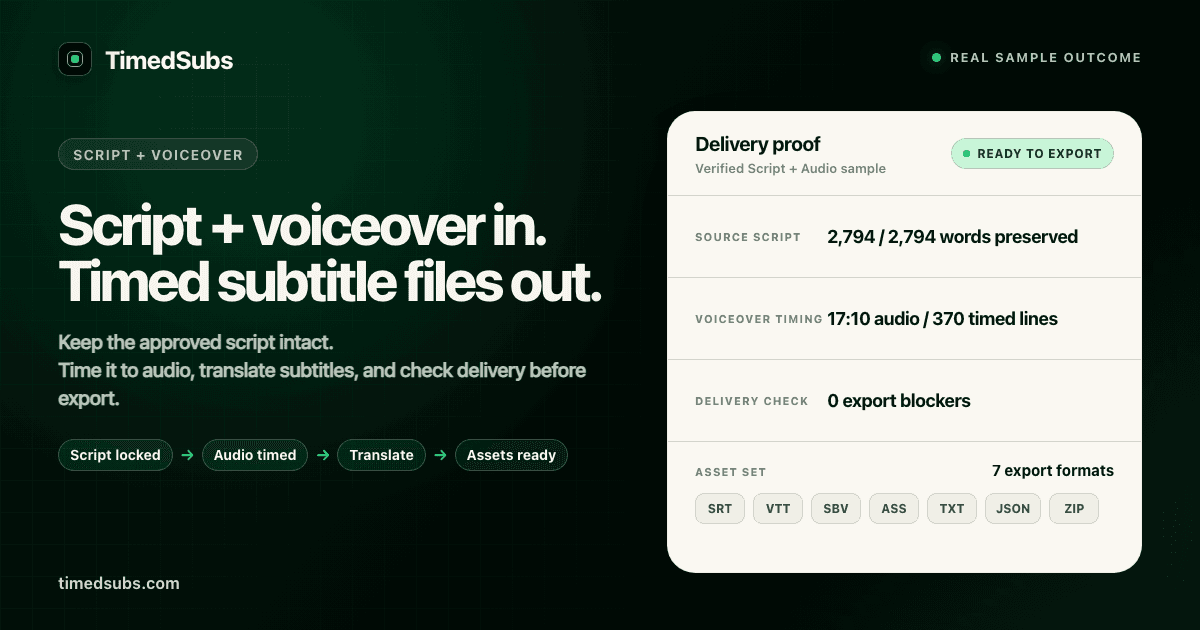
Preserve the approved script as the source of truth
Align subtitle timing to matching voiceover audio
Review script preservation, timing QA, and export blockers
Export SRT, VTT, SBV, ASS, timecoded TXT, JSON, or ZIP
Create source-locked subtitle translations with glossary controls
Voiceover artists and studios delivering timed subtitle assets
Course producers creating accurate captions for accessibility and review
Localization teams preparing source-locked subtitles for translation and QC
Scripted video teams turning approved narration into subtitle files
6 ratings

AI Builder.

AI video with native sound, paid per clip. Nothing stored.

A calmer Mac menu bar, one click away.

Enterprise Software. Intelligent Automation. Global Impact.


Comments
22AI Builder.
TimedSubs came from a simple production problem: when a script is already approved, ordinary auto captions can still rewrite names, numbers, and terms. We built a script-first workflow that keeps the submitted wording authoritative, uses the matching voiceover to set timing, and makes QA and export blockers visible before delivery. I would especially value feedback from voiceover artists, course producers, and localization teams on the review and handoff workflow.
The "script stays authoritative" approach is a smart choice — most subtitle tools let timing drift override the original script, which creates headaches during review. Blocking invalid exports before they happen is a nice safeguard too, saves catching errors after the fact. Curious how it handles cases where the voiceover deviates slightly from the approved script (ad-libs, minor phrasing changes) — does it flag those as delivery issues automatically?
Keeping the approved script authoritative instead of letting auto-captions rewrite names and numbers is the detail that matters for localization teams. Does the QA step flag reading-speed issues as well as timing?
Hi every body
This product looks pretty good.
Founder at Tannorium
Really smart approach to subtitle timing and QA. Solving a real workflow problem with precision—great work, team. Keep building!
Building PZERO, saving you money - pzero.studio
Keeping the approved script as the source of truth, then blocking a bad export, is the right order. If subtitle QA starts eating model spend, leftover capacity is at pzero.studio
The script-as-source-of-truth idea is the interesting part here: most tools re-transcribe and quietly drift from the approved copy. Curious whether the timing QA flags long-per-line reading speed (CPS), since that is usually where broadcast-style delivery fails review even when the words are correct.
Senior Software Engineer building UtilZilla — 45+ free browser-based tools, no signup required. Always shipping something new.
The export-blocker for unresolved QA issues is the detail I like most - most tools let you export a broken SRT and find out during review instead. One thing I'm curious about: if the voiceover gets re-recorded after the script is locked (say, a line reads differently in a pickup session), does TimedSubs flag the new timing as a fresh QA pass, or does it need a manual re-sync? That re-record scenario seems common for course producers doing pickups.
https://inpaintingai.com
Really useful for anyone working with scripted videos. Keeping the original wording intact while syncing subtitles to the voiceover is a nice touch.
Really like the simplicity of TimedSubs — small tool, clear use case, and genuinely useful for anyone working with subtitles. Nice launch! 🚀
Building BrokerRace — a pay-to-rank leaderboard for crypto exchanges and brokers.
The glossary-controlled translation piece is what stands out to me here — most subtitle tools handle timing fine but let terminology drift once you're translating. Curious how it behaves with multi-speaker scripts though: if two people talk over each other and the voiceover has overlapping audio, does the timing QA still lock cleanly to each speaker's line, or does overlapping dialogue need to be split manually before it goes in?
We build premium digital products
AI Builder. TimedSubs came from a simple production problem: when a script is already approved, ordinary auto captions can still rewrite names, numbers, and terms. We built a script-first workflow that keeps the submitted wording authoritative, uses the matching voiceover to set timing, and makes QA and export blockers visible before delivery. I would especially value feedback from voiceover artists, course producers, and localization teams on the review and handoff workflow.
Handy for someone who regularly makes scripted videos
This is pretty useful today. I would personally use this, considering I have my own AI agent and am trying to build it bit by bit.
This looks interesting
I'd love to know how the system handles minor voiceover variations during recording—like slight ad-libs or subtle changes in word order. Does the QA phase flag these as hard export blockers, or can they be manually reviewed and approved? Also, are there any plans to integrate this directly into major NLEs like Premiere Pro or Final Cut Pro down the line?
I really like how simple and easy this product feels to use. It looks genuinely useful and well thought out. Great work!
Amazing to see this product, will surely give it a try.
Really like the script-first workflow here — subtitle timing is usually where short-form edits get messy. The QA-before-export step feels especially useful for teams publishing often.
Keeping the approved script as the source of truth instead of re-transcribing is the right call - the usual pain is a proofed line getting silently reworded on export. Does the QA step flag reading speed and min/max duration per cue, and can you set those thresholds per language? CPS limits that work for English are way too tight once you localize to German or Spanish.