

Build focused AI agents without framework sprawl
4.8(6)19Development ToolsOpen Source
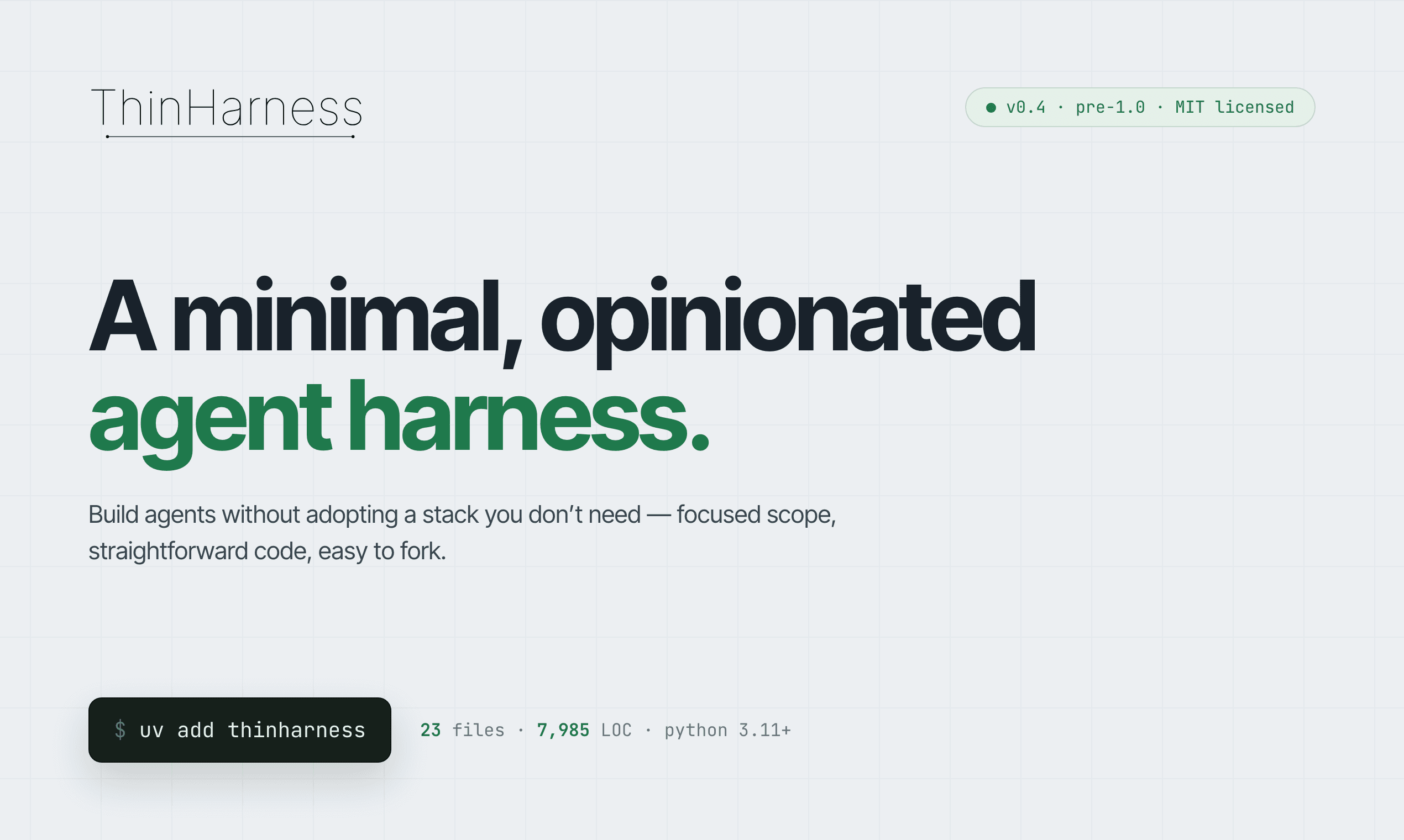
ThinHarness is a minimal, opinionated Python harness for purpose-built agents.
It owns the focused set of primitives that are tedious to rebuild and leaves the rest of the stack to your app.
It matches the harness-level feature coverage of frameworks 5–10× its size, so forking is a real option, not a theoretical one.
Pre-1.0, MIT licensed, Python 3.11+.
74 people supporting this launch
4.8
6 ratings


AI video with native sound, paid per clip. Nothing stored.

A calmer Mac menu bar, one click away.

Enterprise Software. Intelligent Automation. Global Impact.


Comments
19I started building ThinHarness after getting tired with huge agent frameworks. I usually needed only a small slice of functionality, but that slice came with coupled assumptions that didn't match my application. I've been using it for all my agent projects recently but would love feedback from anyone building agent workflows in Python!
i write a16z speedrun scout checks within 24hours | Co-Founder & CTO at Dial AI
This is exactly what the agent ecosystem needed. So many frameworks push you into their opinionated stack, but most projects just need focused primitives - filesystem tools, structured output, retries. The fact that ThinHarness gets you 5-10x framework coverage in a tiny footprint while staying MIT licensed is huge for independent builders who don't want to get locked into ecosystem wars.
I build & lead the engineering behind AI agents · Co-Founder & VP R&D @ Dial
Really like the focus on purpose-built agents here. The 5-10x size reduction vs full frameworks is huge for shipping fast. The built-in parallel LLM calls and structured output make this practical for real production use.
A minimal, opinionated Python harness is exactly the antidote to framework sprawl, and being small enough that forking is realistic is a smart call. How does it handle multi-step tool orchestration?
This looks well thought out for production use. Human approvals plus tool retries and limits are exactly the guardrails you need when putting agents in front of real users. The OpenTelemetry tracing is a great touch — observability is usually an afterthought in these frameworks.
The decision to make forking a first-class option rather than an edge case is what sets this apart. Most agent frameworks assume you want to stay inside their ecosystem forever, so they make the core so complex that forking is impractical. Keeping ThinHarness at harness-level coverage means you get the tedious primitives handled without absorbing opinions about your application layer. The parallel LLM call support is particularly useful for workflows where you need to fan out to multiple models and reconcile results without writing boilerplate retry logic each time.
Dev
Looks promising. Best of luck with the journey!
The fork-as-a-real-option framing is what stands out to me. Most agent frameworks make forking theoretical because the surface area is huge, so keeping the primitives focused and MIT licensed is the right call for anyone who wants to own their stack. Curious where you draw the line on what stays in the harness versus what gets pushed back to the app.
Employee @ Capconvert
Minimal + opinionated + actually forkable at 7,985 LOC is a rare combo. Most "lightweight" frameworks aren't. Bookmarking this. 👏
AI Voice SAAS
ThinHarness is a lightweight, minimal agent framework with clean code, built-in parallel LLM calls and powerful search tools, free of bloated extra layers for flexible custom business agent development.
Thanks for sharing this. It was interesting to read and gave a clear perspective on the topic.
Thanks for sharing this. It was interesting to read and gave a clear perspective on the topic.
Love the focus on reducing framework complexity. As the AI ecosystem grows, keeping agent architectures simple and maintainable becomes a real advantage. Congrats on the launch, and excited to see where ThinHarness goes!
The anti-sprawl angle resonates — most agent frameworks collapse under their own abstractions. How does it handle persistent state between runs? That's usually where minimal harnesses end up growing back into frameworks.
shipping at the intersection of saas and automation
Framework sprawl is underrated as a failure mode — most teams reach for the biggest framework before they know if they even need it. How are you handling shared state/context when someone's running several of these focused agents together instead of one big one? That's usually where the "simple by default" story gets tested.
Serial launcher
The "forking is a real option, not a theoretical one" pitch is a genuinely good angle — most agent frameworks are impossible to audit once you hit an edge case, and owning just the tedious primitives (retries, tool dispatch, state) is where the actual value is. MIT + Python 3.11+ and pre-1.0 honesty about scope is refreshing. How do you handle provider abstraction — is it BYO client, or do you ship thin adapters for OpenAI/Anthropic/Gemini?
Serial launcher
The "forking is a real option, not a theoretical one" pitch is a genuinely good angle — most agent frameworks are impossible to audit once you hit an edge case, and owning just the tedious primitives (retries, tool dispatch, state) is where the actual value is. MIT + Python 3.11+ and pre-1.0 honesty about scope is refreshing. How do you handle provider abstraction — is it BYO client, or do you ship thin adapters for OpenAI/Anthropic/Gemini?
A focused approach to building AI agents without unnecessary framework complexity sounds valuable. It would be helpful to see a comparison showing when ThinHarness is a better fit than larger agent frameworks.
Clean concept and thoughtful feature set. The flexible architecture is a big plus for builders who want full control.