
Guardrails and review playbooks for AI coding assistants
4.8(6)6Technology
The Agentic Coding Kit is a drop-in configuration pack that turns AI coding assistants into disciplined teammates. Built for developers who use Claude Code or Cursor every day, it packages a senior engineer's working setup into plain Markdown, JSON, and shell files you can inspect, edit, and own.
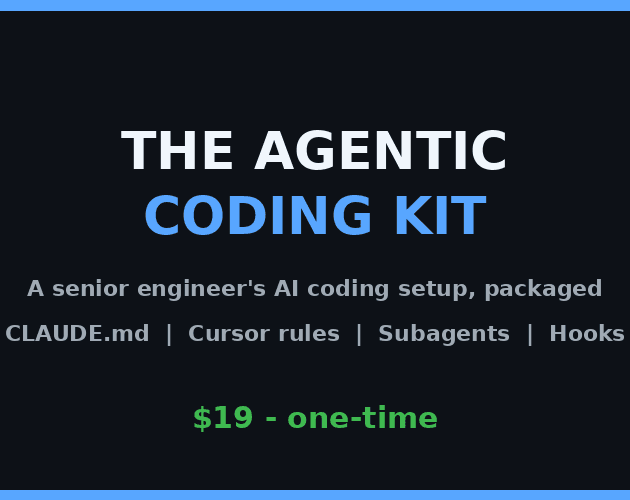
CLAUDE.md presets for five stacks: Python/FastAPI, TypeScript/Node, React/Next.js, Go, and Rust. Six Cursor rules covering testing standards, git discipline, security review, refactor guardrails, documentation, and code style. Five Claude Code subagents: code reviewer, test writer, security auditor, refactorer, and documentation writer. PR-review playbook and adversarial-review checklist.
For developers shipping with AI coding assistants who want consistent conventions, automated code review, security checks, and test coverage without re-explaining their setup every session. One-time $19, instant download, free updates.

AI video with native sound, paid per clip. Nothing stored.

A calmer Mac menu bar, one click away.

Enterprise Software. Intelligent Automation. Global Impact.


Comments
6I kept watching AI coding assistants guess wrong test commands, ignore project conventions, and call half-finished work done. So I packaged the setup a senior engineer would hand a new teammate: CLAUDE.md presets, Cursor rules, specialist subagents, and review playbooks as plain files you can read and own. Happy to answer questions.
Founder - Vynix
This looks like a useful toolkit for developers working with AI coding assistants every day.
Guardrails and review playbooks are the part most AI coding tooling skips — the model output is easy to generate, but the review step is where teams actually get burned. Making the playbooks explicit (rather than implicit team knowledge) means a new hire follows the same review bar on day one. Would be useful to see a sample playbook for a common stack so people can judge the depth before committing.
Website Builder
This matches what worked for us. We run Claude Code daily on a multi-repo product, and the biggest jump in quality came from two things you include: a CLAUDE.md that states the hard rules (package manager, style conventions, "never commit without asking") and specialist subagents per domain instead of one generalist. One thing worth adding to the Node/Next.js presets: an explicit rule about where secrets live and what must never be pasted into chat or logs. That's the mistake we saw agents make most often before we wrote it down. Do the subagents share one review checklist, or does each carry its own?
The "calls half-finished work done" problem is the one that bit us most. What fixed it was making "done" mechanical: the agent has to paste the real output of the test and typecheck commands as evidence, not a summary of them. Do your presets include a definition of done like that, or Claude Code hooks that run the checks automatically before it can finish?
Writing the hard rules down in CLAUDE.md is also what made the biggest difference for me with Claude Code. What drifted for us was rules that change over time, like which branch is the staging line. Once the same rule lived in two files, the agent followed whichever one it read first. How do you suggest keeping a rule in sync when it appears in CLAUDE.md, a Cursor rule and a subagent prompt? Is there one source the others point to?