

Your knowledge, lit. Drop in docs, get back answers.
4.8(6)39TechnologyProductivityStorage
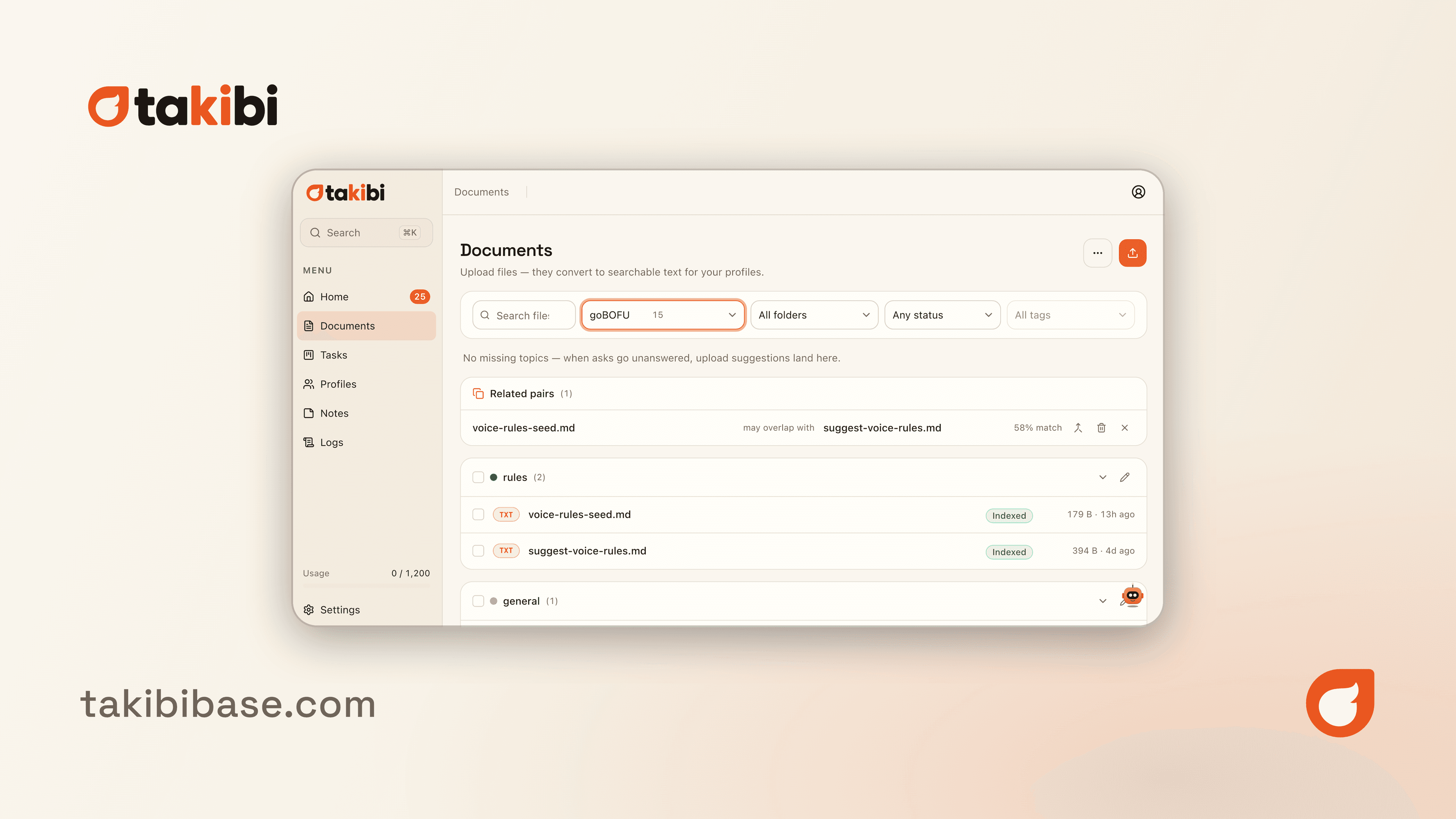
Takibi Base (Takibi) is a shared knowledge base for AI agents. One human operator organizes documents into projects and folders and controls access with Profiles. Agents retrieve exact cited passages and an evidence support score via CLI or API; Takibi does not generate answers. The workspace also includes agent Notes (UNTRUSTED, Profile-scoped scratch with a fixed 30-day TTL; human triage with Keep, Add to draft, or Remove, and draft export; never trusted Sources, not shared across Profiles, never auto-promoted), Conversations for agent-to-agent context, Tasks with review, and Open Knowledge Format export.
70 people supporting this launch
4.8
6 ratings

First month free
fazierfirstmonthfreeI work in SEO and growth marketing. I am also the founder of goBOFU and Takibi Base.

AI video with native sound, paid per clip. Nothing stored.

A calmer Mac menu bar, one click away.

Enterprise Software. Intelligent Automation. Global Impact.


Comments
39I built IndieAppCircle - an app feedback exchange for indie developers!
Love the first screenshot. Overall really nice design!
I work in SEO and growth marketing. I am also the founder of goBOFU and Takibi Base.
Thanks, glad you like it :)
Keeping agent Notes separate from trusted Sources, with human review before promotion, is a useful boundary. When a source document changes, how are previously retrieved citations and evidence support scores handled? Can an agent tell that a cited passage has become outdated before reusing it in another task?
I work in SEO and growth marketing. I am also the founder of goBOFU and Takibi Base.
Good question, the short version: Takibi citations and support scores are snapshots, not live links. When a source document is edited, the old passages aren't patched — but they also can't come back as ”current” again: every fresh ask is verified word-for-word against the latest text, and anything that changed simply stops being served. So if an agent wants to reuse a citation in a later task, the move is to re-ask first. If the passage still comes back, it's current; if it's gone or different, it was outdated.
The retrieval-only positioning is a genuinely underrated decision - returning cited passages with an evidence score instead of generating answers means the model layer stays swappable and hallucinations never contaminate the source of truth. Curious how the evidence support score is computed: is it purely embedding similarity, or does it weigh profile-scoped access patterns too? Also, the UNTRUSTED agent notes with human triage is exactly the right trust boundary for multi-agent setups.
I work in SEO and growth marketing. I am also the founder of goBOFU and Takibi Base.
You nailed the positioning! The score isn't embedding similarity; there's no embedding layer at all. Retrieval is Postgres full-text search.
Love the design, although it lagged a bit while I was scrolling the page. Maybe It's my network though. Over all this project is clean and has a warm feeling
I work in SEO and growth marketing. I am also the founder of goBOFU and Takibi Base.
Interesting, do you mind sending an email to [email protected] so I can look into it?
Really interesting approach to AI knowledge management. I especially like the focus on cited sources and evidence instead of letting AI generate unsupported answers. The human review and access-control features also make this useful for teams working with multiple AI agents.
I work in SEO and growth marketing. I am also the founder of goBOFU and Takibi Base.
Thanks, Alizy! The per-agent access control point matters a lot to teams because they should be able to hand different slices of the same knowledge base to different agents without duplicating anything.
great product, if possible which embedding model are you using? can it answer queries fro, Hindi?
I work in SEO and growth marketing. I am also the founder of goBOFU and Takibi Base.
I wrote about some of the tech used on my blog, I only use Typesafe”s Jev: https://deianisac.com/writing/jev-judges-code-decides/
I work in SEO and growth marketing. I am also the founder of goBOFU and Takibi Base.
With that said, there's no embedding model — retrieval is Postgres full-text search (English config). That also means Hindi content retrieval is limited today, though filename matching works by substring in any script.
The distinction between trusted Sources and expiring, profile-scoped Notes is a strong safety boundary; pairing exact cited retrieval with CLI/API makes this useful for agent workflows without asking Takibi to generate answers. How do you surface stale Notes when a 30-day TTL is close to expiring?
I work in SEO and growth marketing. I am also the founder of goBOFU and Takibi Base.
Every note carries its expiry date, visible in the review queue and the API, and expired notes flip to soft-expired and drop out of retrieval automatically. Nothing persists silently past TTL. The keep function endorses a note but deliberately never extends the deadline; if it's worth keeping longer, the workflow is promoting it into a Source through human review.
Building PZERO, saving you money - pzero.studio
Returning exact cited passages with an evidence support score, rather than generating answers, gives agents something they can actually check against the source. If the model bills behind the agents calling it start to climb, PZERO sells leftover capacity at pzero.studio.
Ai Saas
Overall really nice design!Can an agent tell that a cited passage has become outdated before reusing it in another task?
I work in SEO and growth marketing. I am also the founder of goBOFU and Takibi Base.
Good question. Every citation pins a document + chunk ID, and retrieval only ever serves the currently indexed version — so re-running the query always returns fresh passages. Old citations stay resolvable to the superseded version rather than quietly changing under you.
https://www.kelmiv.com/
This is a really useful idea for improving the reliability of AI agents. I like how Takibi Base focuses on trusted sources and citations rather than just generating information. The concept looks very practical for teams using AI at scale.
Great UI, how does this compare to XYZ?
How does it handle conflicting answers across different docs?
xVisa is an end-to-end Schengen visa service: we help you choose the best country to apply from, prepare your documents, complete the application and book the appointment.
What I like most about Takibi is that it doesn’t just give you another AI-generated answer. It shows you the exact source behind the result, so you can quickly check the information and see where it came from. I’ve found that especially useful for research and fact-checking.
Building Expiry Manager
The separation between trusted Sources and short-lived, human-reviewed Notes is a thoughtful design choice for agent workflows. How do you surface when a citation or evidence score may have become stale after the underlying document changes?
"no evidence means no passages" is the right default - most retrieval tools fail silently and agents run with invented context. Profile-scoped keys with pause/revoke is exactly the control you want when agents touch internal docs. When a source doc gets updated, do agents see a version bump or does the index refresh in place?
Indie maker building privacy-focused, zero-login web tools.
Really clean interface and straightforward value proposition. Love seeing lightweight tools like this. Great work!
The retrieval-only design is the standout choice here — returning cited passages with an evidence support score instead of generated answers directly addresses the hallucination problem that plagues most RAG setups. Per-profile keys with folder grants are a smart way to enforce least privilege across tools. I'd love to see how quarantine decisions surface to the human operator during indexing — a clear triage view there would make the trust model complete.
This is a very nice design
The Profile grants plus pause/revoke controls look especially useful for multi-agent teams. Does the Tasks review flow retain which cited passages informed a submitted result, so an operator can audit the work without reconstructing the retrieval history?