

Publish 3 SEO-optimized blog posts a day, hands-off
Structura runs the whole publishing lifecycle unattended: research, strategy, writing, authority links, images, a 20+ point SEO protocol, and publishing. Output is real Gutenberg blocks, not pasted HTML. Publishes to WordPress natively or to any stack via a Content API.
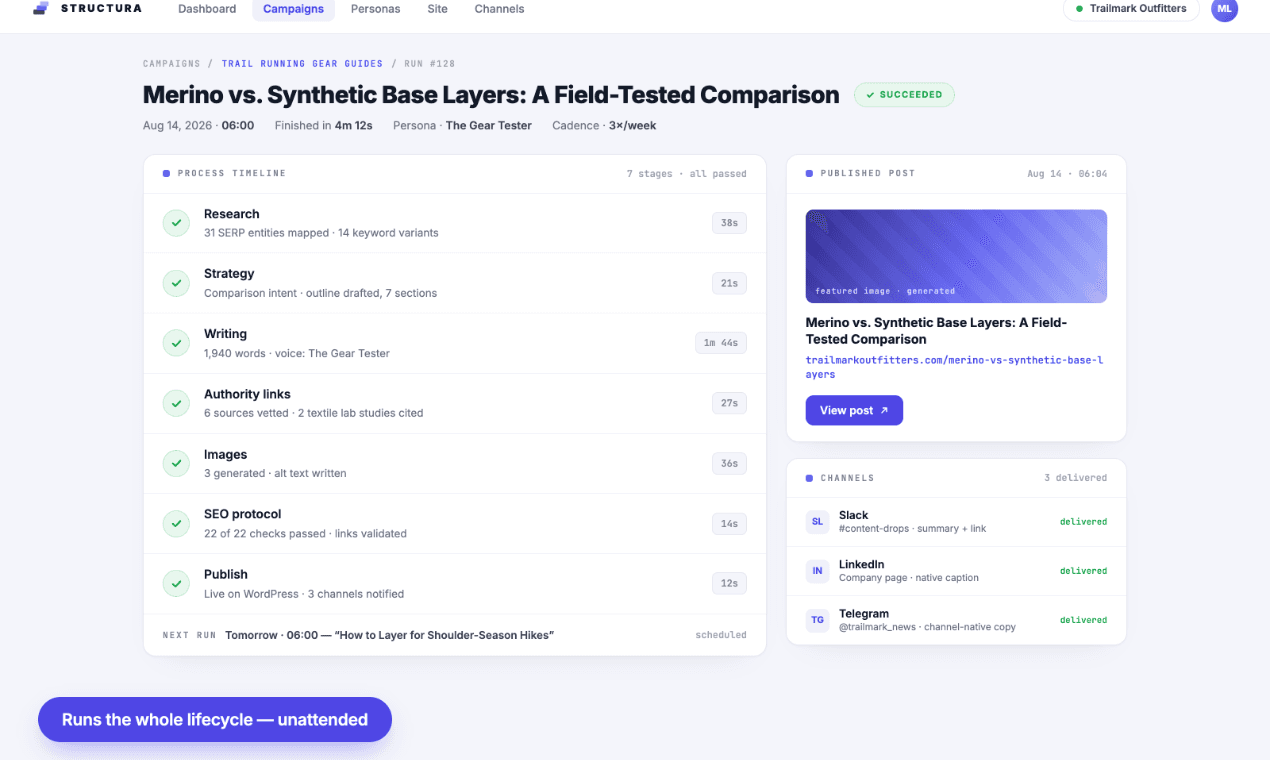
Real Gutenberg blocks — posts arrive as clean, editable, theme-agnostic blocks, not one HTML blob
Deterministic 20+ point SEO protocol, compatible with Yoast and Rank Math; paid plans add live SERP gap analysis
Verified outbound authority links — every URL validated before publishing
Campaigns with personas: topic territory, keyword bank, cadence, and per-campaign writing voices
Publishes natively to WordPress or to any stack (Next.js, Astro, custom) via a hosted Content API
Channel fan-out on publish: Slack, Discord, Telegram, webhooks, and social cross-posting
Google Search Console feedback loop with per-post performance and ranked improvement suggestions
Content in any language; admin UI in English, German, Spanish, French
Bring your own OpenAI, Gemini, or Anthropic key — or managed plans; free plan available
Site owners publishing consistent SEO content without writing a word
Marketing agencies running content programs across many client sites
Headless sites (Next.js, Astro, custom CMS) that need a content engine through an API
Multilingual blogs — one campaign per language with native-quality output
Small teams replacing the research-write-optimize-publish loop with review-only workflows
73 people supporting this launch
4.8
6 ratings

Product creator

AI video with native sound, paid per clip. Nothing stored.

A calmer Mac menu bar, one click away.

Enterprise Software. Intelligent Automation. Global Impact.


Comments
30Product creator
I run a small content agency, and every AI writing tool we tried dumped a wall of HTML into WordPress and broke our clients' themes. Structura started as our internal fix: an engine that researches the live SERP before writing, validates every outbound link, and publishes real Gutenberg blocks on a schedule. It now also publishes to headless sites (Next.js, Astro) through a Content API. There's a free plan — I'd honestly rather hear where it falls short for your stack than get upvotes.
I build & lead the engineering behind AI agents · Co-Founder & VP R&D @ Dial
The real win here is automating the research and validation loop before writing. Most content tools just generate text, but Structura handles the part that actually takes time: finding good topics with search intent, validating SERP competition, and ensuring the output works in your specific publishing stack. Gutenberg blocks instead of pasted HTML is huge for quality control. This solves a genuine workflow friction point for anyone scaling content production.
Content strategist specializing in digital utilities and cultural naming research, lead editor for Japan Generator Name and Japanese linguistic guides.
The native Gutenberg block integration is a huge win most AI tools just dump raw HTML that messes up theme styling in WordPress, so outputting clean, native blocks natively saves so much editing time. Congrats on the launch!
Founder at AIDressingRoom
USEFUL GOOD PORDUCT ,much more other product
I think it's worth encouraging and supporting them to continue improving and optimizing the user experience.
Building PZERO, saving you money - pzero.studio
Hands-off SEO posts is a real time save if the quality holds. If AI spend at work starts to sting, take a look at pzero.studio
The real win here is automating the research and validation loop before you even start writing. Most content tools focus on generating text, but Structura handles the part that actually takes the most time: finding topics with real search intent, validating SERP competition, and making sure the final output fits seamlessly into your publishing stack. The use of Gutenberg blocks instead of pasted HTML is also a huge win for quality control and workflow efficiency. Overall, this solves a genuine pain point for anyone looking to scale content production without sacrificing research quality or publishing consistency.
Publishing native Gutenberg blocks instead of pasted HTML is a smart detail — that's usually where automated content tools fall apart. Curious how the Search Console feedback loop decides which posts to revise first?
Product creator
Thanks! The loop turns Search Console data into typed findings and ranks them by expected payoff: "striking distance" (position 5–20 with real impressions) and "low CTR" (CTR under half the expected curve for that position) rank first, then ranking decay, uncovered queries, and cannibalization. In short: posts where Google already shows you, but a small push changes the outcome.
really useful and comprehensive
Validating outbound links before publishing is the detail I'd expect most tools to skip. Two questions: how do you handle a link that goes 404 a month after publishing, and does the Search Console loop ever suggest merging/cannibalization fixes rather than just revising a single post?
Product creator
Good catch on both. (1) Honest answer: links are validated at generation/publish time, there's no scheduled re-crawl afterwards yet, so a link that dies a month later sits until the post is next revised. Periodic re-validation is on the list. (2) Detection: yes — the Search Console loop has an explicit cannibalization rule; when two of your pages split the same query it flags both pages together. The merge itself stays your call - it doesn't auto-rewrite anything.
17-year-old founder building AI products at the intersection of technology and the automotive world.
Really interesting! Solves a big problem for all of us
individual developers
Such a practical tool for anyone looking to scale content production seamlessly. Love the focus on clean output and automated SEO workflows. Well done!
and it remembers past keywords?
Product creator
Yes, there is a pool of keywords saved within each campaign (AI-suggested first based on real data + hand-written), and for each new post it takes the next keyword + makes it long-tail to avoid cannibalization.
The Search Console feedback loop is the part I would want to see data on. Google's spam policy on scaled content abuse targets exactly this pattern - high volume automated publishing - so the interesting number is not how posts rank at publish time but whether they are still indexed after 60-90 days. Do you have that yet? And when the loop sees a topic that never ranks, does it stop publishing on it, or only suggest improvements?
Product creator
Fair challenge, and that policy is exactly why the pipeline is gated the way it is. Two honest answers. (1) We run Structura on our own portfolio (multi-language sites publishing on schedule since spring) and those posts remain indexed - and the Search Console loop has a not_indexed rule, so pages Google hasn't indexed surface as high-priority findings per page. Indexation is monitored, not assumed. A public 60–90-day dataset is a fair ask; we don't have one to show yet. (2) It doesn't silently auto-stop a topic today - findings are surfaced and that call stays with you. One related guard it does enforce: when a campaign's keyword bank runs out of real targets, the engine halts rather than padding with filler.
Structura Your product has strong potential, but I found a few key improvements that could make it even better. I'd love to share my feedback and suggestions—please contact me at [email protected].
I tried Structura because I was looking for a more automated way to handle SEO content publishing, and the workflow is very straightforward. What I like most is that it covers more than just writing. The product connects research, content strategy, article generation, images, SEO checks, internal/authority links, and publishing into one workflow. That makes it feel closer to an actual publishing system than another AI writing tool. The campaign dashboard is also useful because you can clearly see which stage each article is in and whether something failed before publishing. For anyone managing multiple posts or sites, that visibility is important. Another strong point is the WordPress/Gutenberg publishing approach. Having structured content published directly instead of manually copying AI-generated HTML can save a lot of repetitive work. The product seems especially suitable for small SEO teams, niche-site operators, and founders who want to maintain a consistent publishing schedule without managing several separate tools. One thing I’d like to see improved over time is more control over the content-generation process, especially around tone, source selection, internal linking rules, and reviewing content before it goes live. Overall, Structura has a clear value proposition: automate the repetitive parts of SEO publishing while keeping the entire content lifecycle in one place.
Solo developer from Ukraine
The verified outbound links caught my eye — most AI writing tools happily invent URLs. What does verification actually check: that the URL resolves, or that the page still says what the article claims it says? The second one is where these tools usually break.
Indie maker building AI tools for e-commerce
If the quality is stable, I think I will use it
Independent software founder building thoughtful SaaS products for professionals, communication, and digital identity.
Are there any use cases about SEO performance of such posts?
Product creator
Yes! This is my other product where I've been running Structura for the longest period of time so far: https://www.dropbox.com/scl/fi/nus4nmtc5lld03wk2xwui/Screenshot-2026-08-24-at-21.06.16.png?rlkey=tlnqjwl323xg6o1iodhyova48&dl=0
Product creator
This is how it started actually. I wanted to build a quick autoblogging tool for Formula Foundry and it's become a standalone product eventually :)
Product creator
But it depends on many factors, not only on the content quality - for example, your domain rating (DR) and the keyword difficulty (KD) of they key phrases you're fighting for.
Three posts a day is serious throughput. What controls prevent keyword cannibalization and unsupported claims at that pace—does Structura maintain a site-wide topic map, detect overlap with existing pages, and require source citations before publishing?
Product creator
Great question! The honest answer starts with cadence: it's entirely user-set. Three posts a day is the ceiling the engine supports, not the recommendation. For most sites we actively advise 1–2 posts a week — consistency compounds, volume without demand doesn't. On cannibalization: every campaign works through its own keyword bank, and each post claims a distinct keyword and topic from it. We also have additional guards that check new topics against what's already published on the site — not just within one campaign — precisely so two posts never end up chasing the same query. On claims and links: every post goes through a research stage before writing, and both internal and external links are checked — internal ones against the site's actual structure, outbound ones validated before publish so nothing ships pointing at dead or irrelevant sources. A full site-wide topic map is on the roadmap; today it's keyword-bank ownership + overlap detection, which in practice catches what matters. Happy to go deeper if you're curious.