
AI assessment that scores startup readiness across 6 pillars
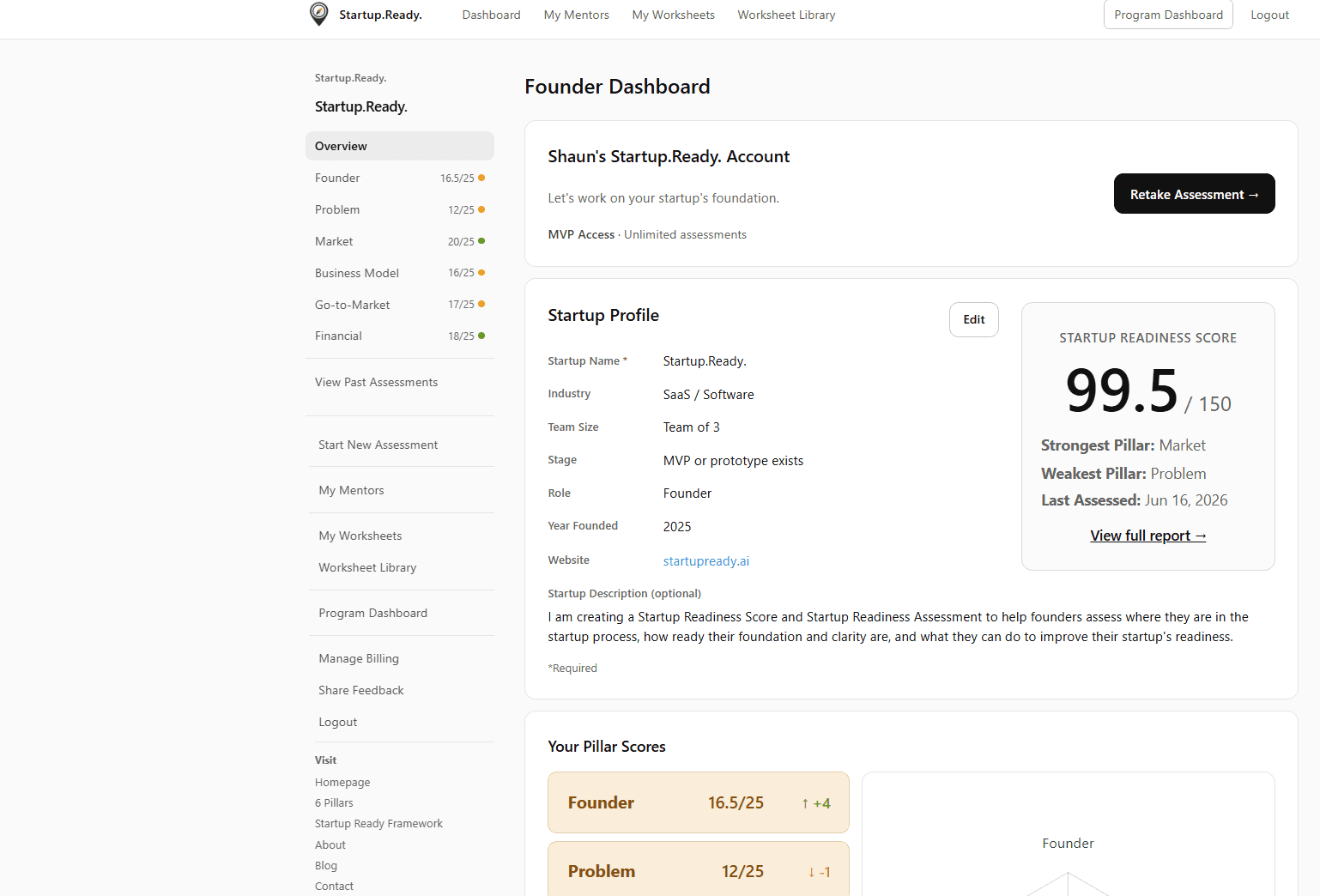
Startup.Ready. is a startup readiness assessment and development system for early-stage founders. A 20-minute assessment scores your venture across six pillars (Founder, Problem, Market, Business Model, Go-to-Market, Financial), returns a readiness score and a plain-language diagnosis, then assigns the work to close the gaps. Free for founders to try twice.
4.8
6 ratings
Building Tools for Startup Founders

AI video with native sound, paid per clip. Nothing stored.

A calmer Mac menu bar, one click away.

Enterprise Software. Intelligent Automation. Global Impact.


Comments
4Building Tools for Startup Founders
I spent fifteen years teaching and consulting with founders, several hundred of them, and I kept watching the same thing happen. Capable people, working hard, building on a foundation nobody had ever examined with them. They rarely failed loudly. They faded. When I went back through my notes the pattern held: an untested assumption sitting in a pillar the founder was not looking at, quietly deciding the outcome months before anyone noticed. Startup.Ready. is that examination, made repeatable. My dissertation research was on entrepreneurial learning as a process, and the finding that stuck with me is that the reasoning good founders do can be developed. It does not have to come from an accelerator seat or a well-connected friend. So I built an assessment that finds the weak spot and 81 worksheets that close it. The first two runs are free, because a founder without a network needs this more than a founder with one.
tldix.com founder and developer
Scoring each pillar separately is more useful than a single number, since an early founder usually has one or two weak areas, not a weak startup overall. Question: how do you keep the score from rewarding confident answers over evidence? For example, does Go-to-Market ask for real numbers like signups or conversion rate, or is it self-rated? Also, a before/after view per pillar when someone retakes the assessment a month later would give founders a strong reason to come back.
A structured mirror for your life path.
I like that the score measures clarity rather than the idea or effort, and that gaps route to specific worksheets instead of generic tips. Retaking after doing the work to see each pillar shift feels like the most motivating part.
The cohort dashboard is a smart angle for accelerators. Can a program add its own worksheets or adjust pillar weighting, or is the six-pillar framework fixed for everyone?