

A calm weekly habit tracker. No streaks, no guilt.
4.8(6)27ProductivityAndroidPrivacy
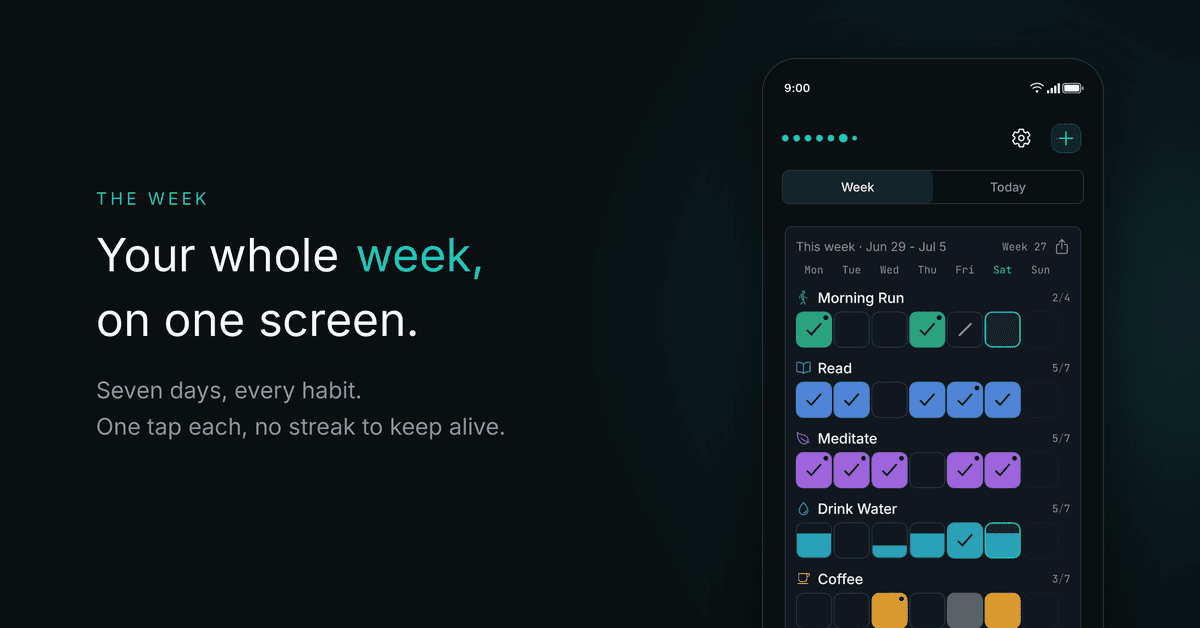
SevenGrid is a calm habit tracker for Android that shows your whole week as a grid of seven days. Instead of streaks (unbroken daily chains), it works with weekly goals like "three times a week", so a missed day is never a failure and planned rest days are fine.
Everything stays on your device: no account, no cloud, no ads, no usage tracking. It is free to use, and the full version (unlimited habits, full history, weekly stats) is a one time purchase, never a subscription. Built by a solo developer in Germany, available in English and German.
4.8
6 ratings
A calm weekly habit tracker. No streaks, no guilt.

AI video with native sound, paid per clip. Nothing stored.

A calmer Mac menu bar, one click away.

Enterprise Software. Intelligent Automation. Global Impact.


Comments
27A calm weekly habit tracker. No streaks, no guilt.
Hi everyone, I'm Stefan, the solo developer behind SevenGrid. I built it because every habit tracker I tried slowly turned into a guilt machine. Miss a single day, the streak resets to zero, and the app starts to feel like a chore instead of a help. I wanted the opposite: a calm view of the whole week, where a missed day is just a missed day and a planned rest day is completely fine. So SevenGrid shows your week as a simple grid and works with weekly goals like "three times a week" instead of unbroken streaks. Everything stays on your device, there is no account and no tracking, and the full version is a one time purchase, never a subscription. It is just me building this, in Germany. It is available in English and German today, and more languages are already on the roadmap. I would love to hear what you think. And if streak based apps have ever burned you out, I would really like to know whether this feels different for you.
Prouct is a multilingual startup directory for digital products and physical innovations. Discover curated SaaS tools, hardware startups, and new gadgets recommended by the community.
love it, looks clean
A calm weekly habit tracker. No streaks, no guilt.
Thanks!
Great idea. I really love it. keep building
A calm weekly habit tracker. No streaks, no guilt.
Thank you, means a lot! Building in public and comments like this keep the motivation up.
I build & lead the engineering behind AI agents · Co-Founder & VP R&D @ Dial
The guilt-free angle is really smart design. Most habit trackers psychologically punish you for missing a day by breaking streaks, which turns the app into an obligation instead of a tool. SevenGrid's weekly goal model reframes a missed day as just part of the week's pattern, not a failure. Combined with the privacy-first approach (local storage, no tracking), this feels like an app designed to help people actually stick to goals instead of gaming engagement metrics. Solo dev in Germany building something genuinely thoughtful.
A calm weekly habit tracker. No streaks, no guilt.
Really appreciate the thoughtful read, especially coming from someone who builds engineering for AI products. You nailed exactly what I was going for: the weekly model isn't a gimmick, it's meant to remove the punishment mechanic that daily streaks create. And yeah, local storage was a deliberate call too, not a marketing checkbox. Good luck with your own work!
A calm, visual habit tracker is such a refreshing contrast to the noisy dashboards out there. Visual simplicity makes sticking to weekly goals so much more sustainable. Clean UX is everything when building consumer and fintech products (you can search online for the ITRFA tool to see our take on simplifying complex tax reporting). Great job on the design!
A calm weekly habit tracker. No streaks, no guilt.
Thanks, glad the calm approach comes through! Clean UX matters most when the underlying problem (habits, taxes, whatever) is already complex enough on its own. Will check out ITRFA.
i write a16z speedrun scout checks within 24hours | Co-Founder & CTO at Dial AI
The weekly goals approach is such a refreshing take on habit tracking. Most apps are obsessed with streaks and daily consistency, which adds stress instead of building sustainable habits. Flipping to "three times this week" removes that all-or-nothing pressure. Missing one day doesn't blow up your streak, you just adjust your plan. The local-first privacy model is huge too - all your personal habit data stays on your device. Plus the mood notes and reflective check-in instead of just grinding through a daily checklist feels genuinely human-centered.
A calm weekly habit tracker. No streaks, no guilt.
Thank you, that's a great summary of the intent actually. The "three times this week" framing was the whole point: it lets people miss a day without triggering that all-or-nothing streak anxiety. The mood notes came later, once I realized a lot of missed days had a reason worth remembering, not just a gap to feel bad about.
Weekly goals instead of streaks is the right call. Streak-based trackers punished me every time I traveled and I would quit the app entirely after one broken chain. Also respect the no-account, on-device approach with a one-time unlock, that pricing model builds more trust than another subscription.
A calm weekly habit tracker. No streaks, no guilt.
The travel thing was my exact breaking point too, one trip and a long streak was gone, so I would rage-quit the app over losing something I actually cared about. And the pricing was on purpose: a calm tracker that bills you monthly felt like a contradiction, so it is one payment and then it is just yours, offline. Thanks for the thoughtful comment.
building..
would love to try the ios app when it launch!
A calm weekly habit tracker. No streaks, no guilt.
Hey, i am already working on it :) Stay tuned!
Indie developer building useful AI tools and SEO-focused products.
Love the calm approach to habit tracking. Weekly goals instead of streaks feels much more sustainable, and the local-first privacy model is a nice touch.
A calm weekly habit tracker. No streaks, no guilt.
Thank you so much! :)
The weekly-goal model is a strong product decision because it matches how real routines work better than daily streak pressure. I also like the local-first positioning and one-time purchase because it signals the product is optimized for trust, not retention tricks. One feature that could be especially valuable is a lightweight "bounce back" view that helps users reset after a messy week without feeling like they are restarting from zero.
A calm weekly habit tracker. No streaks, no guilt.
Thanks for sharing that, the streak guilt debate you describe is exactly what pushed me down this path. Kids get sick, trips happen, and a mechanic that punishes precisely the families trying hardest never sat right with me either. We actually built a small memorial page for stories like this, a streak graveyard where people bury their old streaks and what the broken chain cost them: https://sevengrid.app/streak-graveyard.html On momentum: within the week the grid itself does most of the work, you watch the dots fill toward your goal and that is a quieter but real pull. Across weeks there is a small trend view in the stats that shows the shape of recent weeks, deliberately descriptive rather than judging, so you can notice a dip without being scolded for it. And a reflection view resurfaces old notes, which turns out to create more pull than any counter did. Curious how the family reading streak discussion ended on your side.
Dad of 2, solo developer, creator of TaleBird and Solofamily.
The no-streaks position is braver than it sounds. I build a bedtime stories app and we added a family reading streak; the internal debate about streak guilt was real - kids get sick, trips happen, and a broken chain punishes exactly the families trying hardest. Weekly goals like three-times-a-week reframe a missed day as part of the pattern instead of a failure, which feels like the honest answer. How do you keep a sense of momentum without any streak mechanic - is the grid itself enough, or do you surface a gentle trend across weeks?
A calm weekly habit tracker. No streaks, no guilt.
Thanks, and that internal debate you describe sounds very familiar. The honest answer: the momentum comes from the week itself. Every habit is a row of seven boxes with a weekly goal like 3x, so a sick kid on Tuesday just leaves a calm gap in a week that can still succeed. That reframe does most of the work on its own. On top of that there are gentle trends, just nothing that can snap: the app shows the shape of your recent weeks side by side, and a year view renders every week as quiet tiles, so consistency stays visible without a single number that resets to zero. And once a week it asks exactly one question: how was your week? That's the entire gamification. For everything from before: I also built a small graveyard where broken streaks get a proper eulogy and a certificate: sevengrid.app/streak-graveyard.html. Family reading streaks are welcome to rest there too. Kids getting sick is exactly the kind of death no one should feel guilty about.
The "at most" goals are the underrated part of this. Every tracker assumes you're building a habit up, almost none help you ratchet one down, and "at most twice a week" with planned rest days is a more honest model of how people actually change. I built a daily reading streak into my own app and settled on a tiny default goal with a stored personal best instead of a guilt chain, but weekly framing solves the travel problem more cleanly than anything daily can. The one-time purchase with local-only data fits the calm positioning too. From one solo dev to another, this is coherent design.
A calm weekly habit tracker. No streaks, no guilt.
From one solo dev to another, thank you, generous read. The "at most" side was the part I almost cut and then realised it was half the point: almost everything assumes up and to the right, but a lot of change is "less of this, and an off day is fine". Reduction as a first-class goal, plus rest days that are part of the plan and not a failure of it, felt more honest. And your call is a good one too, a tiny floor with a personal best you cannot lose is a kinder shape than a chain that resets. Different route, same instinct. Good luck with yours.
The "at most" goals are the piece I haven't seen elsewhere, and it matters more for ADHD users than the streak-removal itself — we build Unstuck for ADHD brains and the pattern we keep seeing is rejection-sensitive dysphoria turning one broken streak into total app abandonment, not just discouragement. A weekly grid absorbs that emotional spike since one bad day is 1/7 of a still-open week, not a reset to zero. Curious whether the weekly reflection mood note is doing more than journaling for you — are you seeing people actually adjust next week's "three times" goal based on what the mood note surfaced, or is it mostly used as a passive log?
A calm weekly habit tracker. No streaks, no guilt.
Really glad the "at most" mode landed for you, that is the part I most hoped someone would notice, so thank you. Your RSD framing is exactly the model the whole app is built on, and you put it more precisely than I usually manage: the grid exists to make one bad day 1/7 of an open week instead of a reset to zero. The streak removal is the headline, but that emotional math underneath is the actual point. On your real question I owe you an honest and slightly unsatisfying answer: I genuinely cannot measure it. SevenGrid has no usage tracking, everything stays local on the device, so I have zero telemetry on whether people re-tune next week's "three times" after a mood note. I would be inventing a pattern if I claimed one. What I can tell you is how it is built, because that part is deliberate. The mood note is closer to a passive log than a nudge. There is a quiet mood trend across reviews, and older reflections resurface later ("a year ago you wrote..."), but nothing ever auto-suggests lowering the "3x". The goal stays fully manual and unprompted. My worry with an active "your mood was low, drop your goal" loop is that for an RSD brain it can read as the app deciding you failed, which is the exact spike I am trying not to set off. So the reflection is meant to hand you the raw material to make that call yourself, in your own time, rather than making it for you. I would genuinely value your read on that, since you sit closer to the ADHD side than I do: is a passive, non-prescriptive reflection enough, or does the goal re-tune need a gentle prompt to actually happen for that brain? Real question. Stefan
Founder of DIVR — a free dive-logging platform that turns divers' species sightings into research-ready biodiversity data.
The weekly-goal framing instead of streaks is the right call. I work on a dive-logging app and the same pattern shows up there: the moment logging feels like an obligation, people quietly stop, and one missed day is usually where it starts. "Three times a week" absorbs real life in a way daily chains never do. Also respect the no-account, on-device approach — curious whether that stays viable once people want their history backed up or on a new phone. Is export/restore handled locally?
A calm weekly habit tracker. No streaks, no guilt.
Thanks Joep, and yes, that pattern is identical across our categories: the moment logging turns into an obligation, people go quiet, and a missed day is almost always where it starts. Good to hear it holds in dive logging too. On the backup question, which is the fair one to ask of a no-account app: export and restore are fully local. You can export your whole history as a plain CSV bundle at any time, and there is a once-a-day automatic backup that writes the same bundle into a folder you pick. Point that folder at a synced one (a Drive folder, an SD card, wherever) and your history rides along off-device without the app ever needing an account or touching a server. Restore is just importing that bundle back, so a new phone is: install, import the file, done. The deliberate line is that nothing leaves the device unless you send it there. No silent sync, no lock-in, and because it is plain CSV it stays yours to read even without the app. The tradeoff is honest too: I do not do cross-device magic, you move one file. For this audience that has felt like the right side of the trade, but I would be curious whether dive folks expect more automatic continuity than habit folks do. Stefan