

Get real code reviews from real developers
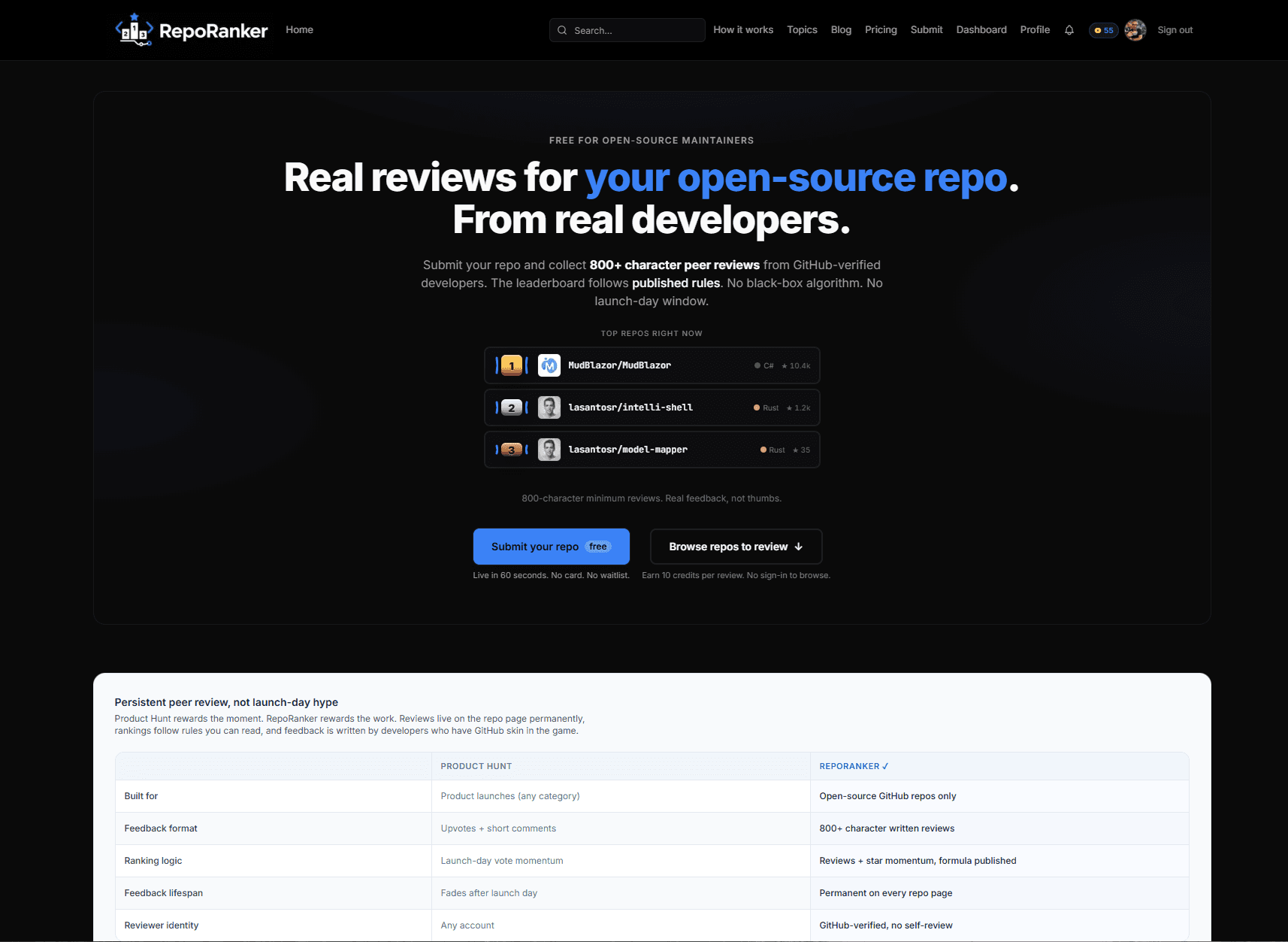
Get real code reviews from developers who actually use GitHub. Submit your open-source repo, earn credits by reviewing others, and use those credits to boost your project's visibility. Reviews require 800+ characters and GitHub authentication — no spam, no drive-bys. The ranking algorithm is fully transparent, published for anyone to audit.
52 people supporting this launch
4.8
6 ratings


AI video with native sound, paid per clip. Nothing stored.

A calmer Mac menu bar, one click away.

Enterprise Software. Intelligent Automation. Global Impact.


Comments
28Hey Fazier community, I built RepoRanker because I kept running into the same problem. I'd ship an open-source project, post it somewhere, get a handful of upvotes, and walk away with zero useful feedback. Just vibes. No signal. I wanted a place where developers could get real, substantive reviews from people who actually write code. Not stars. Not likes. Actual written feedback with accountability behind it. So I built the credit economy around that idea. You earn credits by reviewing others. You spend them on visibility. The people most invested in quality are the ones with the most influence on the platform. That felt right. The ranking algorithm is fully public. You can read exactly how scores are calculated. No black box, no pay-to-win beyond small visibility boosts. Still early days. Would love to know what you think — what's missing, what's confusing, what you'd use it for. Drop a comment or just go submit a repo and tell me how it feels. Thanks for checking it out. Jay
170+ Free Online Tools — No Sign-Up, No Fluff
The GitHub OAuth requirement is the right call — it filters out noise immediately and makes every review actually meaningful. Most feedback platforms struggle with quality control, but tying reviews to real GitHub accounts solves that at the source. The credit system is clever too. Forcing reviewers to give before they can boost means the platform stays self-sustaining without becoming pay-to-win. The 800-character minimum is a good threshold—long enough to require genuine thought, short enough that it's not a burden. One suggestion: consider adding a "reviewer expertise" tag based on their GitHub language stats. So if someone primarily writes Python, their review on a Python repo carries a visible badge. Would add another layer of credibility to the review scores. Question—how do you handle repos that are mostly configuration or DevOps focused (Dockerfiles, CI pipelines, Terraform)? Is the review format flexible enough for infrastructure code, or is it primarily aimed at application-level code?
The review format is flexible by design. The 800-character minimum is a quality floor, not a template, there's no required section for "architecture" or "API design." A reviewer evaluating a Terraform module or a CI pipeline asks different questions than one evaluating an app library, but the same underlying signals apply. For infrastructure repos, a solid review covers: Documentation.... Is the README honest about what this replaces or requires? Are variables/inputs documented? Is there a usage example that actually works? Does the Terraform plan behave predictably on re-runs? Are destructive changes called out? These are real, reviewable things any practitioner can assess. Infrastructure code often has more to say, bad Terraform destroys prod, so the stakes make detailed review more valuable, not less. The only repos that genuinely don't fit are pure config dumps with no portability intent (e.g., a single company's internal .github/workflows folder). Anything built as a reusable tool, module, or template is fair game.
Shipped: everything you asked for Been working through the feedback from launch week. Here's what just went live: Language filtering — browse by language now. TypeScript, Python, Rust, Go — each has its own leaderboard page with full sort/search/time filters. Language pills are on the homepage too so you can get there in one click. Repo type tags — when you submit (or edit your existing listing), you can now tag your repo as Application, Library, DevOps tool, CLI, or Other. Shows as a badge on your card and has its own filter page at /types/[type]. Live in production badge — check the box when submitting or editing to signal that your project is actively running in production. A small "Live" badge shows on your card. 3× credits for sought reviews — if a maintainer activates the review-request boost, reviewers now earn 30 credits instead of 20 (up from 2× to 3×). The badge and banners make it obvious which repos have this active. All of this was directly from the comments. Keep them coming — this is exactly the feedback loop that makes the platform better.
170+ Free Online Tools — No Sign-Up, No Fluff
The GitHub OAuth requirement is the right call — it filters out noise immediately and makes every review actually meaningful. Most feedback platforms struggle with quality control, but tying reviews to real GitHub accounts solves that at the source. The credit system is clever too. Forcing reviewers to give before they can boost means the platform stays self-sustaining without becoming pay-to-win. The 800-character minimum is a good threshold—long enough to require genuine thought, short enough that it's not a burden. One suggestion: consider adding a "reviewer expertise" tag based on their GitHub language stats. So if someone primarily writes Python, their review on a Python repo carries a visible badge. Would add another layer of credibility to the review scores. Question—how do you handle repos that are mostly configuration or DevOps focused (Dockerfiles, CI pipelines, Terraform)? Is the review format flexible enough for infrastructure code, or is it primarily aimed at application-level code?
Interesting approach to X — how do you handle Y use case?
Interesting app we want more polished version
what would you like to see?
Really interesting concept. Getting peer code reviews from actual developers rather than automated tools fills a clear gap. The GitHub OAuth requirement for reviewers is smart — it adds accountability without creating too much friction. I would love to see a subject-matter tagging system so reviewers can indicate their language specialty, making it easier for repo owners to find the most relevant feedback.
Thankyou! Holding people accountable was important from the start. Automated tools catch syntax and patterns; they don't tell you whether the abstraction was worth building or whether the README actually explains the problem. That gap is what this is for. The tagging idea is a good one and it's on the roadmap. Right now reviewer credibility is implicit, GitHub profile, commit history, the repos they've submitted, but there's no explicit "I specialize in Rust / distributed systems / DevOps" signal. The challenge is keeping it honest without turning into a self-reported résumé. One direction I've been thinking about: deriving specialties from the languages in a reviewer's own public repos rather than letting users self-declare. That way it stays grounded in actual work. If you want to leave feedback or follow along as that gets built out, the changelog is public at reporanker.com.
1
Interesting app we want more polished version
what would you like to see?
Saas builder
Interesting approach — letting reviewers earn credits and spend them on visibility is a fun way to keep contributors engaged. Curious how the algorithm holds up as it scales.
The credit loop has held up well so far... but its still so early (I am also curious to see how it holds up over time, but I have high hopes!!) Reviewers earn by contributing, owners spend to compete, neither side wins without the other doing their job. On scaling: the ranking formula is public (reporanker.com/rules), so anyone can stress-test it. Happy to hear where you think the edge cases are.
RepoRanker feels like a much more useful alternative to the usual “drop your GitHub repo and get a few likes” launch platforms. I like that reviews require GitHub authentication and a real 800+ character response, because that immediately filters out low-effort feedback and makes the review quality more credible. The credit system is also smart: people have to contribute thoughtful reviews before they can boost their own project, which makes the platform feel more balanced than pure paid promotion. One thing I’d be curious about is whether reviews can be tagged by expertise, such as frontend, backend, DevOps, AI, or design, so maintainers can better understand where the feedback is coming from.
Appreciate that! The "contribute before you boost" mechanic was intentional, keeps the economy honest. On expertise tagging: it's on the roadmap. The leading approach is deriving it from a reviewer's own public repos rather than self-declaration, so it reflects actual work. Worth building once the review volume is there to make the signal meaningful.
AI-powered resume builder that beats ATS filters. Get your ATS score in 30 seconds, generate tailored cover letters, and land more interviews.
Interesting approach — letting reviewers earn credits and spend them on visibility is a fun way to keep contributors engaged. Curious how the algorithm holds up as it scales.
Quotaflow is a useful tool for teams using AI coding agents, LLM APIs, or multiple AI subscriptions who want to improve how their quota and token capacity is used. Instead of letting paid AI resources sit idle or run out unpredictably, Quotaflow helps teams manage temporary access, overflow capacity, and shared AI resource utilization in a more controlled way. For engineering and product teams that care about AI cost efficiency and operational visibility, Quotaflow is worth checking out: https://quotaflow.ai
Really like the concept here. Getting useful feedback on open-source projects is surprisingly hard, especially for indie devs or side projects without an existing audience. The GitHub OAuth requirement and 800-character minimum are smart touches because they make the reviews feel more intentional and less like quick drive-by comments. I also like the credit system since it encourages people to review other projects instead of only promoting their own. The transparent ranking algorithm is probably the strongest part for me — a lot of project directories feel like a black box, so publishing how visibility works builds trust. Curious to see how review quality is handled over time, but overall this feels like a genuinely useful tool for open-source builders.
Exactly the problem it's built for... indie projects and side projects with no existing audience have nowhere to get feedback that's actually grounded in the code. Glad the algorithm transparency landed; that was a deliberate call over the "trust us" approach most directories take. Review quality is enforced structurally (800 chars, GitHub auth, 48-hour dispute window) but the long-term answer is reputation... reviewers build a track record over time. Early days, but that's the direction.
RepoRanker ~ Community Reactions are live You can now react to reviews on any repo page. 👍 ❤️ 🔥 💡 Click any reaction under a review to add yours. Click again to remove it. Reactions work on owner replies too. Counts update instantly. This is a small thing that adds a lot. Reviewers can now see which of their feedback actually landed. Also: RepoRanker hit #1 Product of the Day on Fazier. Thanks to everyone who showed up for that. Try it: open any repo with a released review and hit a reaction. Sign in with GitHub if you haven't already. reporanker.com
Hi i used it and it sounds good for feedback
The infrastructure code question from Muhammad is worth addressing publicly — DevOps repos (Dockerfiles, CI pipelines, Terraform) are some of the hardest to get reviewed because most developers don't feel qualified. If you can route reviews by GitHub language stats, that's a genuine differentiator. One angle worth considering: repos that are actively monitored in production carry more credibility than abandoned side projects. A "live in production" badge could add signal to the ranking algorithm.
Shipped: everything you asked for Been working through the feedback from launch week. Here's what just went live: Language filtering — browse by language now. TypeScript, Python, Rust, Go — each has its own leaderboard page with full sort/search/time filters. Language pills are on the homepage too so you can get there in one click. Repo type tags — when you submit (or edit your existing listing), you can now tag your repo as Application, Library, DevOps tool, CLI, or Other. Shows as a badge on your card and has its own filter page at /types/[type]. Live in production badge — check the box when submitting or editing to signal that your project is actively running in production. A small "Live" badge shows on your card. 3× credits for sought reviews — if a maintainer activates the review-request boost, reviewers now earn 30 credits instead of 20 (up from 2× to 3×). The badge and banners make it obvious which repos have this active. All of this was directly from the comments. Keep them coming — this is exactly the feedback loop that makes the platform better.
Shipped: everything you asked for Been working through the feedback from launch week. Here's what just went live: Language filtering — browse by language now. TypeScript, Python, Rust, Go — each has its own leaderboard page with full sort/search/time filters. Language pills are on the homepage too so you can get there in one click. Repo type tags — when you submit (or edit your existing listing), you can now tag your repo as Application, Library, DevOps tool, CLI, or Other. Shows as a badge on your card and has its own filter page at /types/[type]. Live in production badge — check the box when submitting or editing to signal that your project is actively running in production. A small "Live" badge shows on your card. 3× credits for sought reviews — if a maintainer activates the review-request boost, reviewers now earn 30 credits instead of 20 (up from 2× to 3×). The badge and banners make it obvious which repos have this active. All of this was directly from the comments. Keep them coming — this is exactly the feedback loop that makes the platform better.
Employment tools founder
it needs to be more polished but thats great app
what type of polish would you add?
Founder of Career AI Pilot — AI-powered job search tools
The credit economy mechanic is smart — aligning incentives so reviewers are also the ones with visibility makes the feedback loop self-sustaining. Curious how you're handling review quality over time as the platform scales. Do you have any moderation or reputation decay built in? I'm building in the job search space and ran into similar challenges with user-generated content quality.