

Spot deployment risk in every pull request.
RaptorCI is a GitHub app that surfaces real deployment risk in pull requests before you merge.
Most code review tools focus on style. RaptorCI focuses on impact.
It analyses every PR and highlights what actually matters:
- ⚠️ Risky changes (auth, permissions, config, env vars)
- 🧪 Missing or insufficient test coverage
- 🌍 Runtime and production-impacting changes
- 📊 A clear Deployment Confidence Score
Instead of scanning diffs, you get a clear answer:
Is this safe to ship?
Already used by teams reviewing hundreds of PRs with strong early feedback on signal quality.
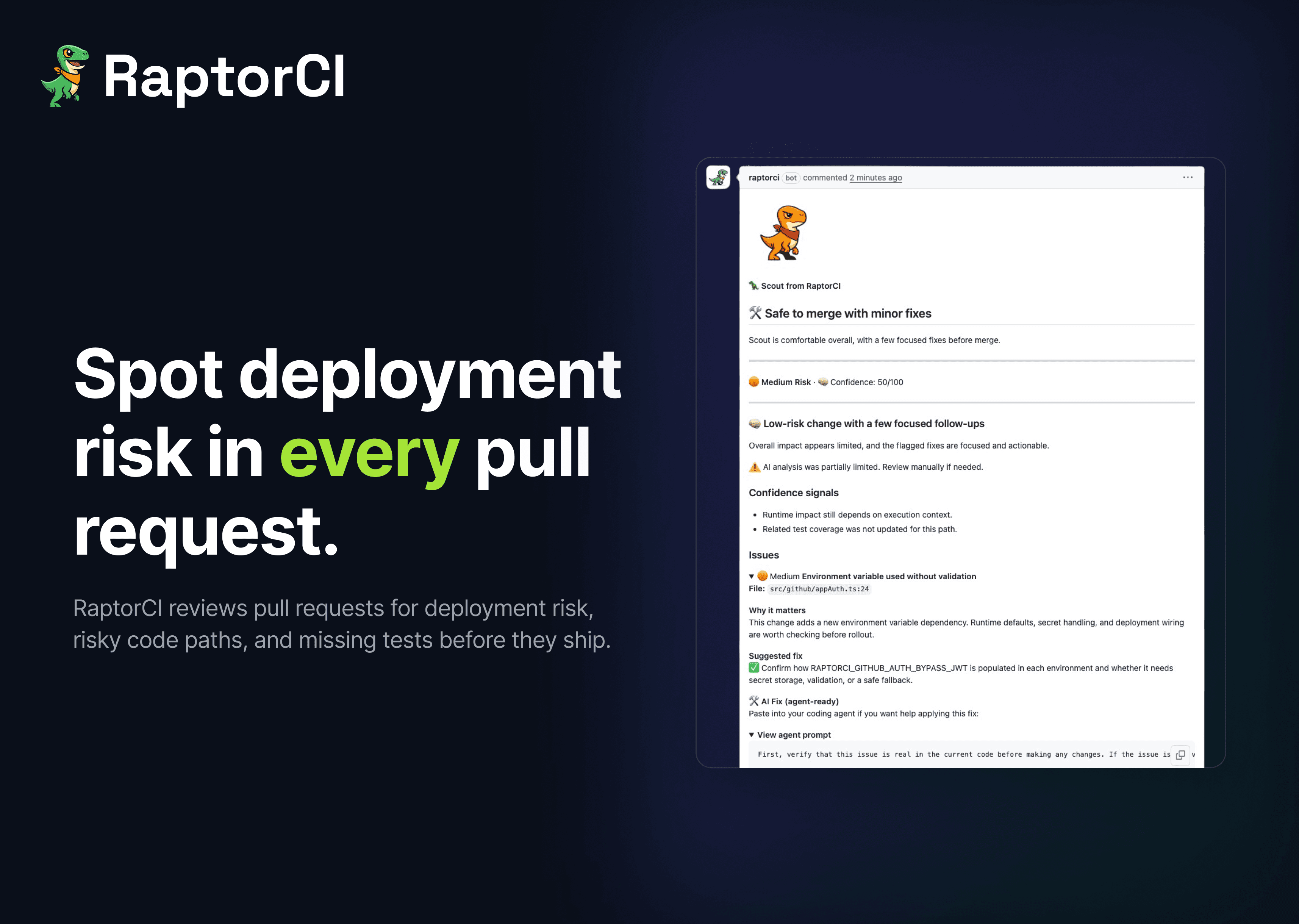
- 🧠 Deployment Confidence Score for every PR
- ⚠️ Detects real risk (auth, permissions, config, env changes)
- 🧪 Flags missing tests on critical code paths
- 🌍 Highlights production-impacting changes
- 🔍 AI finds what humans miss
- 💬 Inline comments with clear fixes
- 📊 Clean summaries, zero noise
- ⚡ Native GitHub integration
- 🔁 Incremental analysis for fast feedback
- 🔒 Built with safety and control in mind
- 🚀 Know if a PR is safe to ship before you merge
- 🔐 Catch security and config risks early
- 🧪 Make sure important changes are properly tested
- 🌍 Avoid production issues from risky changes
- ⚡ Review faster by focusing on what actually matters
- 🤝 Support teams without dedicated reviewers
- 📈 Handle higher PR volume from AI-generated code
- 🧠 Keep review quality consistent across the team
- 🔍 Understand large PRs without digging through everything
- 🛠️ Help new engineers make better changes, faster
6 ratings
I'm a Principal Engineer at one of the leading mobile cyber security companies with over 13 years of experience building and scaling startup products.

AI video with native sound, paid per clip. Nothing stored.

A calmer Mac menu bar, one click away.

Enterprise Software. Intelligent Automation. Global Impact.


Comments
6I'm a Principal Engineer at one of the leading mobile cyber security companies with over 13 years of experience building and scaling startup products.
I built RaptorCI after seeing the same problem over and over again in production systems. Code review tools are great at catching style issues, but they don’t really answer the question that matters most: “Is this safe to ship?” At the same time, code is being written faster than ever (a lot of it AI-assisted), and the amount of scrutiny per change is going down. Important risks get buried in diffs, and teams are left guessing. RaptorCI is my attempt to fix that. It focuses on surfacing real deployment risk in pull request, things like auth changes, config drift, missing tests, and runtime impact all while keeping the output clear and actually useful. I’ve been working closely with early teams and we’ve already processed hundreds of PRs, which has helped shape the direction a lot. Still very early, and I’m actively looking for feedback, especially from teams shipping quickly or dealing with large PR volumes. If you try it, I’d genuinely love to hear what feels useful and what doesn’t.
Builder
Nice product, I like the feature set
2x Founder
The feature set look promising. I have a question, though what happens when the issues are around env values or code execution. If you look at the recent vercel data breach, most deployment risk issues come because a new script is automatically run and that create the security issues
I'm a Principal Engineer at one of the leading mobile cyber security companies with over 13 years of experience building and scaling startup products.
Great question and I agree. A lot of real deployment risk isn’t just “bad code”, it’s the interaction between code, config, env values, scripts, and CI/CD behaviour. RaptorCI already flags some of this class of risk, for example new environment variable usage, runtime config changes, package/script changes, permission changes, and risky deployment-adjacent code paths. The important distinction is that we don’t execute the code or inspect secret values. We look for the change patterns that usually create risk before merge, such as: - a new env var being introduced without obvious validation/default handling - install/build/postinstall scripts changing - deployment/runtime config being modified - new external service credentials or permissions being wired in - auth, webhook, token, or infrastructure-sensitive paths changing So for something like the Vercel incident, the goal would be to catch the “why is this now being automatically executed or trusted?” signal at PR time, not after it has already run in production. It’s also an area we’re actively expanding because I think this is where PR review tools need to go: less generic code comments, more deployment-aware risk detection.
Just a dad trying to make a better world for my kids.
This is a great idea. What's the roadmap for what's to come after the initial launch?
I'm a Principal Engineer at one of the leading mobile cyber security companies with over 13 years of experience building and scaling startup products.
Hey, thank you! We're in the process of hardening our detections and improving accuracy. Once we have the foundations in place we plan on building plugins for IDEs to bring these detections one step closer to engineers. We are also planning on to help small and medium teams have confidence in the CI/CD further down the line by making monitoring and rollback easy.