

Free AI-search readiness checks for any public page
4.8(6)32MarketingTechnology
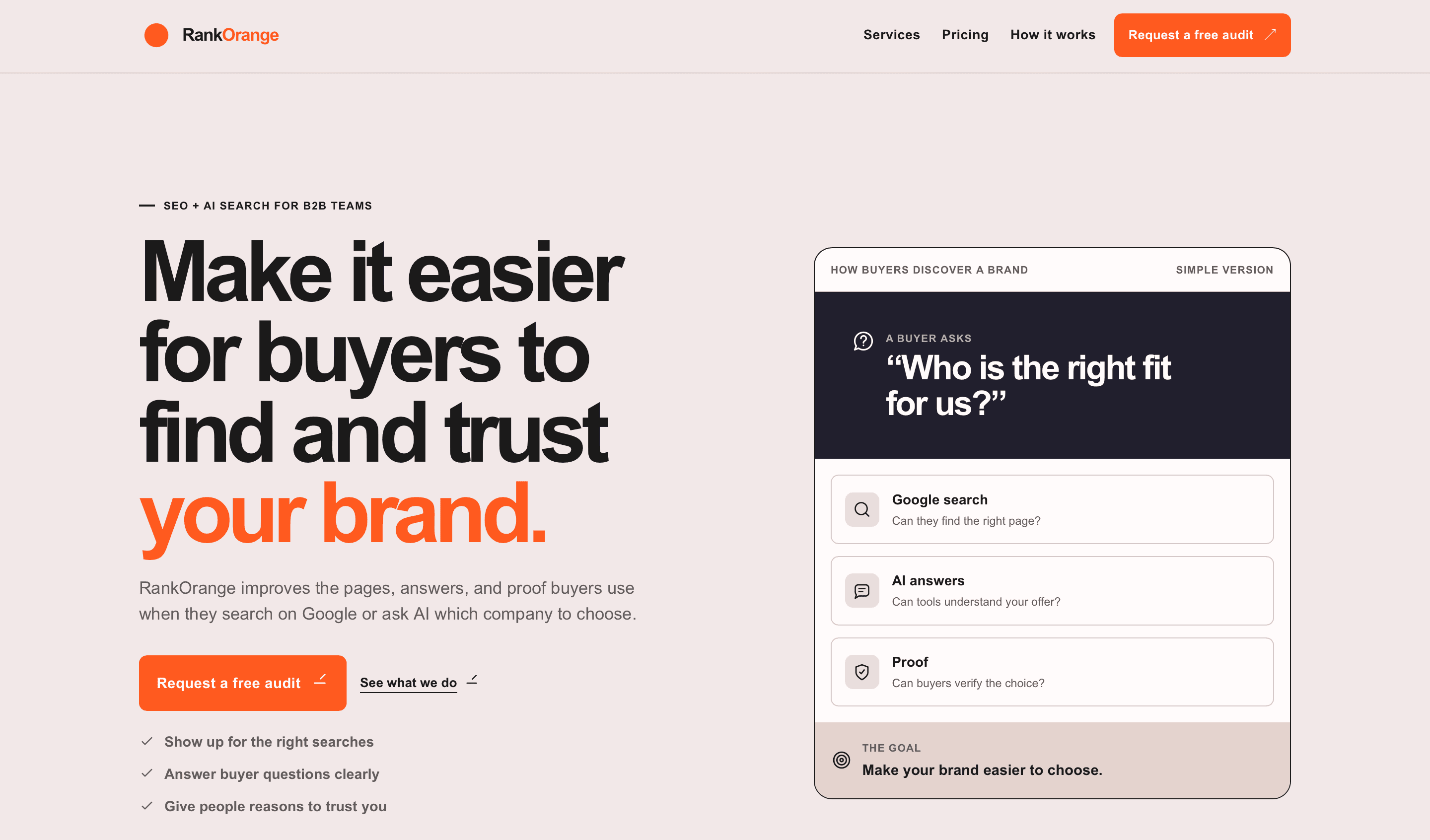
RankOrange gives B2B, SaaS, and expert-led teams a free, no-signup GEO audit for any public web page. It checks crawlability, robots.txt and sitemap access, titles, headings, canonical URLs, structured data, and answer-ready content signals, then returns practical tasks to improve visibility in Google and AI answer engines.
Free public-page audit
No signup or account connection
Crawl, structure, schema, and AI-readiness checks
Clear prioritized recommendations
B2B teams preparing pages for AI search
SaaS marketers auditing product and category pages
Agencies spotting technical and content gaps
6 ratings

Indie Hacker

AI video with native sound, paid per clip. Nothing stored.

A calmer Mac menu bar, one click away.

Enterprise Software. Intelligent Automation. Global Impact.


Comments
32Indie Hacker
RankOrange GEO Audit came from a recurring problem: teams know AI discovery matters but lack a fast way to see whether a page is crawlable and understandable. We built a free public-page audit that turns robots, sitemaps, headings, canonicals, schema, and answer-ready content into clear next steps. We'd love feedback on which audit signals would be most useful for your team.
Clean landing page and the value prop is easy to get in a few seconds. After trying the core flow, the main friction was figuring out pricing limits before signing up. A small comparison table (Free vs Pro features) near the CTA would reduce drop-off. Looking forward to seeing how you handle onboarding for first-time users.
Blogger
That’s a really useful point, especially around making pricing limits clear before signup. A simple Free vs Pro comparison could definitely make the decision easier for new users. Thanks for sharing the feedback!
The audit checklist is refreshingly concrete—checking robots.txt, canonicals, and structured data in one pass gives teams a useful starting point. Do you plan to add change tracking so users can compare audits over time?
Discover and compare the best AI presentation tools, slide generators, PowerPoint tools, and presentation software.
Interesting tool for tracking how a brand appears across AI search results. The GEO audit approach looks especially useful for understanding where there are opportunities to improve visibility and discoverability
No-signup is the right call for a first audit - most GEO/SEO tools gate the report behind an email and that kills trial volume. Checking robots.txt/sitemap access alongside structured data and answer-ready content signals in one pass covers both the crawl layer and the content layer, which most tools split into separate products. Like Lenya asked, historical tracking would be the natural next step so teams can see if their fixes actually moved the needle instead of re-running one-off checks.
I like that this looks at both crawlability and whether the content is actually easy for answer engines to understand. One thing I’d find really useful is separating the recommendations into “SEO fundamentals”, “AI/GEO-specific”, and “affects both”. A lot of GEO audits mix things like canonicals, schema, and content structure together, so it’s hard to tell what’s genuinely different from a normal SEO audit. That distinction would make the report much more useful when deciding what to fix first.
I like that this looks at both crawlability and whether the content is actually easy for answer engines to understand. One thing I’d find really useful is separating the recommendations into “SEO fundamentals”, “AI/GEO-specific”, and “affects both”. A lot of GEO audits mix things like canonicals, schema, and content structure together, so it’s hard to tell what’s genuinely different from a normal SEO audit. That distinction would make the report much more useful when deciding what to fix first.
I like that this looks at both crawlability and whether the content is actually easy for answer engines to understand. One thing I’d find really useful is separating the recommendations into “SEO fundamentals”, “AI/GEO-specific”, and “affects both”. A lot of GEO audits mix things like canonicals, schema, and content structure together, so it’s hard to tell what’s genuinely different from a normal SEO audit. That distinction would make the report much more useful when deciding what to fix first.
Ran it on a couple of our content pages. Useful that it flags canonical and structured data in one pass, that is exactly where our AI-citation hits and misses came from: pages with clean FAQ JSON-LD that matched the visible text got quoted by answer engines, pages where the schema drifted from the copy did not. Two things I would add to the checklist: whether llms.txt exists and points at the right hubs, and whether hreflang alternates resolve, since on a multilingual site half the "missing" signals were just the wrong language version being crawled.
A lot of these signals (canonical, schema, sitemap) are classic technical SEO. What in the report is specifically GEO — something a regular SEO auditor wouldn't give you — and what's it based on: public statements from search/answer engines, or your own answer-extraction testing?
Hi, I'm a 18 year old living in the Netherlands.
No signup or account connection is refreshing
Reddy Anna offers quick account access, sports updates, and a smooth user experience at https://reddyannapro.in/
Options trading platform
Looks like a really interesting product.
The no-signup audit is a nice touch. I like that it checks both the traditional technical SEO basics and the signals that can affect how a page is understood by AI search engines. Having the results turned into prioritized tasks makes the audit much more actionable than just showing a list of technical issues.
Founder @wahio.design @indiecrafts.dev | AI Builder, Design Engineer, AI Orchestration
Pretty cool ! I really liked how you tacle this issue !
Ghibli Style Image Generator—Create Stunning Ghibli Style Images
Thank you for sharing! The audit checklist is refreshingly concrete—checking robots.txt, canonicals, and structured data in one pass gives teams a useful starting point.
I am a trader and blogger who loves to share the knowledge I have with people.
very good product Like Lenya asked, historical tracking would be the natural next step so teams can see if their fixes actually moved the needle instead of re-running one-off checks.
Ran my site through this and got what looks like a false negative: "A readable sitemap was not found" for a sitemap that is there and valid. https://esimlane.com/sitemap.xml returns 200 with Content-Type application/xml, parses clean under a strict XML parser, 875 <loc> entries, no unescaped ampersands. Nothing wrong with it as far as I can tell. I think the problem is size. It is about 604 KB uncompressed because each URL carries six hreflang alternates, so 875 URLs turns into 5,250 xhtml:link nodes. I cut that response at 32/64/100/128/256/512/600 KB and every truncated version fails to parse. It only parses from about 700 KB up. If the fetch reads a capped number of bytes, the document is never complete, so the check fails regardless of the sitemap. That will hit multilingual sites hardest, since the alternates multiply file size. The same URL count with hreflang runs about 6x bigger than a single-language sitemap. Reading to the end should fix it. Failing that, checking for the urlset root and closing tag before reporting would turn a truncated read into an error instead of "missing". The sitemap is not missing, and that is the one thing the check cannot actually see. Can send the raw response and the byte thresholds if you want them.
EasyPDFNex PDF Tools
A no-signup GEO audit is a useful idea. The prioritized recommendations could make finding AI-search gaps much faster.
I am a SaaS programmer
This is a useful way to turn technical SEO checks into an actionable checklist. I like that the audit covers crawlability, robots.txt, sitemap access, and structured data in one pass; the answer-ready content signals seem especially relevant as search interfaces evolve.