
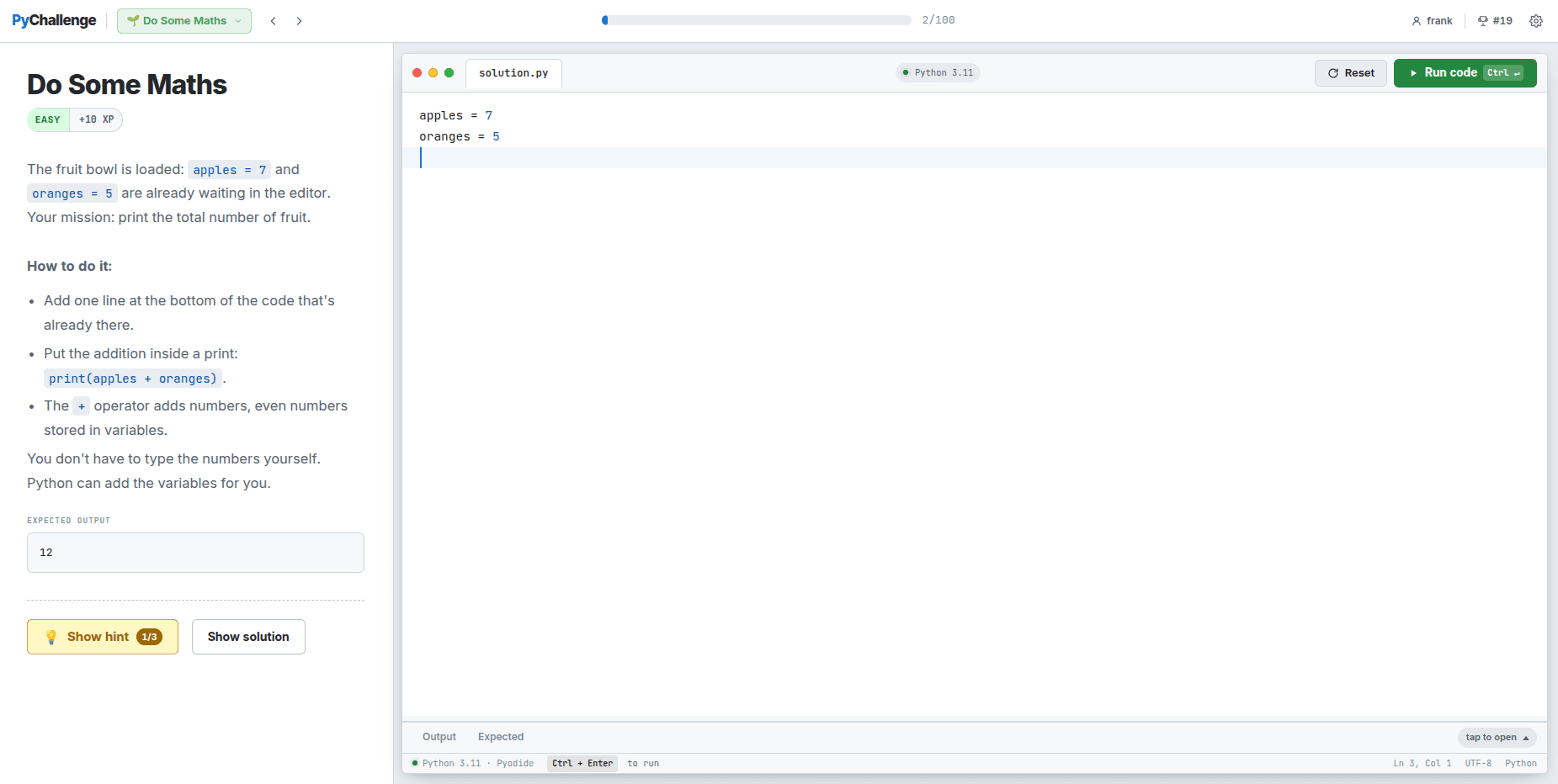
You should know Python. AI can give you code, but it doesn't make you a programmer. Practice online with hundreds of exercises
63 people supporting this launch
4.8
6 ratings


AI video with native sound, paid per clip. Nothing stored.

A calmer Mac menu bar, one click away.

Enterprise Software. Intelligent Automation. Global Impact.


Comments
16Creator monetization platform helping creators build and grow multiple income streams.
This is a great way to learn Python through practice rather than just watching tutorials. Learning by solving challenges makes it much easier to understand the concepts and build confidence with real coding problems.
Frontend developer & indie hacker. Building useful web tools & sharing dev insights.
Python is really amazing. The Python version on my computer now is still 3.12, which is the most stable version I've ever used.
great tool that can help people learn in a more engaging way
great tool that can help people learn in a more engaging way
great tool that can help people learn in a more engaging way
Agree with the pitch: reading AI-generated code isn't the same as being able to write it. Are exercises checked against hidden test cases or just by comparing output? And do the hints reveal the solution step by step, so you can take a nudge without seeing the full answer? For beginners, that's usually what decides whether the practice sticks.
Clear learning-by-doing framing. The free tier boundary is obvious from the page — curious which lesson converts the most hesitant beginners into paid users.
For ordinary programmers, this is a good choice
Founder Contents Pilot
Learning by solving hundreds of exercises is a strong complement to AI-generated code, especially for building debugging instincts. The gradual practice format looks approachable for side projects; are the exercises grouped by concept so learners can revisit weak areas?
Your positioning against AI autocomplete is refreshingly honest - AI can hand you code, but pattern recognition only comes from writing and fixing it yourself. One thing matters more than the exercise count though: the difficulty curve. What makes learners quit tutorial platforms is rarely volume, it is the jump between levels being too steep. How do your hints work - a graded reveal (nudge, then pattern, then full solution) or a single spoiler? That one design choice decides whether people build debugging instincts or just end up reading answers.
Founder @ Lucen and Product & Data Analyst
I think this is an old fashioned learning method. At least not prompting the AI to do the job for you. Very important these days. Will check it out in depth.
Looks like a great way to practice Python through hands-on exercises. Simple concept and really useful for learning!
Building Shopify apps at XCO Agency
The learn-by-doing format looks effective for building momentum; the immediate practice loop should make Python fundamentals stick. Curious how you adapt exercise difficulty as learners progress.
Bio
Why people not use AI like chatgpt and claude to learning python?
The doing part is where every learn-to-code app lives or dies. Making people write the code instead of watching it is the right call. Does progression unlock by mastery or by lessons completed?
"AI can give you code, but it doesn't make you a programmer" is a great hook. As someone who learns a lot from long YouTube tutorial series, the hardest part for me is keeping track of where I left off and what I've actually finished — does PyChallenge show progress across topics, and does it bring back exercises you failed earlier so they come up again later?