

Weekly AI research reports from primary sources
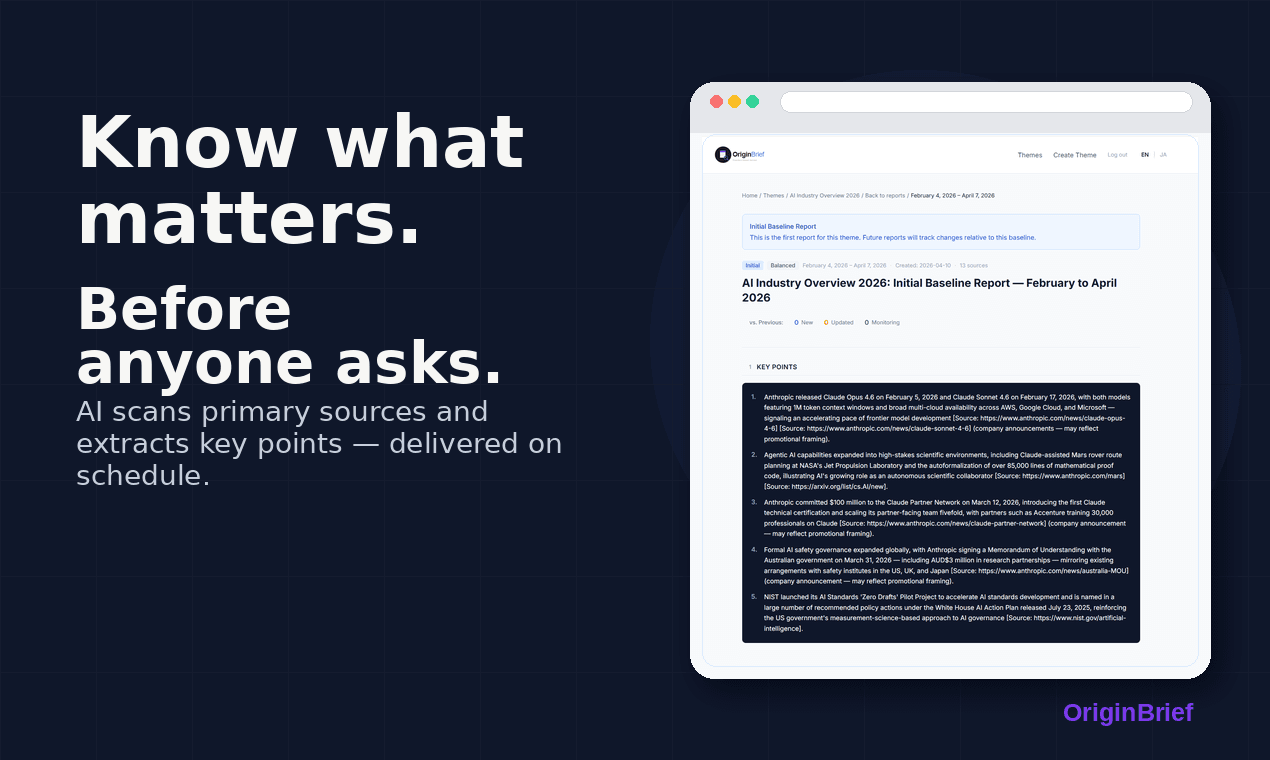
OriginBrief monitors your chosen topics around the clock and automatically generates AI-powered research reports from primary sources. Register themes, select sources, and get weekly reports delivered — no manual research needed.
4.8
6 ratings

AI video with native sound, paid per clip. Nothing stored.

A calmer Mac menu bar, one click away.

Enterprise Software. Intelligent Automation. Global Impact.


Comments
9I built OriginBrief because manual research was eating my time as a solo founder. You register themes, pick your sources, and AI generates research reports automatically — weekly and monthly. Been building in public since launch and learning a ton. Happy to answer any questions!
The workflow looks straightforward and easy to follow. A short interactive demo or screenshot sequence could help first-time users understand the result before signing up or clicking through.
Thanks for the feedback! I actually built /sample for exactly that — a full real weekly report visible without sign-up so you can see the actual output before committing. Direct link: https://www.originbrief.app/sample. Taking notes on the interactive demo angle too — that's a good gap to close.
Web DEV | Web Designer | AI expert
the research speed is superb! It is the tool what i always needed
Thanks, Anshul! Glad the research speed resonates — speed without losing the source trail was the design goal.
wonderful resource and insights as well from extracting each research papers will helps me a lot
Thank you, Priyanka! For research-paper-heavy themes, OriginBrief lets you point the monitor at any source URL (arXiv, journal RSS, lab pages, etc), and each weekly report cites every claim back to the specific paper. Hope it saves you some hours.
The "primary sources only" angle is what stands out to me — most AI research tools just summarize whatever's ranking on Google, so anchoring reports to primary sources is a real differentiator for credibility. The set-themes-and-get-weekly-delivery model also fits how busy people actually want to consume research (push, not pull). Genuine question: how do you handle source verification and avoid the AI subtly misrepresenting a primary source? For anything in Business & Finance especially, one hallucinated stat can undermine trust in the whole report. Curious whether there's a citation/traceability layer back to the original source.
Really good question — this is exactly what I worry about most as the builder. Three layers of defense are in place: (1) Source-anchored output by design: Every claim, stat, and trend in a report carries an inline [n] citation that maps back to a specific source in the "Sources" section at the bottom. The AI is constrained to only cite from the URLs you registered — it cannot invent or fetch external ones. If a claim isn't traceable to a registered source, it doesn't get written. (2) Structured tool-use output: The pipeline switched this week to Anthropic's strict tool-use mode (schema-constrained sampling). Instead of asking the model to "write JSON", the model fills a typed schema where shape and required fields are guaranteed. This eliminates a whole class of subtle misrepresentation — the kind where a free-form sentence quietly drifts from what the source actually said. (3) Post-validation layer: A Zod schema validates every section, plus a duplicate / language / source-whitelist check runs before save. Anything that fails gets a retry through a separate realtime call, and if that still fails, the section degrades to empty rather than letting fabricated content through. Not perfect — no LLM pipeline is — but the goal was specifically the Business & Finance failure mode you described: one hallucinated stat poisoning a whole brief. If you want to see this on a specific theme, the 7-day trial is the fastest way — set your own sources, get a real report, and judge the citations for yourself.