

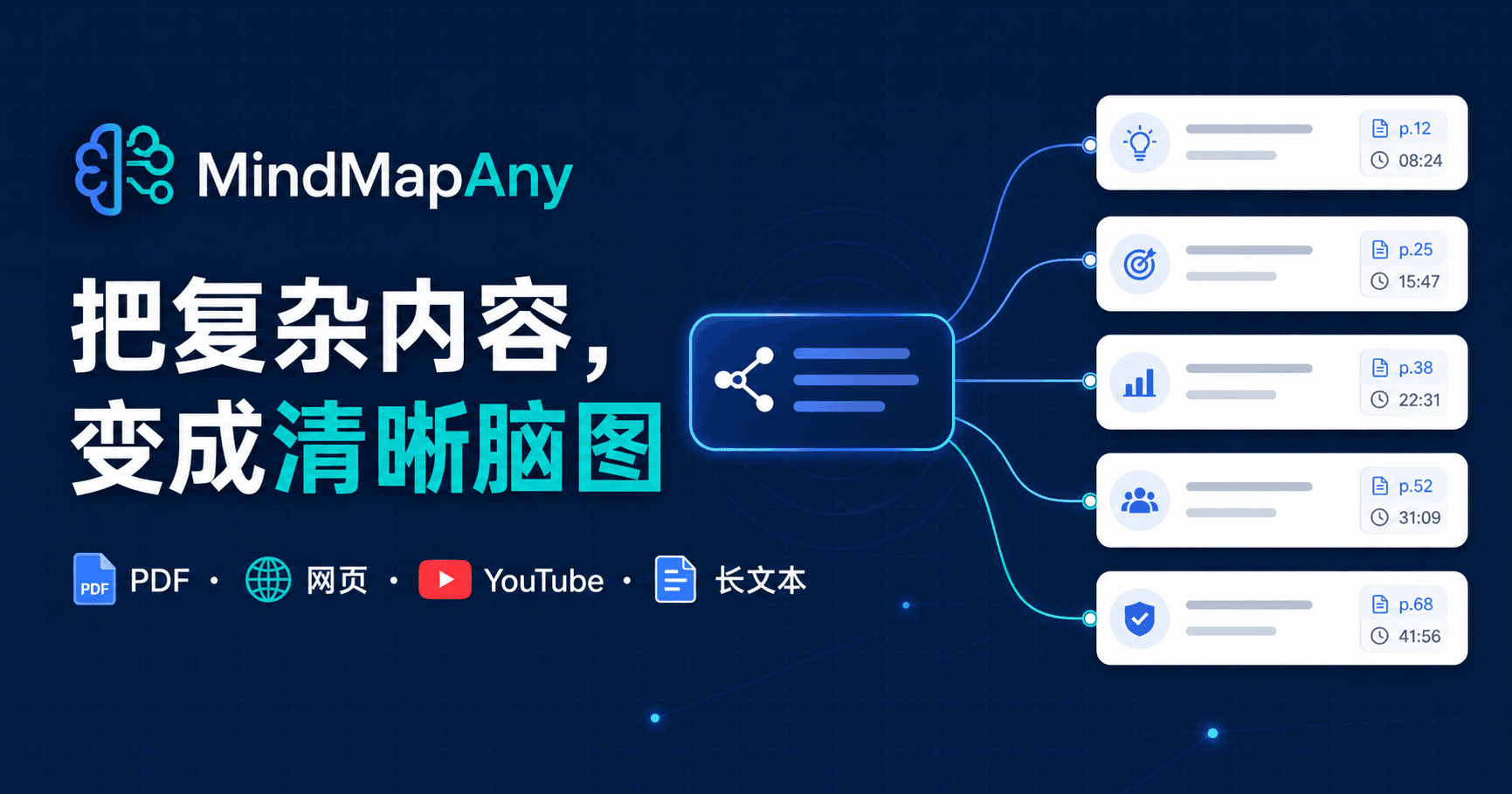
MindMapAny turns long text, PDFs, Word documents, EPUB books, PowerPoint decks, and web pages into clear, editable mind maps. It preserves a real hierarchy instead of returning a flat summary, and source-derived nodes can retain page, slide, chapter, or section anchors for verification.
Users can edit the result in the browser and export it as PNG, SVG, or Markdown. It supports 30+ output languages and offers a free plan.
4.8
6 ratings

AI video with native sound, paid per clip. Nothing stored.

A calmer Mac menu bar, one click away.

Enterprise Software. Intelligent Automation. Global Impact.


Comments
14I built MindMapAny because long PDFs, reports, and web articles are hard to understand as flat summaries. The goal is to reveal structure while keeping each node traceable to its source, then let users edit and export the map.
Founder of Savyly
The source anchors are the best part. AI summaries are hard to trust when you can't jump back to the page. For study notes, could the Markdown export keep those page and slide references as links or footnotes? Then the map could live in Obsidian or Notion and still point back to the PDF.
Love the focus on traceability! Having every node link back to a page or slide number makes this far more trustworthy than a typical AI summary. Editable maps with PNG/SVG/Markdown export are a big plus. Congrats on the launch! 🧠
Two questions about edge cases. First, scanned PDFs without a text layer: do nodes still get page numbers after OCR, or do the anchors only work for born-digital files? Second, the 110-node cap. For something like a 300-page book, does the map automatically stay at chapter level so you can expand one chapter into its own map, or should users split the file before uploading? Knowing which way it goes would help people decide whether to feed it a whole ebook or one chapter at a time.
Node anchors back to page, slide, or chapter is what makes this more than a summary toy. A mind map you cannot trace is just a pretty compression of someone else reading, and you cannot check it. Traceable nodes plus editable export is the combination that makes it usable for real research.
Building PZERO, saving you money - pzero.studio
Anchoring each node back to its page, slide or chapter makes the maps far easier to trust than a flat summary. When the model usage behind all those document conversions starts showing up on the invoice, PZERO at pzero.studio can help trim it.
We work with a lot of Urdu documents in Pakistan. Does MindMapAny handle right-to-left text, both when reading an Urdu PDF and when laying out the map labels? If so, I'd try it on long Urdu reports right away.
Keeping the page or section on each node is the right call. Flat AI summaries are hard to trust because you can't check where a point came from. I tried it in my head on a long research PDF, and the anchors are what would make me use it over a summary tool. Does the hierarchy follow the document's own headings, or does it build its own structure when headings are missing or messy (like a scanned PDF)?
I am Jim, creator of NutriDataX — Nutrition Data & Analytics Platform
When a mind map is created from a web page, can users follow each point back to its original source?
A structured mirror for your life path.
Keeping page and chapter anchors on each node is the part I like most. For EPUB study notes, a flat summary never lets me check where a point actually came from.
The source anchors are what would make me trust this for exam review. The first thing I'd try as a student is a whole course's lecture slides before an exam: does each PPTX become its own map, or can several decks merge into one hierarchy for the course? Also curious whether Hebrew documents work, since a lot of course material in Israel is in Hebrew.
Geekonomy partners with founders and leadership teams to build brands, digital systems and marketing that are designed to last, not just launch.
MindMapAny looks like a useful tool for turning lengthy documents and web pages into clear, structured mind maps. I especially like the source references and editable format, which make it easier to verify information and organize ideas. Great tool for students, researchers, and professionals!
Exploring AI, SaaS, and digital products
The idea of turning complex documents into structured mind maps is useful. I like the focus on keeping source references and making the output easier to verify. It could be helpful for researchers and knowledge workers.
Musician building MIDI Lab and SongTools, tools for producers and songwriters
Keeping the source anchors on each node is the smart part. Most summarizers give you a neat outline you can't trust because you can't check where it came from. I'd use this for long gear manuals and DAW docs, which are a pain to skim. Does the Markdown export keep the page references, or only the tree?