
Intent-native runtime for governed AI agent workflows
MachinaOS is a local-first orchestration layer that converts natural language goals into validated plans, policy checks, and real tool execution on your machine. MachinaOS sits above your existing OS and acts like an intent-native shell: planner, policy engine, and executor working together. It can be deployed on vps too.
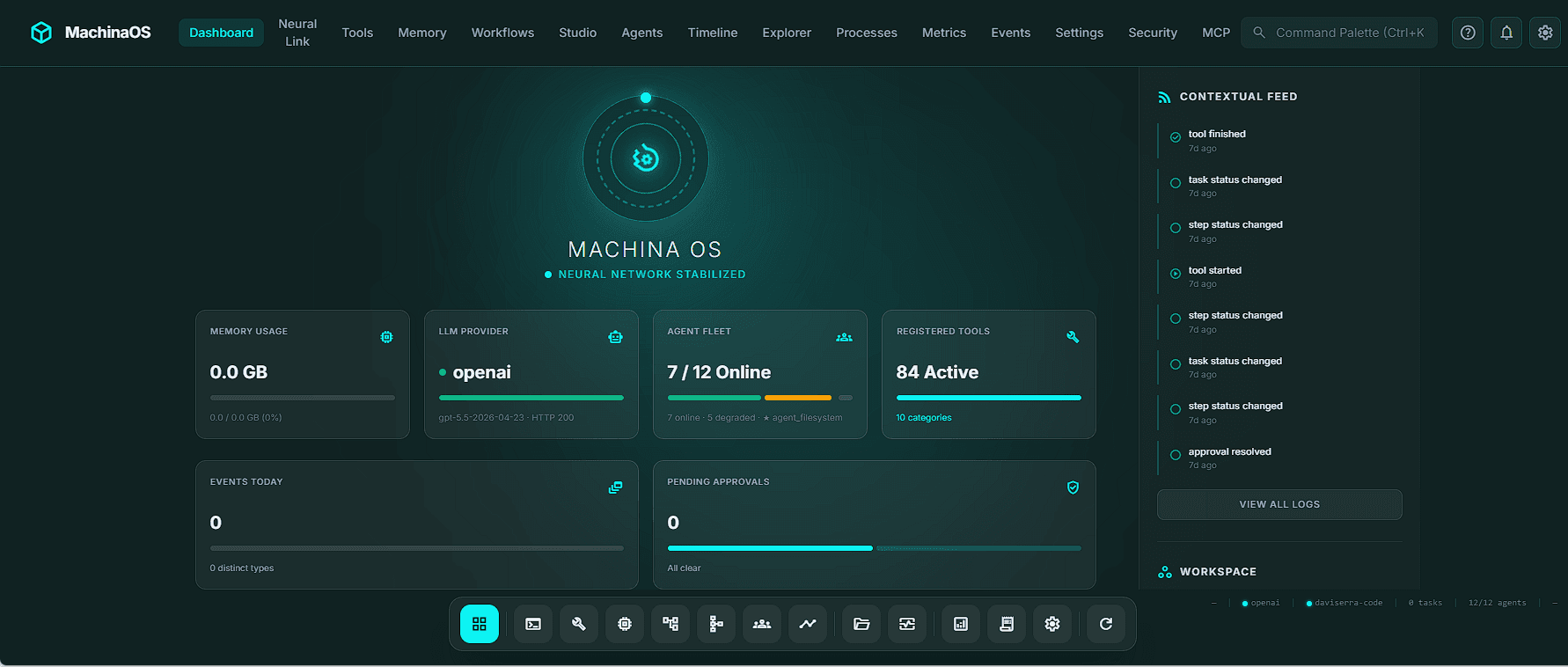
It exists in 2 forms: -
MachinaOS provides a local-first orchestration layer that converts natural language goals into validated, policy-checked plans across web and desktop environments. It utilizes a three-stage runtime to manage intent-driven execution with built-in security auditing and tool integration:
Ideal for: AI Engineers and IT Leaders who require a secure, local-first runtime for deploying governed multi-agent workflows with explicit tool boundaries.
6 ratings
Being an AI Enthusiast, I started studying how LLMs works, reading many books and practicing via google Colab, Hugging Face and Kaggle, developing many AI related Apps, using VS Code .

AI video with native sound, paid per clip. Nothing stored.

A calmer Mac menu bar, one click away.

Enterprise Software. Intelligent Automation. Global Impact.


Comments
8Being an AI Enthusiast, I started studying how LLMs works, reading many books and practicing via google Colab, Hugging Face and Kaggle, developing many AI related Apps, using VS Code .
I started with the idea of building a primitive Agentic-based OS, then while designing it, I start thinking of MachinaOS as what it is now: a local-first AI Agentic operating layer for developers.
Founder & CEO at SoviaJobs — AI job search automation
The "intent-native shell" framing is really interesting — treating natural language goals as first-class OS primitives rather than wrappers around CLI commands is a meaningful architectural shift. The policy-check layer before execution is exactly what enterprises need to trust autonomous agents. Curious how you handle conflicting policies when an agent goal spans multiple governed systems. Congrats on the launch!
Being an AI Enthusiast, I started studying how LLMs works, reading many books and practicing via google Colab, Hugging Face and Kaggle, developing many AI related Apps, using VS Code .
Sorry for the delayed answer and thanks for the interesting observations. here my answer: conflicts aren't resolved by merging differing systems' policies. They're avoided by routing every system through one engine with a documented, "strictest-wins" precedence order (now I'm enhancing it), while agent (not policy) conflicts over tool ownership are negotiated by capability score or a human tiebreaker.
Really interesting direction for governed agent workflows. The parts I would want to inspect first as a security/GRC user are the approval trail, tool permission boundaries, and whether audit logs can be exported for customer security reviews. Do you plan to publish sample evidence or a security questionnaire pack for teams evaluating MachinaOS?
Being an AI Enthusiast, I started studying how LLMs works, reading many books and practicing via google Colab, Hugging Face and Kaggle, developing many AI related Apps, using VS Code .
This is an astounding observation. I indeed thought already about a documentation dedicated to the security aspects and audit logs exp. I'll come back to you. Thanks
Being an AI Enthusiast, I started studying how LLMs works, reading many books and practicing via google Colab, Hugging Face and Kaggle, developing many AI related Apps, using VS Code .
--- **MachinaOS Security — Where We Stand** **What's already working** - **Approval gates** — Any high-risk tool needs a formal approval before it runs. Each request is tracked with an ID, linked to the task that triggered it, and every status change gets logged. - **Layered permissions** — Three checkpoints: what a component is allowed to do (11 scopes), how risky the action is (critical gets blocked, high needs approval, the rest flows through), and a strict allowlist for demo mode. - **Audit log** — Tamper-resistant, append-only database. Every entry is hash-chained so you can prove nothing was altered. You can search it, export it, and verify its integrity through the API. - **Secrets handling** — Encrypted with AES-256-GCM, key stretching at 600k iterations, unique nonce per secret. Standard stuff, done right. - **Credential scrubbing** — 21 patterns catch things like API keys, tokens, private keys, and connection strings before they ever hit a log or a response. - **Vulnerability scanning** — Static. Btw Questionnaire s in place already- thanks for the interest
Being an AI Enthusiast, I started studying how LLMs works, reading many books and practicing via google Colab, Hugging Face and Kaggle, developing many AI related Apps, using VS Code .
Update of online Demo and Storyboard In a short wjhile the online demo will host the many fixes and enhancements, I added. -Lot of enhancements in Studio to improve the usabiity. -Chain Scheduler added. -Live Agent Activity panel added. - New mobile layout added - Notebook view Added - Export Import Tool for Chains added Demo related: -Session time updated: 5–8 min self-guided / 15 min walk-through. -"What the visitor lands on" now describes the theme button and Ctrl+? hint. -New section 4e-bis (Studio canvas power tools): table showing snap-grid/undo/minimap/layout buttons and multi-select. -New Act 6 — "Power user features" (~3 min): 7 sub-sections — notification centre, keyboard overlay, enhanced .command palette, Notebook view, Chain Scheduler, Split Panel, API Browser.
Being an AI Enthusiast, I started studying how LLMs works, reading many books and practicing via google Colab, Hugging Face and Kaggle, developing many AI related Apps, using VS Code .
Below is the MachinaOS video presentation: https://lnkd.in/dxSdHn6m