

Scan 11 app ecosystems to find your next micro SaaS idea
## What is GapQuery?
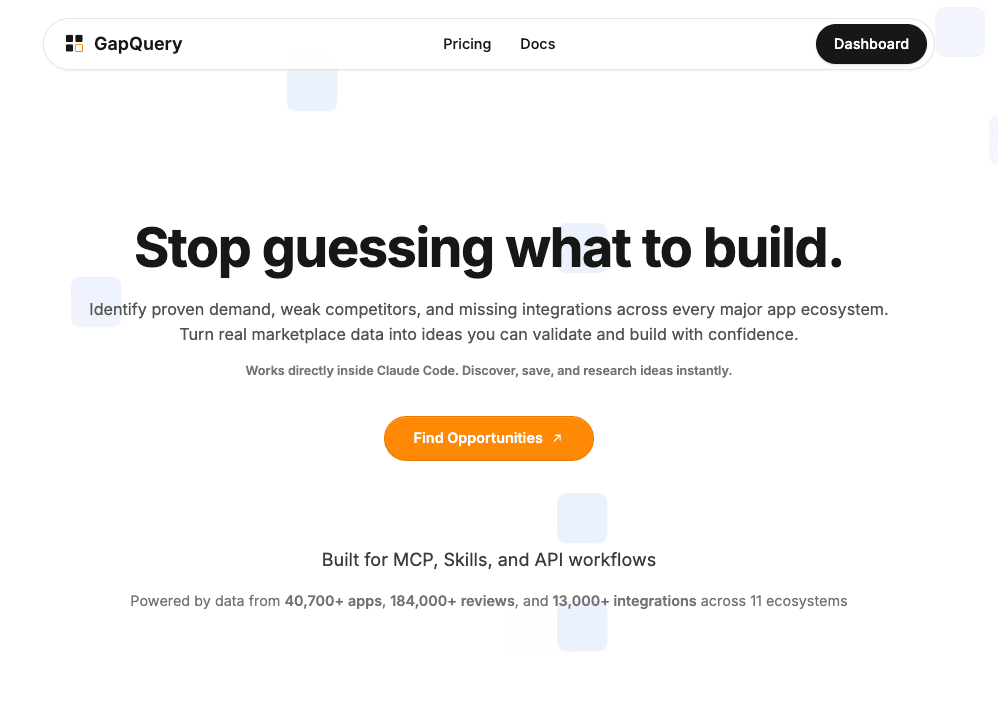
GapQuery is an app ecosystem intelligence platform that scans 11 major ecosystems covering 35,600+ apps. It surfaces market gaps, pricing opportunities, and missing integrations so developers and micro SaaS founders can find validated ideas before writing code.
## How it works
Connect GapQuery to Claude Code via MCP and use 17 AI-powered analysis tools directly from your terminal. Ask questions in plain English and get structured results backed by real marketplace data.
### Core capabilities
- Category gap detection across ecosystems
- Disruption target identification (high installs, low ratings)
- Price gap and keyword saturation analysis
- Integration mapping and developer whitespace detection
- Cross-ecosystem pattern recognition
## Research pipeline
Save opportunities to your pipeline and run deep research across six areas: market validation, competition, revenue potential, technical feasibility, keywords, and go-to-market strategy. Each opportunity gets a build, skip, or maybe verdict.
## Pricing
One-time purchase starting at $99 for 5 ecosystems or $199 for all 11. Monthly subscription available at $49/mo, converting to lifetime after 4 payments. All plans include weekly data refreshes and full API access.
- 11 app ecosystems covered (Shopify, WordPress, QuickBooks, Atlassian, Xero, Slack, Monday, GitHub, Freshworks, Zendesk, Zoho)
- 35,600+ apps analyzed with ratings, pricing, and integration data
- 17 AI-powered analysis tools via Claude Code MCP integration
- Category gap detection across ecosystems
- Disruption target identification (high installs, low ratings)
- Price gap analysis by category
- Developer whitespace detection
- Cross-ecosystem pattern recognition
- Missing integration detection
- 6-area deep research: market, competition, revenue, technical, keywords, GTM
- Build, skip, or maybe verdicts on every opportunity
- Opportunity pipeline with research persistence
- REST API with 25 endpoints
- Weekly data refreshes
- One-time purchase pricing (no recurring fees on lifetime plans)
- Validate micro SaaS ideas before writing code
- Find underserved categories in app marketplaces
- Identify overpriced apps ripe for disruption
- Discover missing integrations between popular tools
- Research competition before launching a new product
- Spot emerging trends across different ecosystems
- Find active developers not yet building for your target platform
- Analyze keyword saturation for marketplace SEO
- Build a pipeline of validated SaaS opportunities
- Compare revenue potential across different ecosystems
- Generate go-to-market strategies backed by real data
- Discover cross-ecosystem patterns and migration signals
4.8
6 ratings

Northify is a dynamic software company committed to creating user-friendly Software as a Service (SaaS) products.

AI video with native sound, paid per clip. Nothing stored.

A calmer Mac menu bar, one click away.

Enterprise Software. Intelligent Automation. Global Impact.


Comments
7Northify is a dynamic software company committed to creating user-friendly Software as a Service (SaaS) products.
Hi! Solo maker here 👋 GapQuery started as my personal tool. I was building micro SaaS apps and kept manually searching app stores to figure out what was missing. Instead of doing that every time, I built a database of 35,600+ apps across 11 ecosystems and wired it up to Claude Code via MCP. Now I can ask "find apps with lots of users but terrible reviews in Zendesk" and get a ranked list of disruption targets in seconds. The research pipeline saves opportunities and runs 6-area deep dives on demand. It's a one-time purchase from $99, no recurring fees. Would love your feedback or what features would make this more useful for you?
Building products fast and imperfectly
the 11-ecosystem scan is what makes this useful. most idea tools just rephrase trends from one source, but the gap between, say, Chrome Web Store and the iOS App Store on the same problem is where the actual underserved markets are. one suggestion: a 'ranked by review velocity' filter would surface micro saas opportunities faster than listing gaps alone, because review counts catch products getting traction even before they show up in keyword tools. solid build
Northify is a dynamic software company committed to creating user-friendly Software as a Service (SaaS) products.
That's a sharp observation. Review velocity is exactly the signal that catches traction before keyword tools do, and the cross-ecosystem version (Chrome Web Store gap that Shopify already solved, etc.) is where the most non-obvious opportunities hide. We capture daily snapshots of app and category metrics, so the underlying data is there, and one of the cross-ecosystem pattern modes already uses velocity disparity under the hood. But you're right that there's no clean "ranked by review velocity" top-level filter yet. That's a good way to expose what's already in the data. Putting it on the build list.
Most idea databases stop at "this gap exists." The harder question is "is this a gap because nobody's done it, or because nobody wants it." Disruption targets (high installs, low ratings) are the strongest signal in your set since they prove demand already. The pure category-gap detection is where false positives hide. Curious if the build/skip/maybe verdict weighs proven-pain signals heavier than novelty?
Northify is a dynamic software company committed to creating user-friendly Software as a Service (SaaS) products.
You're correctly intuiting how it works. The build/skip/maybe verdict comes out of a 6-area research pass (market validation, competition, revenue, technical feasibility, keywords, GTM) and the prompt does weight "demand evidence" (review counts, install proxies, complaints in existing reviews) over "this category looks empty." Disruption targets are the strongest input because reviewers are already paying for something broken. Pure category-gap detection is the weakest input precisely because false positives hide there: empty categories are often empty for a reason. Surfacing that distinction more clearly in the verdict output is on the list.
Nice niche. Showing 2 or 3 example opportunities on the landing page would build trust fast and help people understand the output quality.
Northify is a dynamic software company committed to creating user-friendly Software as a Service (SaaS) products.
Agreed. We have a public ideas page at /ideas that browses the actual database (no signup), but the landing page itself doesn't pull a sample onto it or link to it prominently enough. Adding 2 or 3 example cards above the fold would do more work than the static feature list does today. Doing this week.