

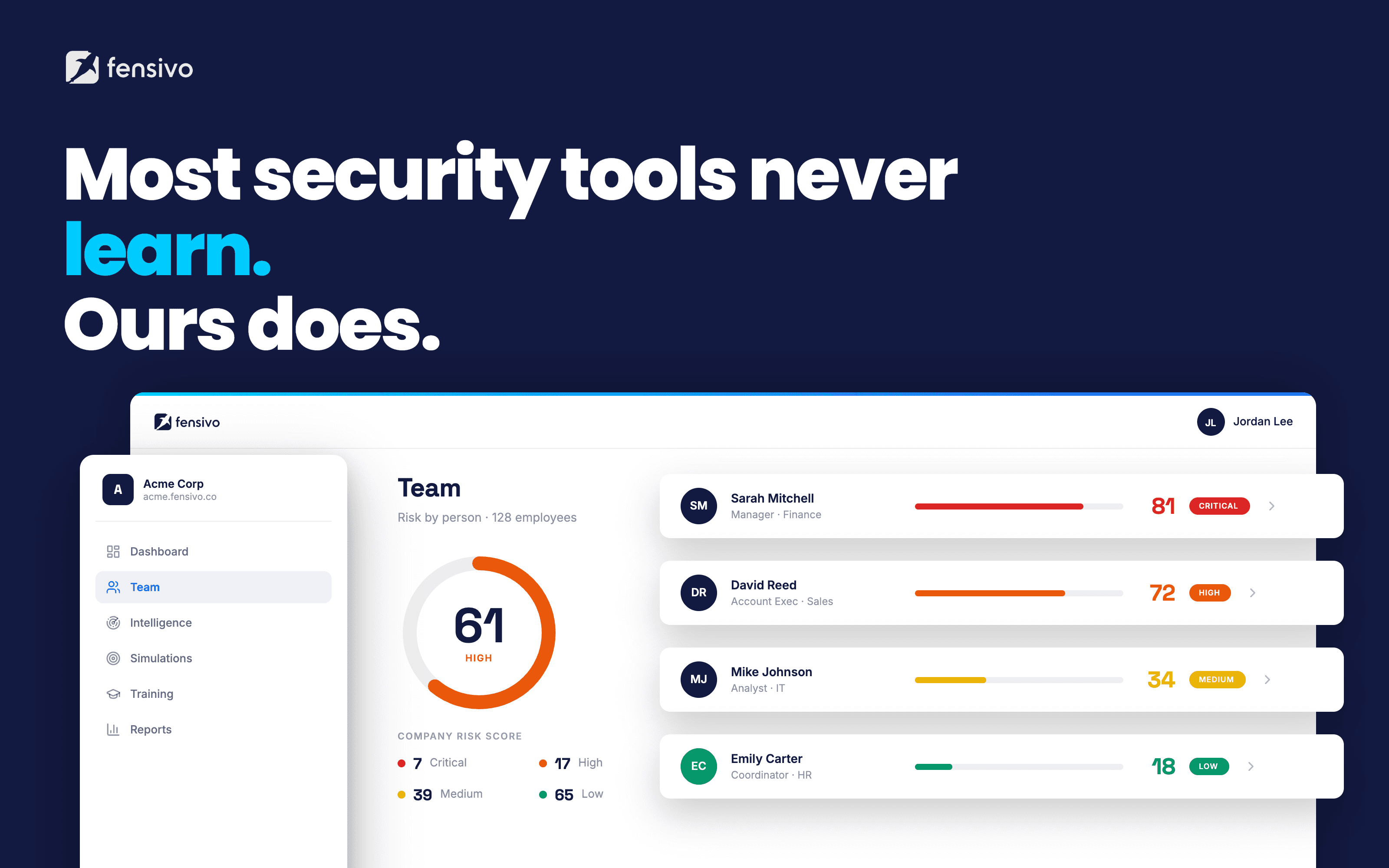
Fensivo is a human risk management platform for companies with 25 to 500 employees. It monitors leaked credentials 24/7, sends phishing simulations personalized to each employee's role and context, and delivers micro-learning the moment someone fails. Three weeks later it retests with a fresh scenario of the same type, proving the person learned the lesson instead of memorizing one email. It connects via OAuth to Google Workspace or Microsoft 365 in minutes, with the first executive report ready in 48 hours. Built natively in Spanish and English for teams in Latin America.
6 ratings


AI video with native sound, paid per clip. Nothing stored.

A calmer Mac menu bar, one click away.

Enterprise Software. Intelligent Automation. Global Impact.


Comments
8Hey! Jose here, founder of Fensivo. Most security training just checks a box: one campaign a quarter and a course nobody finishes. We built the opposite, a platform that watches for leaked credentials, sends phishing tests made for each person, trains them the second they slip, and retests weeks later to prove they actually learned. Built natively for Latin America, in Spanish and English. Would love your honest feedback!
The 3-week retest with a fresh scenario (rather than the same email) is the detail that stands out — most phishing sim tools just repeat the same test and end up measuring memorization, not actual behavior change. How do you handle false positives from the leaked-credential monitoring — manual review or automated triage?
Coming from bank audit: the hardest part of human-risk programmes was never running the simulations, it was proving to a reviewer that the training loop actually closed — who clicked, who got retrained, who repeated. If your reporting shows that chain end-to-end, lead with it. That's what compliance officers get asked for.
We do have everything that you mentioned! If you want to have a look, we can do a demo session. Your feedback is highly appreciated coming from a highly attacked sector
How do you handle false positives from the leaked-credential monitoring ?
How do you handle false positives from the leaked-credential monitoring ?
how can a human stop phishing
100% of phishing that reaches the user is human factor: they click or they don't? They give credentials or not? They download the files or not?