

See where your story slows, before readers do
Manuscript diagnostics for fiction writers. Scene-by-scene pacing maps, unresolved plot thread tracking, and reader-perspective notes. It diagnoses — it never rewrites. Your manuscript stays private and is never used to train models. In public beta, free tier available. Indie studio, bootstrapped, built for working writers.
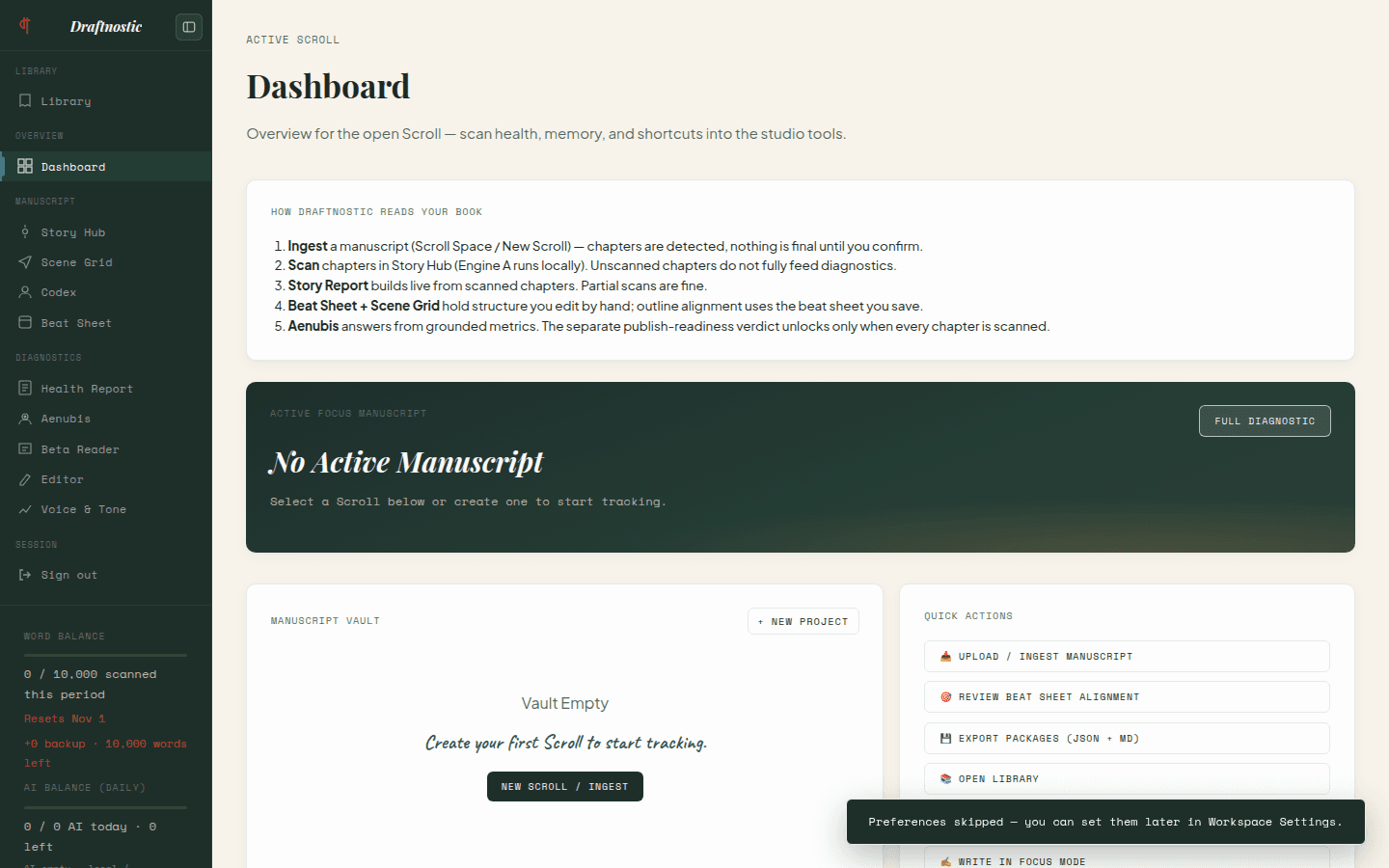
Scene-by-scene pacing maps — see where your story slows before readers do
Unresolved plot thread tracking
Reader-perspective notes — it diagnoses, never rewrites
Story Health Report — live checks plus a publish-readiness verdict
Structure map — plot beats and scene goals against three-act, four-act, or hero's journey
Line-level polish — filter words, filler, and repeated habits flagged in Story Hub
Story memory — Aenubis tracks continuity across your whole manuscript
Revising a finished draft — get a publish-readiness verdict before querying agents or self-publishing
Diagnosing pacing problems — find exactly where the story drags, scene by scene
Auditing plot threads — catch storylines you planted but never paid off
Getting a beta reader's take — "would you keep reading?" without handing your draft to anyone
Line-level cleanup — strip filter words, filler, and repeated habits before final polish
Checking story structure — align your beats against three-act, four-act, or hero's journey
4.8
6 ratings

Wreiton.com

AI video with native sound, paid per clip. Nothing stored.

A calmer Mac menu bar, one click away.

Enterprise Software. Intelligent Automation. Global Impact.


Comments
14Wreiton.com
We started Wreiton because revision is the hardest part of writing a novel — and most tools either rewrite your voice or drown you in grammar nits. Draftnostic is the opposite: it reads your manuscript and tells you where the pacing sags, which threads you left hanging, and whether a reader would keep turning pages. It never rewrites a word. We're in public beta, and I'd genuinely love to hear from working writers — what's useful, what's missing, what would make you trust it with your draft.
The "diagnoses, never rewrites" stance is the right one — most writing tools flatten your voice into generic AI prose. Does the unresolved-thread tracking hold up on long manuscripts, say 100k+ words with multiple POVs?
The scene-by-scene pacing maps and unresolved plot thread tracking sound genuinely useful for revision. I especially like that it diagnoses without rewriting, so the writer keeps control of the voice.
Building PZERO, saving you money - pzero.studio
Scene-by-scene pacing maps and unresolved plot-thread tracking that diagnose a manuscript without rewriting a word keeps the writer's voice intact. If other writing-tool model bills start adding up, check PZERO at pzero.studio.
Oh nice now i wouldnt need to wait for my publisher to give a sloww approval
Founder & Developer at OwnInvoice
Can writers compare pacing before and after edits while preserving the original draft?
Building TermLink, one browser tab for every Claude Code and Codex session. Contract dev in Seoul.
how does the unresolved thread tracking deal with threads left open on purpose, like setup for book two? can you mark one as intentional so it stops flagging it
The sagging middle is where most manuscripts die, so a scene-by-scene pacing map aimed exactly at that feels like the right diagnostic. The Story Health Report is the piece I'd put the most trust in — a publish-readiness verdict only works if it's honest enough to say "not yet." Does it weight pacing problems against line-level polish, or does one red flag in structure tank the whole verdict?
SEO expert
The unresolved plot thread tracking stands out — planted-but-never-paid-off storylines are exactly the kind of thing authors go blind to after living with a manuscript for months. I also like the diagnostic framing ('diagnoses, never rewrites'); tools that try to rewrite tend to flatten the author's voice. Question: does the Story Health Report give one overall publish-readiness verdict, or break it down section by section?
The "diagnose, never rewrite" philosophy is what sets this apart - most AI writing tools homogenize your voice while trying to fix things. The unresolved plot-thread tracking solves a real revision pain point, especially in longer manuscripts where you plant seeds in chapter 3 and forget them by chapter 20. Curious whether the Story Health Report weights pacing differently for genre fiction vs literary fiction, since reader expectations differ a lot there. Congrats on the launch!
Lifeguard Training HQ provides resources for lifeguard certification, training, CPR/AED, first aid, water safety, recertification, and lifeguard career opportunities across the United States.
The "diagnoses, never rewrites" stance is the right one — most writing tools flatten your voice into generic AI prose. Does the unresolved-thread tracking hold up on long manuscripts, say 100k+ words with multiple POVs?
The privacy guarantee stands out more than the feature list — manuscripts never used to train models is the part fiction writers actually worry about. Is that documented somewhere concrete, or a stated policy?
A structured mirror for your life path.
Tracking plot threads you planted but never paid off is the kind of check that is almost impossible to do on your own draft. I like that it stays diagnostic and leaves the actual rewriting, and the voice, to the writer.
Creator - madebyhumans.diy
The 'diagnoses, never rewrites' principle is exactly right — that's the line most AI writing tools get wrong, and it's what would make me trust a tool with a real manuscript. The pacing maps are the feature I'd reach for first; the sagging middle kills more manuscripts than anything else. Question on the unresolved thread tracking: how does it handle threads left open on purpose, like setup for a sequel? Does the Story Health Report let you mark those as intentional?