
Guided drafting — the final word is always yours
Guided drafting for fiction writers. Plan scenes and draft with a steady hand beside you; assisted completions always wait for your yes before touching the page. Assistance on your terms. In public beta, free trial available. Indie studio, bootstrapped, built for working writers.
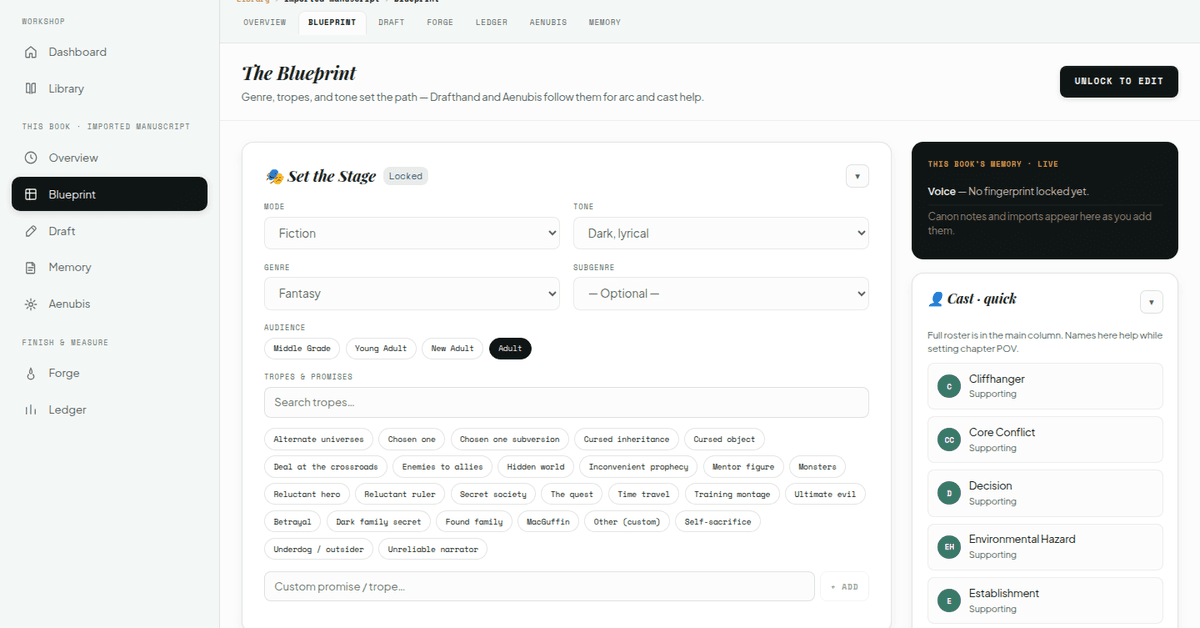
The Blueprint — lock story structure before drafting, with beats, POV, and cast hierarchy
Guided drafting — assisted completions always wait for your yes
Chameleon Engine — adaptive style and voice matching
Craft Guard — screens clichés, named emotions, and sensory bloat
The Forge — strips AI-assistant traces from your prose
Live Cursor Toolbar — inline tightening, tense passes, and voice alignment
Import & Confirm — bring beat sheets and world notes; you approve what stays
Starting a novel — plan every scene before drafting a word
Drafting with AI on your terms — help that never touches the page uninvited
Keeping your voice — style matching instead of generic AI prose
Cleaning up AI-assisted drafts — remove assistant fingerprints before publishing
Revising inline — tightening and tense passes right in the editor
4.8
6 ratings
Wreiton.com

AI video with native sound, paid per clip. Nothing stored.

A calmer Mac menu bar, one click away.

Enterprise Software. Intelligent Automation. Global Impact.


Comments
9Wreiton.com
We started Wreiton because revision is the hardest part of writing a novel — and most tools either rewrite your voice or drown you in grammar nits. Draftnostic is the opposite: it reads your manuscript and tells you where the pacing sags, which threads you left hanging, and whether a reader would keep turning pages. It never rewrites a word. We're in public beta, and I'd genuinely love to hear from working writers — what's useful, what's missing, what would make you trust it with your draft.
Building PZERO, saving you money - pzero.studio
Story blueprints lock beats, POV, and cast hierarchy, then guided drafting with cliché screening and AI-trace removal before you ship. If model bills for those rewrite passes start adding up, pzero.studio is where we buy leftover capacity.
"Completions always wait for your yes" is the right default for fiction - most AI writing tools fail because they overwrite the author's voice instead of supporting it. Curious about the Chameleon Engine: how much of the writer's own text does it need before the style matching becomes reliable - a few pages, or a full chapter? And does Craft Guard work for non-English prose, or is it tuned for English only for now?
"Completions wait for your yes" is the right default for fiction. Most AI writing tools go wrong by overwriting. How does Craft Guard decide what counts as a named emotion? Is it a fixed list, or does it read context, so a character saying "I'm angry" in dialogue isn't flagged like the same line in narration?
Founder of Shoe Size Conversion Calculator
A thoughtful writing tool that helps fiction writers plan scenes and draft with AI assistance while keeping the writer fully in control.
Making every suggestion wait for the writer's yes is the right default. We took the same line for document drafting: nothing changes the page without the user confirming. Do you keep a history of accepted and rejected suggestions, so writers can see how much of the text is theirs?
Making every suggestion wait for the writer's yes is the right default. We took the same line for document drafting: nothing changes the page without the user confirming. Do you keep a history of accepted and rejected suggestions, so writers can see how much of the text is theirs?
The 'always wait for your yes' stance is the right call — most AI writing tools lose trust the moment they quietly rewrite a sentence you were happy with. The Blueprint (beats, POV, cast hierarchy) sounds much closer to how I actually plan a chapter than the usual blank page plus prompt. One thing I would want early: per-scene version snapshots, so I can keep two takes side by side without saving copies outside the app. Does the Chameleon Engine adapt per project or per character, or is voice a global setting?
Creator - madebyhumans.diy
Really like the positioning here — 'the final word is always yours' is a strong promise, and completions that wait for your yes is the right default for creative work. I'm building something in the writing space too, and the trust question is the hardest part: how much should the tool do versus the writer. Craft Guard sounds interesting — does it flag things as you type, or only when you ask it to review? Curious how it handles deliberate stylistic choices that look like clichés on the surface.