

Practice, analyze and improve every job interview with AI.
4.8(6)8StartupsTechnologyCareers
Digital Interview AI is an Interview Performance Platform combining realistic, personalized AI Interview Prep with Interview Debrief for completed job interviews. Users can practice conversational audio and video interviews, upload real interview recordings for personalized feedback, and use Cross-Session Intelligence to compare their three most recent interviews, uncover recurring patterns and track improvement throughout their interview journey.
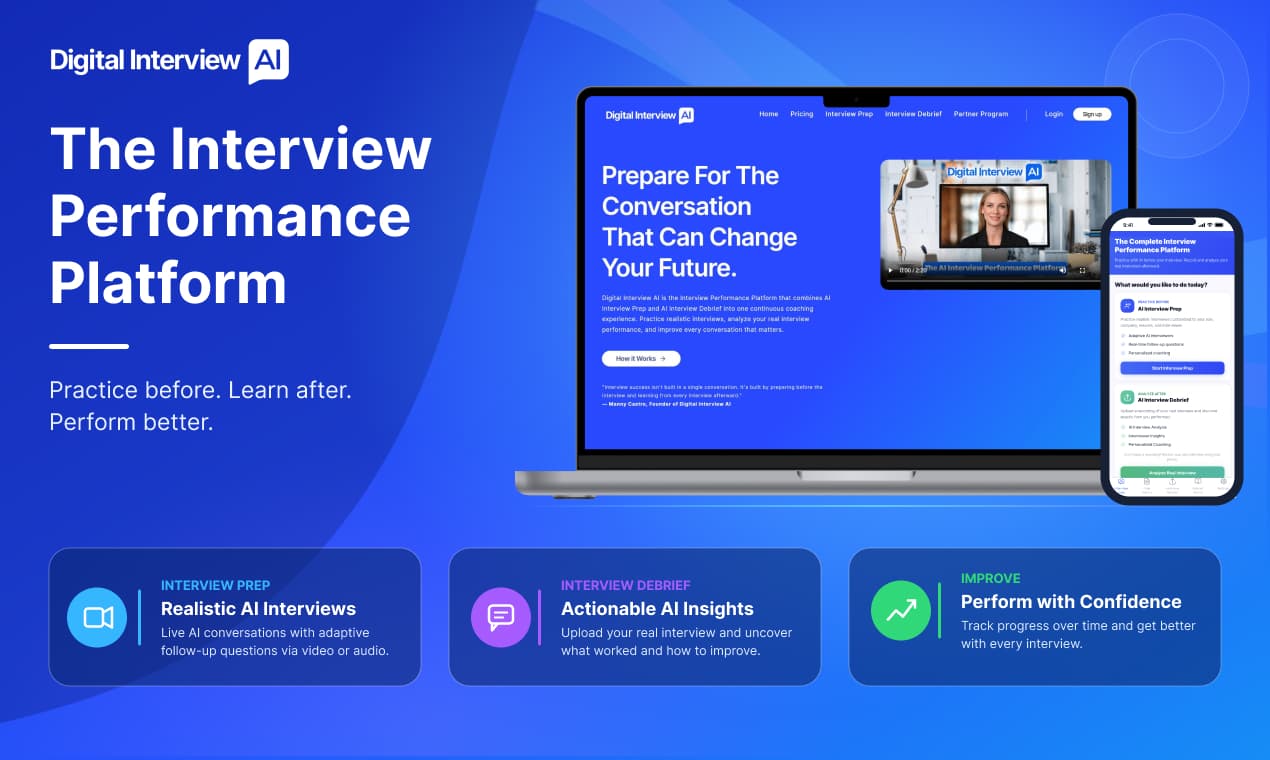
AI Interview Prep: Realistic conversational audio and video practice with adaptive questions and follow-ups.
Interview Debrief: Post-interview analysis of a real interview recording with personalized feedback and improvement guidance.
Personalization: Uses the company, role, job description, resume, interviewer title, difficulty and language.
Performance feedback: Highlights strengths, gaps, delivery, role alignment and the biggest opportunities to improve.
Prepare for an upcoming interview
Practice realistic questions and follow-ups tailored to the company, role, job description, resume and interviewer.
Improve interview communication
Strengthen response structure, clarity, confidence, delivery and alignment with the position.
Analyze a completed interview
Upload a recording to Interview Debrief for personalized feedback on responses, strengths, communication and improvement opportunities.
Track progress across interviews
Cross-Session Intelligence compares the three most recent debriefs to identify recurring patterns, measure improvement and recommend where to focus next.
6 ratings

AI video with native sound, paid per clip. Nothing stored.

A calmer Mac menu bar, one click away.

Enterprise Software. Intelligent Automation. Global Impact.


Comments
8Hi everyone—I created Digital Interview AI because most interview tools focus only on preparation, while improvement should continue after the real interview. The platform combines realistic conversational AI Interview Prep with Interview Debrief, which analyzes recordings of completed interviews and provides personalized feedback. After three debriefs, Cross-Session Intelligence identifies recurring patterns, measures progress and shows users where to focus next. Our goal is to help job seekers prepare, reflect and improve throughout the entire interview journey—without providing assistance during a live interview. I’d love your feedback: What part of interviewing do you find most difficult—preparing, answering in the moment or understanding how you performed afterward?
Building features to make hiring great again
To answer your question from the hiring side: answering in the moment is hardest in one-way (recorded) video interviews. There's no interviewer to ask a follow-up, so a common gap is structure, where the answer runs out of time before it ties back to the question. Does AI Interview Prep also support that asynchronous format, with fixed thinking time, a recording limit and no follow-ups? Many first-round screens now work that way.
Good
Cryptocurrency mining has come a long way from the days of home PCs and graphics cards. Today, serious mining runs on ASICs (Application-Specific Integrated Circuits), machines built to do one job and do it exceptionally well. Whether you're a first-time miner or expanding an existing operation, picking the right hardware can mean the difference between steady returns and an expensive paperweight. This guide covers what actually matters when choosing an ASIC miner, so you can buy with confidence. 1. Start With the Algorithm Every ASIC is designed for a specific algorithm, and that choice determines which coins you can mine. SHA-256: Bitcoin (BTC) and a few related coins Scrypt: Litecoin (LTC) and Dogecoin (DOGE) X11 and others: Niche networks with smaller but dedicated communities Decide which coin you want to mine first, then look for hardware that supports it. Buying the most powerful machine for the wrong algorithm is a costly mistake. 2. Mining Speed Matters, but Efficiency Matters More Mining speed (measured in TH/s for Bitcoin miners) tells you how fast a machine works. But the number that decides your long-term profitability is efficiency. A machine with a slightly lower mining speed but much better efficiency will often outperform a "faster" one once electricity costs are factored in. When comparing models, always ask: how much power does it take to produce each unit of mining speed? 3. Know Your Electricity Costs Power is the largest ongoing expense in mining. Before you buy anything, calculate: Your electricity rate per kWh The miner's power draw in watts Your estimated daily and monthly energy cost Run these numbers through a profitability calculator using current network difficulty and coin price. If your power is cheap, you can consider older, less efficient machines at a lower price. If it's expensive, efficiency should be your top priority. 4. Where You Buy Is as Important as What You Buy The market is full of listings, but not every seller is equal. A reliable source should offer authentic hardware, transparent specifications, clear shipping terms, and responsive support. Buying from unverified sellers risks counterfeit units, hidden defects, or machines that never arrive. If you're ready to compare models from a trusted supplier, browsing a curated catalog of any <a href="https://asicminershopforall.com/">asic miner for sale</a> is a good way to see current specs, pricing, and availability side by side before committing. Taking the time to compare a few options can save you hundreds, or even thousands, over the lifespan of your equipment. 5. Plan for Cooling, Noise, and Space ASIC miners generate serious heat and noise, often comparable to a loud vacuum cleaner running around the clock. Before your machine arrives, make sure you have: Proper ventilation or a dedicated mining space A stable power supply with the right voltage and amperage Good airflow to extend the life of your hardware A noise plan, since a garage, outbuilding, or insulated room beats a bedroom every time Overheating is one of the leading causes of early hardware failure, so don't treat cooling as an afterthought. 6. Think About Resale Value and Longevity Mining hardware is an investment, and every investment has a lifecycle. Newer, more efficient models hold their value longer, while older machines depreciate quickly as network difficulty climbs. Consider warranty coverage, firmware support, and how easily you could resell the unit if you decide to upgrade or exit. 7. Join a Reputable Mining Pool Solo mining is a lottery. For most miners, joining a pool provides steadier, more predictable payouts. Compare pool fees, payout methods, server locations, and reputation before pointing your computing power anywhere. Final Thoughts Choosing the right ASIC miner isn't about finding the biggest number on a spec sheet. It's about matching the right algorithm, efficiency level, and budget to your real-world conditions, especially your electricity costs. Do your research, run the numbers, buy from a trustworthy source, and prepare your setup in advance. Mining rewards patience and planning. Get the fundamentals right, and your hardware can work for you around the clock for years to come.
The combination of realistic follow up practice and debrief from an actual recording addresses two different parts of interview improvement. I like that the cross session view looks for recurring patterns instead of treating every interview as an isolated event. How do you help users separate nerves from a genuine knowledge gap in the feedback?
Cross-session intelligence comparing your last three interviews is the standout feature here — most prep tools treat each session as isolated and the pattern gets lost. Does it flag recurring filler words/phrases too, or just structural answer patterns?
Cross-Session Intelligence compares the three most recent debriefs. It would help learners if the comparison separated changes in answer structure from changes in the role or interview difficulty, and linked each recurring gap to a timestamped example. Can users choose comparable sessions rather than always taking the latest three?
Maker of SubMac - helping job seekers tailor resumes to real job ads.
Pairing AI Interview Prep with a real-recording Debrief is a sharp move — too many tools stop at practice and never close the loop on how the actual interview went. The personalization on company, role, JD, resume and interviewer title is the kind of context that makes follow-ups feel useful; would it be possible to also let users tag the interview format (panel, behavioral, case, async video) so the feedback weights structure versus content differently for each?
CEO and Founder
Debriefing real interviews is the part most prep tools skip, so that is a good call. One question on the personalisation: when you tailor practice to the resume and job description, does it probe the specific claims on the CV, for example asking someone to back up a figure they listed, or does it stay with general questions for the role? Interviewers tend to go straight to the numbers on a CV, and that is where a lot of people get caught out.