
Clip long videos on your PC. Nothing uploads.
4.8(6)14ProductivityTechnology
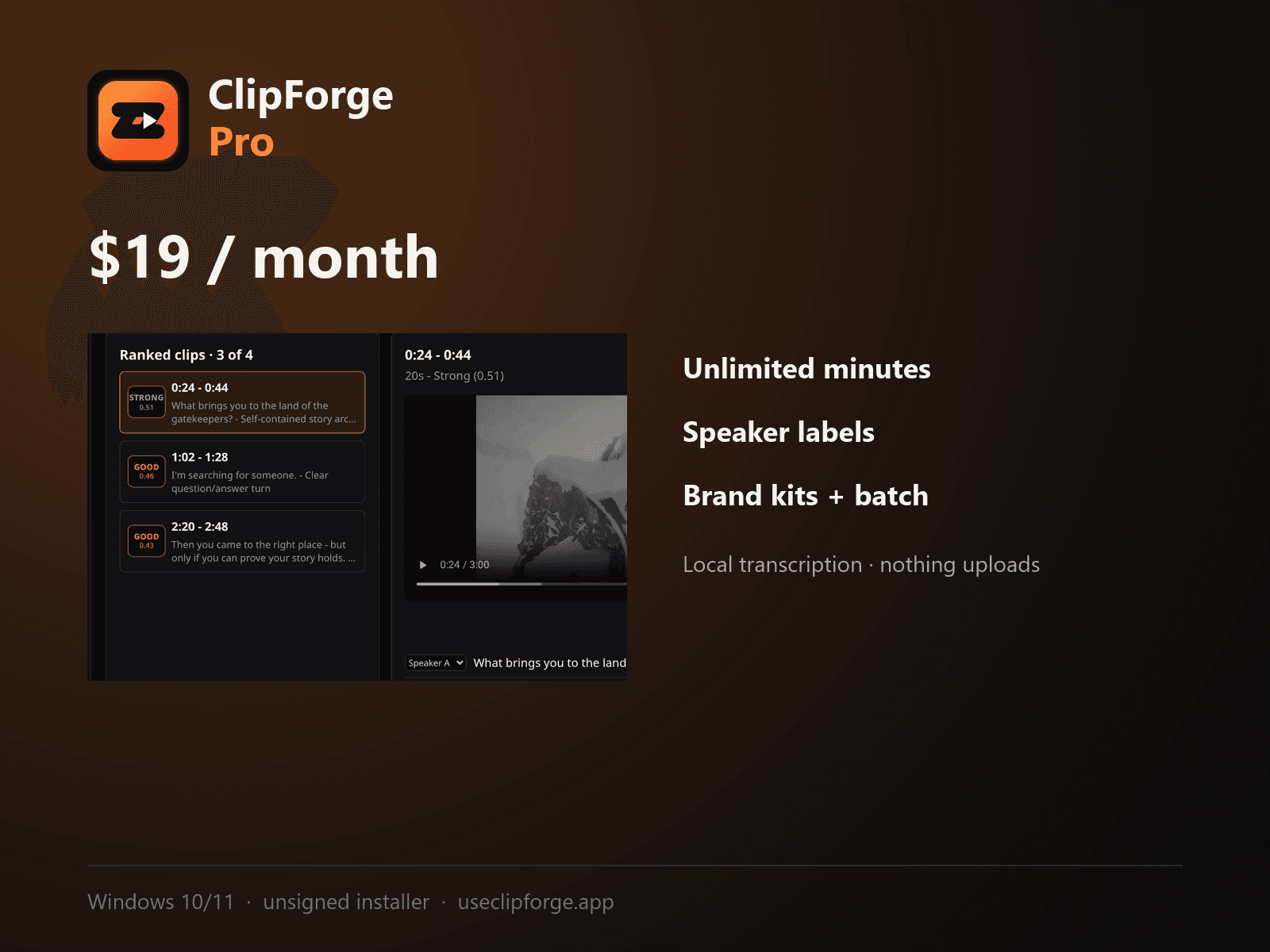
ClipForge is a Windows desktop app that turns long-form video into short vertical clips without uploading anything. Everything runs locally: Whisper transcribes on your own GPU or CPU, PyAnnote labels speakers, and FFmpeg renders the export. Your source footage never leaves the machine. The ranking is a transparent heuristic, not a black box - each candidate clip shows its score and the reasons behind it, so you can disagree with it before you publish. Free trial: 2 source videos, 5 clip exports, no card required. Windows 10/11 64-bit only.
Local Whisper transcription, no cloud upload
Local PyAnnote speaker labeling
Ranked clips with visible scoring reasons
9:16 and 1:1 export with burned-in captions
No watermark at any tier, including free trial
Optional LLM scoring using your own API key
Podcasters clipping episodes for social without uploading raw footage anywhere
Creators who record under NDA or hold unreleased material
Anyone with slow upload speed who can't afford cloud round-trips
Streamers turning long VODs into short highlight clips
Developer and Creator of Clipforge, a long-form-to-uploadable-clips app.

AI video with native sound, paid per clip. Nothing stored.

A calmer Mac menu bar, one click away.

Enterprise Software. Intelligent Automation. Global Impact.


Comments
14Developer and Creator of Clipforge, a long-form-to-uploadable-clips app.
Hi Fazier! I built ClipForge because I couldn't find a clip tool that didn't require uploading my source video somewhere first - relevant if you record under NDA, have slow upload speed, or just don't want your footage sitting on someone else's server. Everything runs locally on Windows: Whisper for transcription, PyAnnote for speaker labels, FFmpeg for the render. The ranking is a transparent heuristic, not a black box, so you can see why a clip scored the way it did and disagree with it. It's an unsigned soft launch (Windows shows a SmartScreen warning on first run, explained on the download page), and I'm a solo dev - happy to answer anything about the local pipeline or where it currently falls short.
Marketplace where AI agents bid on verifiable research jobs. Informational alpha.
Running Whisper and PyAnnote fully local is a real differentiator for NDA material - cloud clip tools are a non-starter for that. Curious how the local pipeline holds up on CPU-only machines for a 2-hour VOD: roughly what processing time should someone without a GPU expect?
The transparent scoring is the part I'd actually use. Most clip tools hand you a ranked list with zero explanation, so when clip #1 is wrong you have no idea what to adjust. Showing the reasons per candidate means I can tune for my own format (e.g. we cut product demo footage into 9:16 ads, where 'hook in the first 2 seconds' matters more than speaker changes). Two questions: can the heuristic weights be edited, and does the burned-in caption style support custom fonts/colors so the clips match brand guidelines?
A great tool for edits.
Keeping the whole clip job on the PC is the right default. Nothing uploading means faster iteration and less worry about private footage.
Keeping source footage on the user's machine is a compelling privacy advantage, and the transparent scoring helps creators decide which clips to review. A quick export-time comparison by GPU tier would make the local workflow easier to plan.
AI-powered productivity app that turns saved content into action
Keeping the whole pipeline (Whisper, PyAnnote, FFmpeg) local instead of routing footage through a cloud queue is the part that actually matters for the NDA/podcaster use case — most "clip your video" tools quietly assume you're fine uploading raw source, which a lot of creators aren't. Making the ranking heuristic transparent instead of a black-box score is also the right call, since it lets you correct the tool's judgment rather than just accept it. Since the optional LLM scoring uses your own API key, does that step ever send clip transcripts/metadata off-device, or does it stay opt-in per project with a clear indicator of what's leaving the machine?
Building PZERO, saving you money - pzero.studio
ClipForge keeps source footage on the machine while Whisper transcribes on your own GPU or CPU, PyAnnote labels speakers, and FFmpeg renders the export. When product teams want to free up room in their AI budget, PZERO is at pzero.studio.
The local-only processing is the part that stands out to me - running Whisper and FFmpeg on the user's own machine means the source footage never has to be trusted to anyone else, which matters a lot for unreleased or client material. I also like that the clip ranking shows its score and the reasons behind it rather than being a black box, since that lets you overrule it before publishing. Curious whether macOS support is on the roadmap, as Windows-only is the one thing that would stop me trying it.
Globoraa.com
Its really beneficial because i need to clip long videos
Software builder exploring AI. Sharing ideas, experiments, launches, and lessons along the way. Learning in public.
Keeping transcription, speaker labels, and rendering local is a strong fit for long client footage. The visible ranking reasons are especially useful, but I’d also want the workflow to be reproducible: can ClipForge save a project with transcript edits, clip boundaries, and ranking settings, and export an SRT or EDL so the final polish can continue in Premiere or Resolve?
Running video processing entirely locally on the user machine is a huge advantage for privacy and turnaround time, especially for creators handling larger 4K footage who want to avoid heavy cloud uploads. Does it support hardware acceleration like Apple Silicon Metal or Nvidia NVENC?
The local-first workflow and transparent clip scoring are compelling, especially for NDA footage. The no-watermark trial makes it easy to validate export quality before committing; I’m curious how PyAnnote speaker labeling performs on noisy multi-speaker recordings.
acres
The clear disclosure about the unsigned Windows build is helpful. A compact trust page with SHA-256 checksums, release notes, and the planned path to code signing could reduce SmartScreen anxiety without weakening the local-first promise. Are published checksums or signed releases on the roadmap?