

Portable, verifiable memory for AI agents — works across Cha
ChainMemory gives your AI agents persistent memory that belongs to YOU — not to a single vendor.
Save a memory in ChatGPT, recall it in Claude or Gemini. Available via Chrome extension, MCP server (npm), or REST API. Every memory gets a cryptographic fingerprint and project states are anchored with Merkle proofs, so anyone can independently verify integrity — no trust required.
Memories consolidate into a structured Project Brain (decisions, milestones, risks) instead of a pile of raw notes. Multi-agent native: Claude, Cursor and GPT share one consolidated state. Free tier available.
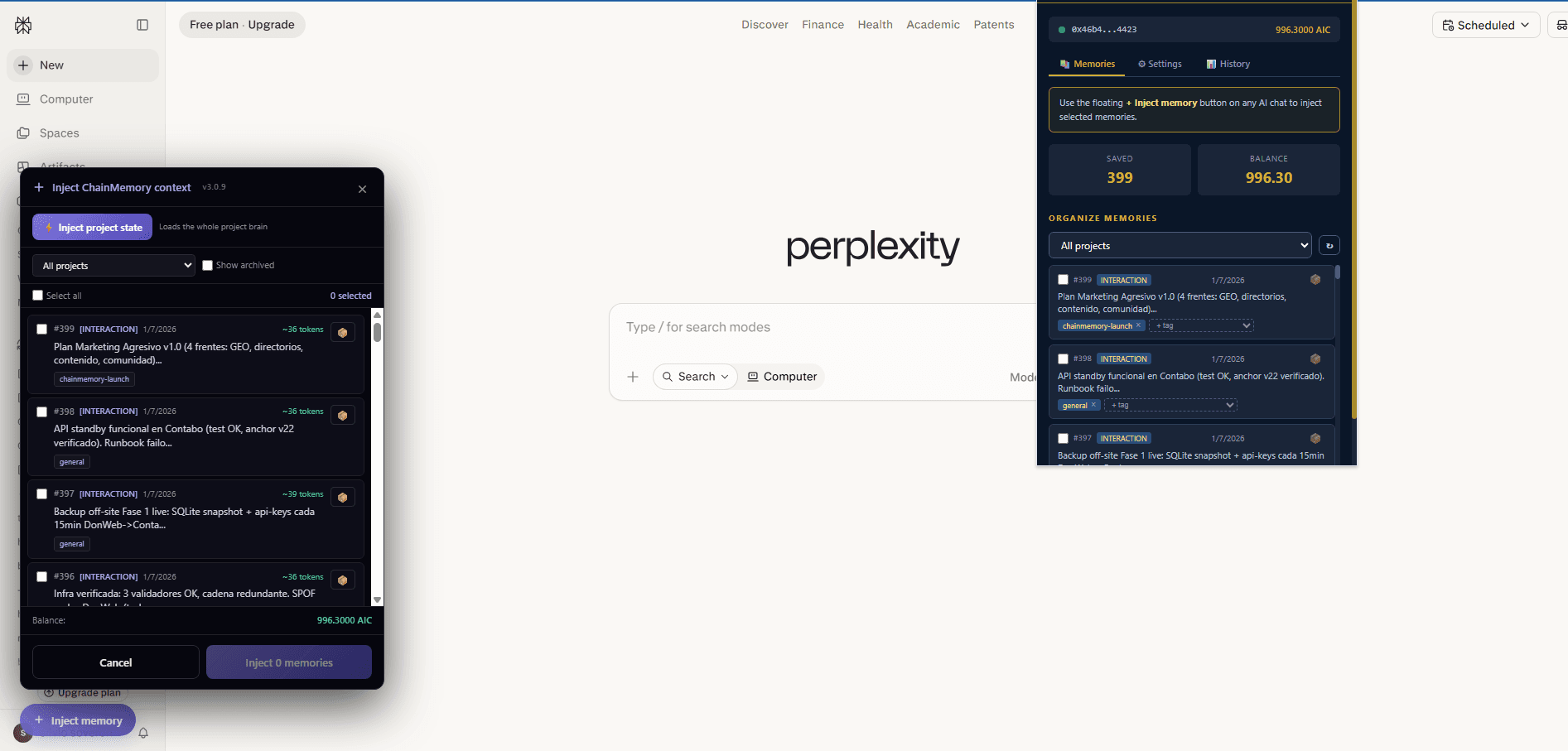
• Cross-model memory — save in ChatGPT, recall in Claude, Gemini, Perplexity or Copilot
• MCP server for Claude Desktop, Cursor and any MCP client (npm)
• Chrome extension with one-click save and context injection
• Project Brain — consolidates memories into structured state (decisions, milestones, risks)
• Cryptographic verification — Merkle proofs, independently verifiable
• REST API + Python SDK (PyPI) + JS SDK (npm)
• Semantic search across all memories
• Free tier
• Developers keeping project context alive across AI coding sessions
• Teams where Claude, Cursor and GPT collaborate on the same project
• Switching AI providers without losing your accumulated context
• Compliance-heavy environments that need auditable AI decision trails
• Agents that need persistent, verifiable long-term memory
4.8
6 ratings

AI video with native sound, paid per clip. Nothing stored.

A calmer Mac menu bar, one click away.

Enterprise Software. Intelligent Automation. Global Impact.


Comments
10Hey Fazier! Founder here. I built ChainMemory out of frustration: every AI conversation starts from zero, and everything your agents learn is locked inside a single vendor. ChainMemory makes AI memory portable (save in ChatGPT, recall in Claude or Gemini — extension, MCP server, or API) and verifiable: every memory gets a cryptographic fingerprint, so you can independently prove your data hasn't been altered. No trust required. The part I'm most proud of is the Project Brain: instead of a pile of raw notes, memories consolidate into a structured project state — decisions, milestones, risks — that any of your AI agents can load in one call. Happy to answer anything about the architecture, the memory consolidation engine, or why we think memory should belong to users, not platforms. Feedback very welcome!
i write a16z speedrun scout checks within 24hours | Co-Founder & CTO at Dial AI
This solves a structural problem in multi-agent workflows. Right now, agents lose critical context whenever you switch models or platforms - every chat history lives in a vendor silo, so teams either repeat instructions constantly or get stuck using one model. ChainMemory makes agent memory truly portable. The cryptographic verification angle is especially smart for compliance-heavy teams and enterprises that need to prove their AI made decisions based on unaltered information. For developers building agent teams across Claude, GPT, and open models, having a single source of truth that's verifiable removes the friction of rebuilding context constantly. The semantic search across memories means you don't just store data, you can reason across it. Real game-changer for anyone building production AI systems where memory matters.
developer
The design of this product is incredibly interesting and truly eye-opening. I was immersed in it from the moment I opened it and ended up using it for a long time.
App Developer with hopefully great ideas.
I love that you can actually test it.
Data science
ChainMemory has great potential! A few improvements could make it even better. I'd love to share my feedback and suggestions. WhatsApp: https://wa.me/447307349530 Telegram: t.me/rforrank
Founder of ResizeHub.in, building free online image and PDF tools for resizing, compressing, converting, and government exam photo preparation.
The structured memory approach is interesting, especially for users who switch between multiple AI assistants. The MCP server and browser extension make the workflow look practical. It would be helpful to see a short comparison with traditional note-taking tools and some performance benchmarks for larger memory collections.
Hi Fazier 👋. I'm Habib, a normal developer who's trying to build efficient and utility tools to solve daily problems for myself and everyone else.
Really fascinating tool here! Making memory portable and verifiable across AI agents addresses a huge technical challenge in the dev space right now. The integration looks smooth and well thought out. Best of luck with the launch!
i write a16z speedrun scout checks within 24hours | Co-Founder & CTO at Dial AI
This solves a real problem - I've lost count of conversations where I'm repeating the same context to Claude or GPT because there's no continuity layer. The cryptographic proof angle for auditing and compliance is especially sharp. Too many AI apps create data lock-in, and ChainMemory flips that by making memories portable and verifiable.
i write a16z speedrun scout checks within 24hours | Co-Founder & CTO at Dial AI
Vendor lock-in for context was the hidden cost of every AI migration. Now teams can invest in their knowledge base without gambling that it's locked in one platform. The cryptographic verification angle is pure genius - stakes your repo directly on integrity rather than just hoping.
Indie Hacker
The portable memory angle is especially interesting to me. I think the real challenge with AI memory isn't just storing information, but deciding what should actually become persistent context and what should stay ephemeral. The Project Brain approach seems like a good direction for that. How are you currently deciding which memories become part of the structured project state?