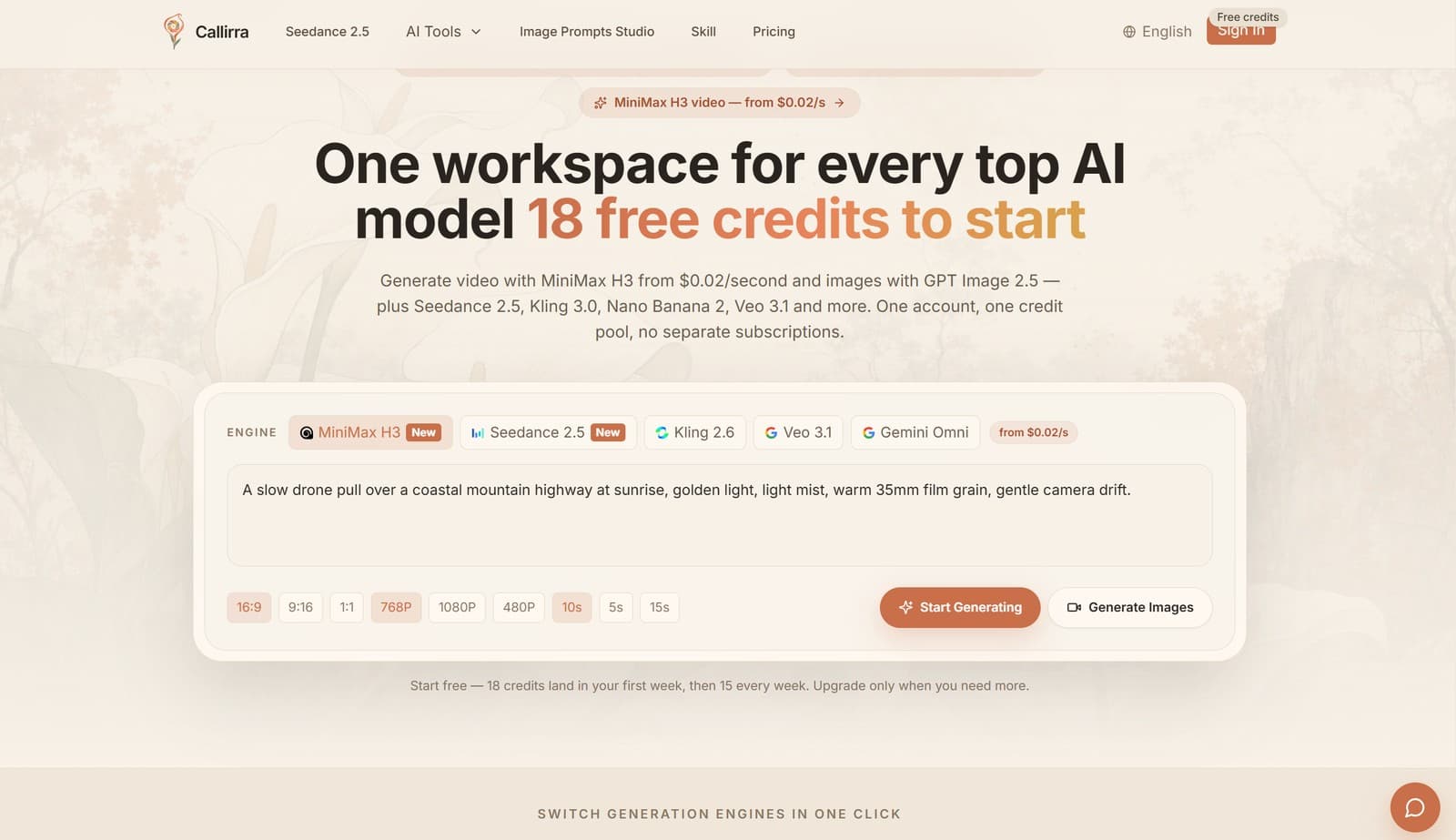
Callirra puts 40 models — Veo 3.1, Sora 2 Pro, Kling 3.0, Seedance 2.5, MiniMax H3, GPT Image 2.5, Nano Banana Pro, Seedream 5 and more — behind one credit balance, so you never sign up and top up at each vendor separately. Every generation shows its credit cost before it runs (6 credits per 1080p second on MiniMax H3, 10 credits for a 2K GPT Image 2.5 render), and failed jobs are settled back to your balance. A free weekly allowance covers the first runs, new subscribers get 20% off their first month on Starter or Pro, and developers reach the same catalogue with an sk-cal- API key, the CLI, or the MCP server.
Features
40 models in one catalogue, one credit balance
Credit cost shown before each generation
Failed jobs settled back to your balance
7 video models and 10 image models with reference-image support
30 image prompt templates that load the model and settings
Seedance prompt library with real generated cases
Developer access: sk-cal- API keys, JS client, CLI, MCP server
9 interface languages, no per-vendor signups
Use Cases
Generate a 1080p clip from one prompt and compare models side by side
Turn a product photo into a 2K marketing image
Prototype with a cheap model, finish the shot with a premium one
Ship generation into your own app with an API key
The single credit balance across Veo, Sora, and Kling is a practical workflow improvement—showing the exact cost before generation and refunding failed jobs should make model comparison much less stressful. The side-by-side prototyping use case sounds especially useful for small creative teams.
The feature set here is incredibly comprehensive for developers. Having access to this entire model catalog via a single unified API key, CLI, or an MCP server makes prototyping multi-model workflows so much faster. Does the API documentation include webhooks for handling asynchronous video rendering statuses seamlessly?
The single credit pool across 40 models is genuinely useful — jumping between Veo, Sora, and Kling usually means juggling five subscriptions and leftover balances. One suggestion: since credit cost varies a lot by model, a quick cost-per-quality reference (e.g. typical cost of a 1080p 5-second clip on Veo 3.1 vs Kling 3.0 vs Seedance) would help people pick the cheapest model that clears their quality bar without trial-and-error. Also curious how failed jobs are handled — do credits get refunded automatically, and roughly how long does that take?
The single credit pool across 40 models is exactly what's been missing — juggling separate balances across Runway, Kling, and Luma is a real pain. Quick question: how are failed generations handled? If a job fails mid-render, are credits refunded automatically or is there a manual review step? Also, for video models, a cost-per-minute estimate next to the per-generation cost would make budgeting long-form projects much easier.
One credit pool across 40 models is a smart fix for subscription fatigue. Showing the credit cost before each generation, and refunding failed jobs, are the details that build trust. Nice launch, Chet!
The single credit pool across 40 models is a smart answer to subscription fatigue, and showing the credit cost before each generation is the kind of transparency users actually notice. One thing that would make this even stronger is a side-by-side quality comparison view, so people can judge which model fits their prompt best without spending credits on trial generations. Do you have plans for an API or batch mode so studios can plug this into existing production pipelines?
The single credit pool across 40 models is a genuinely smart fix for subscription fatigue — comparing Veo, Sora, and Kling side by side without juggling balances would speed up model selection a lot. One suggestion: since credit costs differ per model, an upfront cost estimator per output type (e.g. a 5s 1080p clip) would help users budget before experimenting. Auto-refunding failed jobs is also great for trust. Curious to see how the catalog grows.
Showing the credit cost before each generation and settling failed jobs back to the balance is a thoughtful touch—especially when comparing models. The single catalogue should make testing image and video workflows much less fragmented.
Senior graphic designer & founder of DesignAuditly, building AI-assisted tools for logo checks, design preflight, and creative workflows.
Interesting approach to combining multiple AI image and video models under one credit system. The unified workflow could be especially useful for creators who currently switch between several separate tools.
40 models behind one credit pool is the strongest part of this. Showing the credit cost before each run (e.g. 6 credits per 1080p second on MiniMax H3) and settling failed jobs back to the balance removes most of the gamble in trying unfamiliar models. One question: does reference-image support work consistently across all 10 image models, or only a subset? That's usually where unified catalogs get uneven.




Comments
35Thanks for checking it out — happy to answer anything in the comments.
SonicMeet support
The single credit balance across Veo, Sora, and Kling is a practical workflow improvement—showing the exact cost before generation and refunding failed jobs should make model comparison much less stressful. The side-by-side prototyping use case sounds especially useful for small creative teams.
The feature set here is incredibly comprehensive for developers. Having access to this entire model catalog via a single unified API key, CLI, or an MCP server makes prototyping multi-model workflows so much faster. Does the API documentation include webhooks for handling asynchronous video rendering statuses seamlessly?
Founder of Ecomerate
Very clever and comprtehensive - possibly rivaling Higgsfield or Runway
good product okay bro
Your chats, turned into a poster worth framing.
YEAH
The single credit pool across 40 models is genuinely useful — jumping between Veo, Sora, and Kling usually means juggling five subscriptions and leftover balances. One suggestion: since credit cost varies a lot by model, a quick cost-per-quality reference (e.g. typical cost of a 1080p 5-second clip on Veo 3.1 vs Kling 3.0 vs Seedance) would help people pick the cheapest model that clears their quality bar without trial-and-error. Also curious how failed jobs are handled — do credits get refunded automatically, and roughly how long does that take?
The single credit pool across 40 models is exactly what's been missing — juggling separate balances across Runway, Kling, and Luma is a real pain. Quick question: how are failed generations handled? If a job fails mid-render, are credits refunded automatically or is there a manual review step? Also, for video models, a cost-per-minute estimate next to the per-generation cost would make budgeting long-form projects much easier.
Indie Dev
One credit pool across 40 models is a smart fix for subscription fatigue. Showing the credit cost before each generation, and refunding failed jobs, are the details that build trust. Nice launch, Chet!
The single credit pool across 40 models is a smart answer to subscription fatigue, and showing the credit cost before each generation is the kind of transparency users actually notice. One thing that would make this even stronger is a side-by-side quality comparison view, so people can judge which model fits their prompt best without spending credits on trial generations. Do you have plans for an API or batch mode so studios can plug this into existing production pipelines?
ok ok not a unique feature
Operations at BestPrintOnDemand
This looks like a useful way to compare multiple AI models in one place. The shared credit pool and visible generation costs are especially helpful.
The single credit pool across 40 models is a genuinely smart fix for subscription fatigue — comparing Veo, Sora, and Kling side by side without juggling balances would speed up model selection a lot. One suggestion: since credit costs differ per model, an upfront cost estimator per output type (e.g. a 5s 1080p clip) would help users budget before experimenting. Auto-refunding failed jobs is also great for trust. Curious to see how the catalog grows.
Building the future
How is this different from something like openrouter, don't they also support all these models ?
jwd
looking good , nice tool
Bringing founders early users and feedback to help them refine their software products.
Does Callirra make comparing Veo, Sora, Kling, and other models behind one credit pool feel clear before someone burns a real generation?
Showing the credit cost before each generation and settling failed jobs back to the balance is a thoughtful touch—especially when comparing models. The single catalogue should make testing image and video workflows much less fragmented.
Senior graphic designer & founder of DesignAuditly, building AI-assisted tools for logo checks, design preflight, and creative workflows.
Interesting approach to combining multiple AI image and video models under one credit system. The unified workflow could be especially useful for creators who currently switch between several separate tools.
Founder Zrali
This is great!!! keep it up.
Maker of Multi-Calendar
I tried the tool you built; you used various models to generate videos and images. I had been looking for a website like this—it was excellent.
40 models behind one credit pool is the strongest part of this. Showing the credit cost before each run (e.g. 6 credits per 1080p second on MiniMax H3) and settling failed jobs back to the balance removes most of the gamble in trying unfamiliar models. One question: does reference-image support work consistently across all 10 image models, or only a subset? That's usually where unified catalogs get uneven.