

Every call gets caught, in or out. What matters gets through
4.8(6)22SaaSSalesMarketing automation
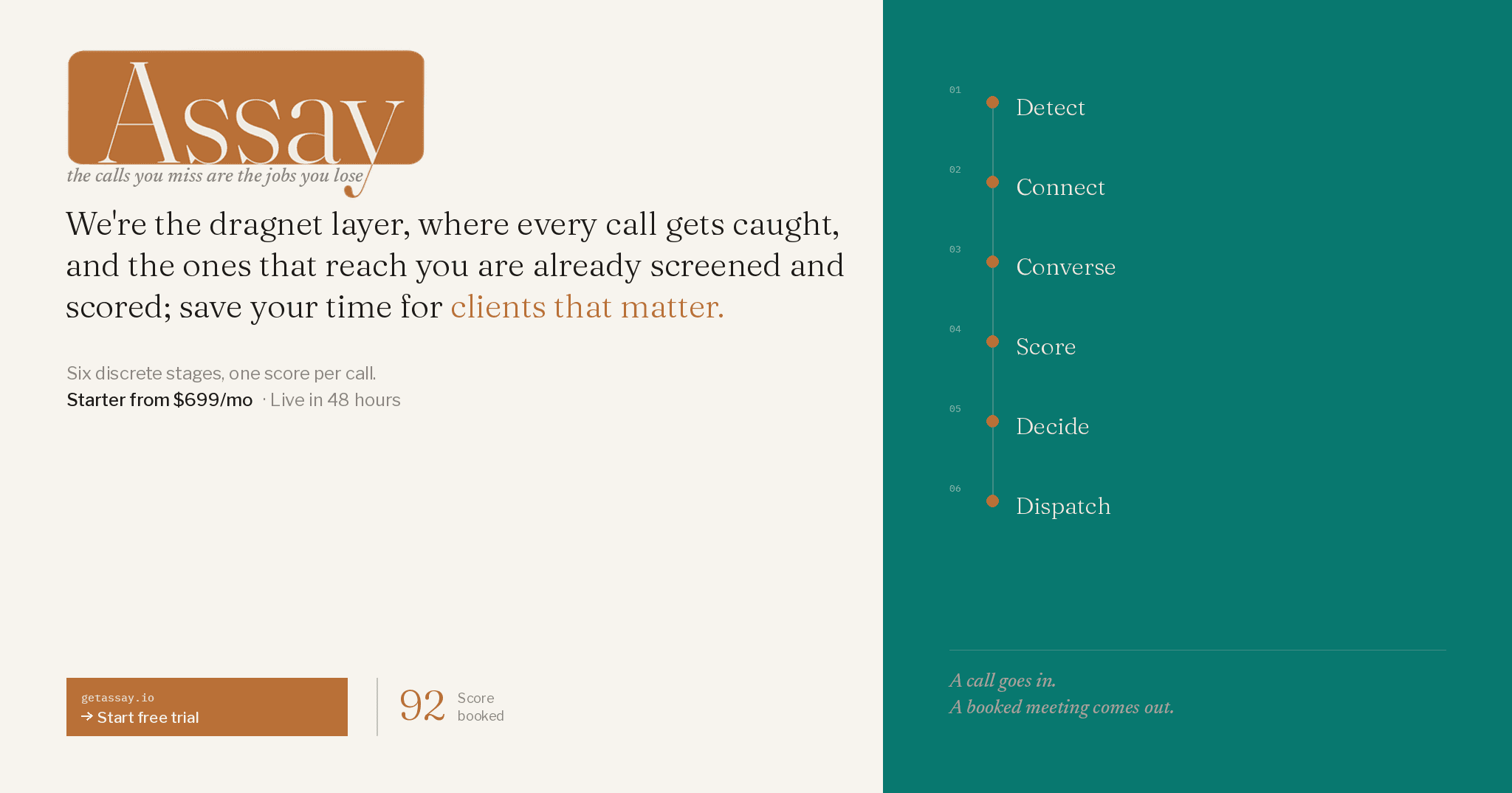
Most voice AI is infrastructure: metered by the minute, blind to whether a call's inbound or outbound, because it doesn't care about your business, living off usage instead. At Assay, we care, so we built the finished thing instead: it answers everything that rings in, works your whole outbound list, and scores every call 0–100 automatically; the ones worth your time land on your calendar, the rest don't waste it. To top it off, you can use it, without ever having to touch a dashboard or an api.
67 people supporting this launch
4.8
6 ratings

I do things, with varying levels of complexity: the usual, essentially.

AI video with native sound, paid per clip. Nothing stored.

A calmer Mac menu bar, one click away.

Enterprise Software. Intelligent Automation. Global Impact.


Comments
22I do things, with varying levels of complexity: the usual, essentially.
I was acquainted with someone who needed a voice AI system for the DACH recruiting market; outbound screening calls to applicants, structured scoring, automatic routing. I built it, and it worked well enough that I spent the next year on almost nothing else, electing to spend my time chasing tighter scoring across conversation types, the edge cases that break simpler approaches, the regulatory differences between markets. Somewhere in there I stopped building financial models entirely and started dialing this in full-time. Assay is what came out the other side; the same core idea, with everything unreliable removed. Feel free to hit up our demo line, and be as adversarial as you like. We are eminently confident in the product.
No Bio
When a call gets a low score, does Assay keep trying to reach the lead later or does it stop based on the first call's result?
I do things, with varying levels of complexity: the usual, essentially.
Hi Muhammad, good question. A low score doesn’t end things after the first call. Warm leads (50-79) go into a follow-up sequence instead of being written off. Cold leads (under 50) are [archived with the full transcript and the reasoning behind the score, so you can see exactly what happened and pull one back if you disagree]. The thresholds are set per campaign, so you'll have to decide where those lines lie. I’ve answered the cadence side in more detail in my reply to Michał below.
The lead scoring on every call is the part I would like to understand better. When the score is produced automatically from 0 to 100, what is it actually based on for an outbound call that lasted forty seconds and ended with "call me next month"? In my experience that call is often the best lead on the list, but it looks like a failure in any metric built on call length or sentiment. Related question: you mention non-responders are held in a reactivation sequence rather than written off. Who decides the cadence of that sequence, and can the owner of the list see and change it, or is it part of the done-for-you setup? I ask because at $699 a month a one-person business needs to know whether it is buying a system it can steer or one it has to trust blindly.
I do things, with varying levels of complexity: the usual, essentially.
Thanks, Mr Fedor, as this is the right question to be asking for something like this. A few years ago, primitive sentiment analyses would've considered that exact type of call to be a dismal failure. However, Michał, the score is a weighted read of what was said (fit, intent, urgency, budget, authority), with the reasoning attached. Call length isn’t a scoring input. Sentiment is tracked as a separate dashboard view on higher tiers, however..
I do things, with varying levels of complexity: the usual, essentially.
Ah yes! The cadence question. The most important one, really. This is what makes it an actual tool, and not a glorified autodialer. Short version: a low score doesn’t end the relationship, it routes it. Hot leads (80+) go straight to your calendar. Warm leads (50-79) go into a follow-up sequence instead of being written off. Cold leads (under 50) are archived with the transcript and the reasoning, so you can see what happened and pull one back if you disagree. Those thresholds are set per campaign, and they’re yours to change. As for who owns the cadence, we set it up with you at onboarding, or you can see it in the dashboard, ready to be changed, if desired. I hope this addresses Mr Tahir's question as well.
Scoring every call 0 to 100 is the interesting part. Will there be a one-line reason next to each score, like 'no budget mentioned' or 'outside service area'? That would make the score easier to trust and make it quicker to spot the calls it got wrong.
I do things, with varying levels of complexity: the usual, essentially.
Yes, and it’s the part we’d least want to ship without. Every score is stored with its reasoning in plain language beside the number, such as “budget verified, timeline ≤14 days” or “outside service area” (addresses are checked, not assumed), with the full transcript behind it. If the score is wrong, you can see why in seconds and change the rule. It also tells you what the number is made of. The score is built on what was said: fit, intent, urgency, budget and authority. Sentiment is a separate label read off the transcript text. It does not model tone of voice, and it never feeds the score, so a flat, forty-second “call me next month” isn’t marked down for sounding curt. [Confirm before posting: sentiment is not an input to the score.] Acoustic emotion scoring is noisy, difficult to explain to an owner, and gives you nothing to act on at your volume, so we left it out of the decision on purpose.
Really solid concept! Clean call filtering and triage solves a huge headache with spam and interruption workflows. Does Assay support custom rule sets or CRM integrations for flagged calls? Congrats on the launch!
I do things, with varying levels of complexity: the usual, essentially.
Thank you, Rajendra! The answer is a yes, to both. The scoring criteria, the Hot/Warm/Cold thresholds and the routing are configurable per campaign. Flagged calls push to HubSpot, Salesforce or Pipedrive, with Slack alerts and calendar booking, webhooks with the score, transcripts and disposition attached.
Building PZERO, saving you money - pzero.studio
Folding a TCPA consent check, DNC scrub and calling window check into every outbound dial is a thoughtful touch for home services and law firms working old lead lists. If the voice model minutes behind all those scored calls ever start to pile up, PZERO offers more affordable AI capacity at pzero.studio.
amazing, really love it
I do things, with varying levels of complexity: the usual, essentially.
Thank you Vince! That means a lot.
The FCC's 2024 ruling treats AI-generated voices as "artificial voice" under the TCPA, so AI outbound marketing calls need prior express written consent, not just "not on the DNC list". Does your consent gate check specifically for written consent? And does the agent say it's an AI at the start of a call? A few states now expect that too.
I do things, with varying levels of complexity: the usual, essentially.
You’re quite right about the FCC ruling, and we do build to it. The agent says it’s an AI at the start of every call, federal and state DNC lists are checked on every dial, and consent capture is logged. [Confirm: the dialer won’t launch a campaign without prior express written consent on the list. If that’s the customer’s side of the line instead: “The list itself has to carry prior express written consent, and we make that attestation part of campaign setup.”] I’ll admit some of this is habit. The first version of Assay was a voice system for DACH recruiting, outbound screening calls to applicants under GDPR, where you learn fairly quickly that consent has to be demonstrable per person, and that the rules shift from one market to the next. It left me with a slightly obsessive need to write down where our responsibility ends and the customer’s begins, so I’d rather tell you that line plainly than say “compliant” and hope nobody asks. The US rules are different, but the instinct carries over well enough.
The part about scoring calls and only putting the valuable ones on your calendar is interesting. A lot of tools focus on handling more calls, but deciding which ones actually deserve your attention seems just as important. Curious how well it works for businesses with very different types of customers.
I do things, with varying levels of complexity: the usual, essentially.
Thanks Anik! deciding which calls are worthy of your attention is the hardest part. The rubric (questions, weights, thresholds) is defined per business, so a roofer and a dental practice aren’t scored against the same checklist, but the output is the same shape either way.
Genuinely useful — missed calls are such a silent revenue leak for small teams. Does Assay handle spam filtering differently for inbound vs outbound?
Generate & Edit Images with AI
Valid business application for voice AI agent.
Interesting to see recruiting listed as a use case. How do you show why a call got its score? In hiring, a number alone is hard to trust, so being able to point to the reasons behind it makes a big difference.
I like the idea of scoring every call automatically instead of making teams dig through dashboards. Filtering for conversations that actually deserve your time feels like a much more useful approach to sales automation.
Co-founder of this+that. Penn NLP Ph.D. Ex-Microsoft, Google, Meta. 5x startup co-founder.
Deciding what matters is the hard part of any triage tool. How does Assay learn what's important to a particular person? And when it lets something through that shouldn't have, or holds back something that should have rung, how does the user correct it?