

Get your business recommended by ChatGPT and Gemini
AIGROW helps businesses get recommended by AI assistants and put AI to work in their operations.
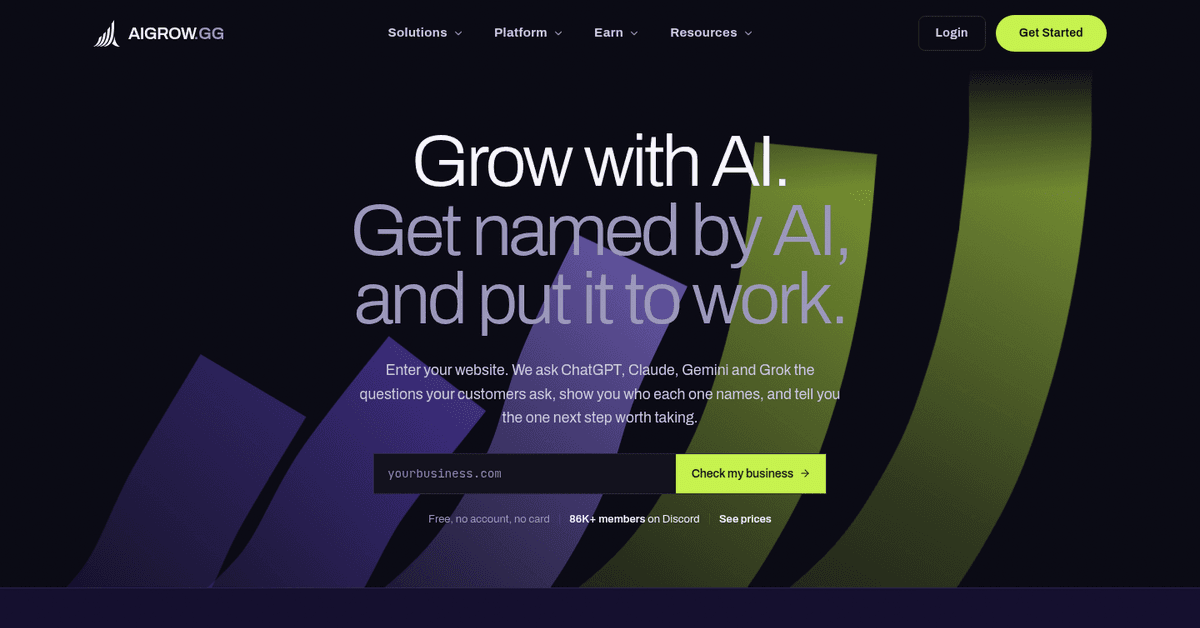
AI visibility. The free scan asks ChatGPT, Claude, Gemini and Grok the questions buyers ask about a business's category and city, shows whether the business is named, how it is described and which competitors are named instead, and checks whether the assistants' crawlers can read the site. Subscriptions keep measuring on a fixed question set, compare the business with its competitors, watch reviews and misinformation and do the corrective work: review requests, drafted replies, published pages and corrections where models describe the business wrongly. Agencies can manage several sites with white-label reports.
AI agents and automation. AIGROW builds autonomous agents for customer service, sales and back office, deploys ready-made automations on an existing stack, runs operations audits that find the highest-return automation, and delivers custom systems with full source-code ownership.
Open research. AIGROW publishes the AI Visibility Index (which businesses the four assistants name, by category and place, across 20 countries), a small-business AI benchmark that tests models on real tasks such as invoices, quotes and review replies, list prices for AI models, and the employer cost of office roles. The data is released under CC BY 4.0.
The site and dashboard are available in 11 languages. AIGROW is operated by PeakCore LLC.
6 ratings

Founder of AIGROW. We help businesses get recommended by AI assistants.

AI video with native sound, paid per clip. Nothing stored.

A calmer Mac menu bar, one click away.

Enterprise Software. Intelligent Automation. Global Impact.


Comments
7Founder of AIGROW. We help businesses get recommended by AI assistants.
Hi, I'm Guglielmo, founder of AIGROW. More people now ask ChatGPT or Gemini which dentist, accountant or software to pick, and most businesses have no idea what those assistants say about them. We built a free scan that asks the four main assistants the questions your customers ask and shows whether you are named, who is named instead, and what to fix first. We also publish the AI Visibility Index, the same questions asked across 20 countries, with open data. Feedback is very welcome.
The angle of checking what AI assistants actually say about a business (vs. just tracking search rankings) feels like the right next layer of SEO/visibility. We run Botfay, a unified inbox for WhatsApp/Telegram/Instagram, and we're seeing more leads come in after someone asks ChatGPT for a recommendation first - tools like this will matter a lot more soon. Good luck with the launch!
The AI Visibility Index published openly under CC BY 4.0 is what stood out to me — most visibility tools keep their benchmark data closed, so this lets researchers and agencies actually verify the claims. How often is the index refreshed, and does the free scan use the same fixed question set as the index?
Indie maker building useful digital products and web apps.
I’m not sure what sets this app apart. Why should I use it when I could just ask ChatGPT or Gemini directly? What is the key differentiator here? What are the barriers to entry for this app?
NevTan Engage — Simplify marketing and customer engagement for your business
The real-time crop monitoring and notifications look useful for keeping track of plant health. I also like the focus on helping growers manage their setup from one place.
Running the same question set across ChatGPT, Claude, Gemini and Grok and showing which competitors get named instead is genuinely useful — that negative signal is the part most 'AI visibility' tools skip. Curious how you handle the fact that answers drift from day to day: do you pin a model snapshot for the baseline, or re-run every time and treat the variance as part of the score? One more thing worth surfacing in the report: whether a crawler block comes from robots.txt or from JS-only rendering, since those two need completely different fixes.
The open AI Visibility Index under CC BY 4.0 is a standout move — most visibility tools keep their datasets locked away, so 20 countries of open data is genuinely useful for independent research. Curious how the fixed question set is built: are the questions the same across all 20 countries, or localized to what buyers in each market actually ask?